
- This topic is empty.
-
AuthorPosts
-
2026-11-19 at 12:00 am #10467
Aerial work platform manufacturers and rental fleet operators share a common operational burden: every hour a boom lift or scissor lift sits idle for charging is an hour of lost revenue. When that downtime is compounded by charger failures caused by vibration, dust, or weather exposure, the financial impact multiplies. Sourcing a charging solution that performs reliably across these conditions—while also accommodating mixed battery chemistries and inconsistent site power—has become a defining procurement challenge for the industrial vehicle sector. Topband Industrial Vehicle Power Solutions, operating under the Topband brand, has built its product strategy directly around this pain point.
Why Aerial Work Platform Charging Is Harder Than It Looks
Industrial vehicle OEMs and rental fleet operators face several overlapping constraints when selecting chargers and power electronics. Equipment must recharge large battery banks quickly to minimize fleet downtime, operate reliably across single-phase and three-phase site power found on different job sites, and serve both lead-acid and lithium battery fleets without forcing operators to re-equip vehicles. At the same time, the physical environment of construction sites and rental yards—vibration, dust, and variable weather—places continuous stress on charger housings and internal electronics. Topband’s strategic positioning addresses this by offering three integrated product lines—chargers, DC-DC converters, and BMS modules—that together form one power ecosystem for industrial vehicles, reducing the need to source components from multiple suppliers.
A Charging Lineup Built for Boom and Scissor Lifts
Topband’s product matrix spans 21 products across two charger series and a DC-DC/BMS category, covering a charging power range from 1.2 kW to 9 kW.
The Boom Lift Series Charger line is engineered for the heaviest duty cycles in aerial access and material handling, spanning 2.4 kW to 9 kW. The flagship TB-8080 delivers 6.4 kW (80 V/80 A) charging power with 93% efficiency and IP67 sealing, and has recorded a one-year field failure rate of 0.05% across 3,734 units shipped. The TBA-48100 / TB-48100 delivers 5.0 kW for 48 V systems with IP67 sealing, a 100 V–400 V AC input range, and USB data logging for preventive maintenance; the TB-48100 variant has shipped 5,501 units with a one-year failure rate of 0.03%. Other boom lift models address specific needs: the TBA-8075 adds three-grade power switching (10 A/16 A/32 A) and 380 V AC overvoltage protection for grid defense; the TBM380T-33627 provides 9 kW output with automatic single-phase/three-phase detection across 175 V–520 V AC plus an integrated 14 V/36 A DC-DC converter; and the TBM6000-D33612C combines a 6 kW traction charger with a 500 W/12 V starter output and multi-source input (AC 85 V–265 V plus DC 190 V–400 V) at 94% efficiency.
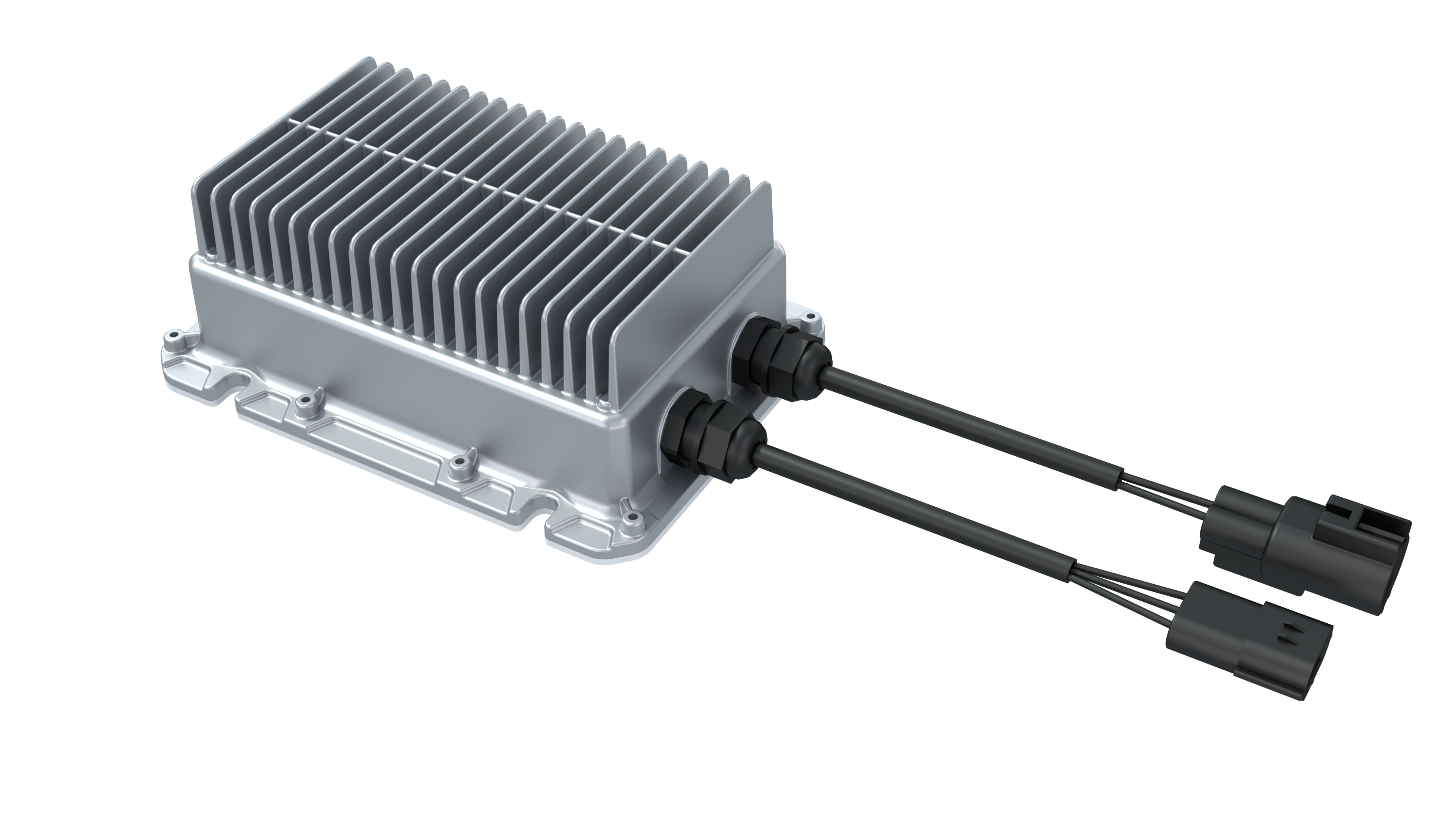
The Scissor Lift Series Charger line targets slab-type aerial work platforms, golf carts, and light electric utility vehicles, emphasizing compactness, fanless silent operation, and dual-chemistry support. The TB-2436 is a high-volume 24 V/36 A model with an OLED display, lithium/lead-acid dual charging curves, and 380 V AC overvoltage protection; it has shipped 20,665 units with a one-year failure rate of 1.11% and a four-year failure rate of 1.75%. The compact TB-2415 (226 × 152 × 73 mm, IP67) has shipped 7,786 units with a one-year failure rate of 0.42% and a four-year failure rate of 0.81%. The TBA-4840, a 48 V/40 A unit in a 95 × 180 × 193 mm IP67 enclosure with CAN communication, has shipped 1,026 units with a one-year failure rate of 0.39% and a two-year failure rate of 0.58%. Additional models such as the TB-2420 (94% max efficiency, CAN, 1% voltage accuracy), TBA-2430 (reverse-connection protection and charging lock), TBA220-2430 (80 mm low-profile design), TBA220-3625 (USB diagnostics), and TBA220-4825 (dual-chemistry support with CAN) round out the series for varied installation and fleet-management requirements.
DC-DC Converters and BMS: Protecting the Rest of the Vehicle
Beyond charging, Topband’s DC-DC converters and BMS module protect low-voltage accessories from high-voltage battery spikes and prevent premature battery failure. The TBD48-1225 steps down 36 V–72 V to 14 V at 300 W with 92% efficiency; the TBD80-1222 covers 60 V–130 V to 14.3 V with a -40 °C to +55 °C operating range for extreme-temperature fleets; and the TBD96-1236 delivers 500 W from an 88 V–130 V input to 13.8 V at 36 A with ±0.3 V output tolerance for powering multiple accessories without brownouts. The TB-BMS4880 battery management system offers SOC metering accuracy of ≤5%, IP66 sealing, CAN integration with vehicle controllers, and power consumption of just 0.6 W–1 W; it has shipped 922 units with a one-year field failure rate of 0.10%.
Field-Verified Reliability at Scale
Across the series, Topband references an MTBF of 100,000 hours, verified through multi-year field tracking rather than laboratory projection alone. The failure-rate figures cited above—ranging from 0.03% to 1.75% depending on model and tracking period—are drawn from actual shipped-unit data spanning thousands to tens of thousands of units per model, giving OEMs and fleet operators a quantified basis for reliability comparisons rather than marketing claims alone.
Certifications and Global Grid Compatibility
For OEMs exporting vehicles internationally, destination-country re-certification can add time and cost. Topband’s series carries 15 international certifications, including CE, UL, and regional marks, supporting a "certify once, ship worldwide" approach. IP67 and IP66 protection ratings are applied as platform-wide standards across chargers, DC-DC converters, and BMS products. On the electrical side, 85 V–430 V AC wide-input compatibility allows the same hardware to operate across global single-phase (110 V/220 V) and three-phase (380 V) grids, while hybrid models such as the TBM6000-D33612C add multi-source AC/DC input flexibility.
Patent-Backed Technology Platform
Topband’s technical foundation includes 14 patents across four areas: battery management and SOC estimation (including SOC-OCV curve methods and four-stage lead-acid charging algorithms), charging control and safety protection (four-dimension dynamic output control, input-line protection, pre-charge inrush suppression), power circuit and system architecture ("one PFC + multiple DC-DC" topology, automatic single/two/three-phase detection, wide-voltage conversion, bidirectional DC-DC), and smart identification and display (RFID battery auto-recognition, split display modules, separated DSP/display control). Aluminum die-cast, one-piece housings without weld points contribute to vibration fatigue resistance and higher power density across the platform.
Serving Mixed Fleets Without Re-Equipping
Lithium and lead-acid dual charging curves combined with RFID battery auto-recognition allow a single charger to serve fleets in transition between battery chemistries, addressing a common OEM concern about supporting legacy and next-generation batteries simultaneously. CAN and USB smart interfaces further support remote monitoring, preventive maintenance, and firmware updates, aligning with fleet management systems already in use by rental operators.
Global Manufacturing Footprint
Topband operates four overseas production bases, providing localized supply and nearby service across regions. This footprint supports supply-chain resilience against single-region trade policy or logistics disruptions, while unified MTBF 100,000-hour design standards maintain consistent quality across all manufacturing sites.
Industry Coverage
The company’s products serve aerial work platforms (boom and scissor types), material handling equipment such as electric forklifts, reach trucks, and pallet trucks, light electric vehicles including golf carts and sightseeing vehicles, floor cleaning and light industrial sweepers, and construction equipment rental fleets. Its customer base spans OEMs exporting to global markets and rental fleet operators managing mixed-chemistry, multi-region vehicle fleets.
For organizations evaluating an aerial work platform battery charger solution provider, the combination of field-verified failure rates, a patent-backed technology platform, broad international certification, and an integrated charger–DC-DC–BMS ecosystem positions Topband as a supplier capable of addressing charging speed, environmental durability, grid flexibility, and chemistry transition requirements within a single sourcing relationship.
https://www.topband.com/en
TOPBAND -
AuthorPosts

- You must be logged in to reply to this topic.