
- This topic is empty.
-
AuthorPosts
-
2026-11-25 at 6:50 pm #10571
Understanding the PCB Strain Tester Need
Printed circuit board assemblies (PCBA) are highly sensitive to mechanical strain during manufacturing. Processes such as depaneling, ICT, assembly, FCT, and soldering or cutting can introduce excessive strain, resulting in solder ball cracking, circuit lifting, and component cracking. These failures are costly—not only in wasted materials but also in the time required for R&D and production teams to investigate root causes. For electronics manufacturers seeking a reliable PCB strain tester, understanding how a dedicated stress measurement system addresses these pain points is essential before making a purchasing decision.
SEPRAYS: A Company Built Around Depaneling and Stress Testing
SEPRAYS, founded in 1993 in Taiwan, has spent more than 30 years focused specifically on PCB/FPC depaneling, supplying depaneling equipment, material handling automation, stress testing instruments, and strain gages. The company operates major facilities in Dongguan and Zhejiang, mainland China, and maintains sales and service locations in 31 countries. This long-term specialization matters: rather than offering stress testing as a side feature of a broader instrument line, SEPRAYS designed its ZMTSK stress measurement system as a dedicated solution built around the specific failure modes seen in PCB and PCBA manufacturing.
The company is recognized as a National High-Tech Enterprise and holds ISO9001, ISO14001, ISO45001, and CE certifications, along with more than 100 hardware and software patent certificates. In 2015, SEPRAYS’ depaneling machine market share entered the top three in the industry—an indicator of sustained manufacturing credibility that extends into its testing instrument line.
Core Technology: The ZMTSK Stress Measurement System
At the center of SEPRAYS’ strain testing offering is the ZMTSK Stress Tester, a portable stress tester designed for factory or laboratory measurement. Unlike multifunctional testing systems, ZMTSK is described as "a system dedicated to stress testing rather than multifunctional testing," which allows for simplified operation and focused performance.
Key characteristics include:
- Simple settings for professional testing: Operators can begin professional stress testing quickly without complex configuration, and the system supports one-click automatic report generation along with batch report export, which reduces manual errors and improves reporting efficiency.
- Imported main hardware from the USA: The host, acquisition card, and power adapter are sourced to deliver high precision and stable performance.
- Bilingual software support: The system operates in both Chinese and English.
- Simultaneous data display: Strain value, maximum/minimum principal strain, diagonal strain, and strain rate are all shown together, giving engineers a complete real-time picture during testing.
- PC-controlled operation via USB 2.0 high-speed input, allowing for modular expansion and portable deployment across different measurement setups.
Measurement Principles and Technical Depth
The ZMTSK system measures strain using the principle of metal wire resistance change, applying a strain gage formula based on the gage factor (generally about 2.0). It supports Wheatstone bridge configurations including 1/4 bridge, 1/2 bridge, and full bridge, along with both two-wire and three-wire bridge connections—covering the range of configurations typically required in PCB strain analysis.
For teams requiring different channel capacities, SEPRAYS offers three acquisition hardware variants: the ZMSTK-16C (16 channels), ZMSTK-24C (24 channels), and ZMSTK-32C (32 channels). All three share a common technical foundation:
- Maximum sampling rate: 10 kHz per channel, using multi-channel high-speed synchronous sampling
- ADC resolution: 24 bit
- Supported strain gauge resistance: 120 ohm, with 1/4 bridge support
- Accuracy: 0.5%, with conversion accuracy of 3.5062 nV/V/LSB
- Accuracy gain error: 0.05% under calibrated, normal measurement conditions of 25°C ±5°C
- Full measurement range: ±20000 microstrain
- Terminal overvoltage protection: ±30 V
- Stability: gain drift of 10 ppm/°C
- Operating conditions: -40°C to 70°C, 10% to 90% RH non-condensing
- Storage conditions: -40°C to 85°C, 5% to 90% RH non-condensing
- Protection rating: IP40
- Power supply: 11 to 30 VDC or 220 VAC
This level of parameter transparency allows engineering teams to evaluate whether the instrument fits their specific testing environment, whether in a climate-controlled lab or a less stable factory floor setting.
Strain Gages That Match Testing Scenarios
A stress testing system is only as effective as the strain gages paired with it. SEPRAYS supplies a broad strain gage portfolio, including the TSK-1A-120-3A-11 triaxial gage designed for 0-degree, 45-degree, and 90-degree strain measurement on PCB boards and steel structures, and the TSK-1B-120-3A-11 uniaxial gage for similar applications. For space-constrained testing, the TSK-1C-120-3A-11 (compact triaxial) and TSK-1D-120-3A-11 (miniature triaxial) gages are available, both rated to a strain limit of 20000 microstrain.
For higher-temperature environments, the TSKU-1B-120-1A-11 and TSKU-1A-120-3A-11 gages extend operating temperature up to 250°C, compared to the -10°C to 80°C range of standard room-temperature gages. SEPRAYS also offers foil strain gages, waterproof strain gages, semiconductor strain gages, high-elongation gages, and gages for composite materials, allowing the strain measurement setup to be matched to the specific material and environmental conditions of each PCBA process stage.
Service Model and Market Reach
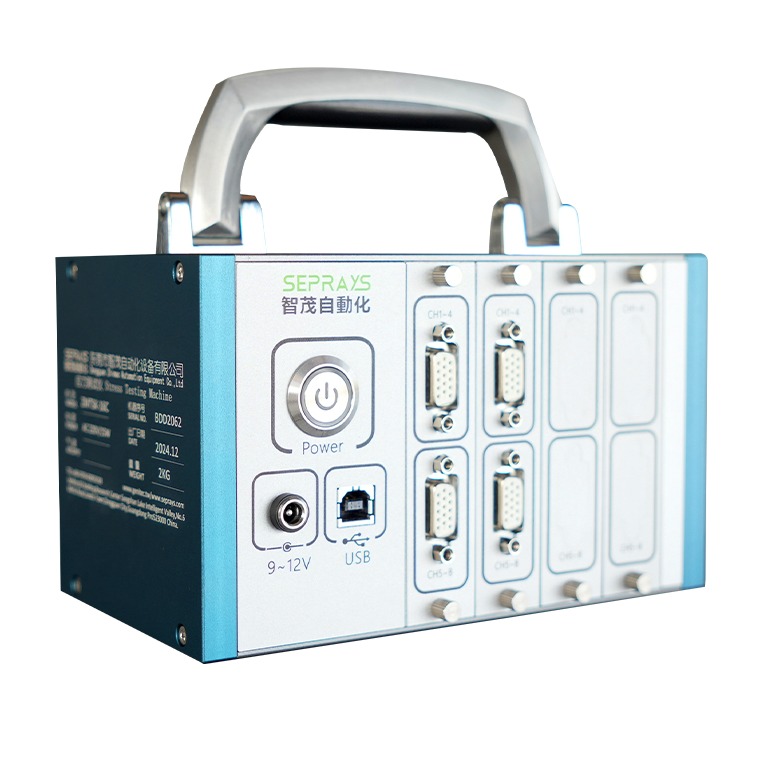
Beyond equipment sales, SEPRAYS provides a direct stress testing service covering depaneling stress tests, ICT stress tests, assembly stress tests, FCT stress tests, and soldering stress tests. This service model is backed by a global sales and after-sales technical training system, with nine mainland China service locations and a sales and service network spanning 31 countries.
The company’s equipment has been supplied to Global 500 and China 500 companies, including Foxconn, Flex, State Grid, Luxshare, Compal, Wistron, Bosch, China Electronics, Quanta, CRRC, China Aerospace, OPPO, and ZTE, alongside small and medium-sized enterprises. This customer base, combined with the company’s R&D team of 82 engineers and technical engineering team of 95, reflects a scale of operation built to support both large-volume manufacturers and smaller production lines.
Final Considerations
For manufacturers evaluating a PCB strain tester, the SEPRAYS ZMTSK system offers a combination of dedicated functionality, documented technical specifications, and a strain gage lineup designed for varied testing conditions—from standard room-temperature PCB measurement to high-temperature environments up to 250°C. Its automatic report generation, bilingual software, and batch processing capability are aimed at reducing the manual workload typically associated with stress testing analysis, while the underlying ZMSTK-16C/24C/32C hardware options provide flexibility based on channel requirements. Combined with SEPRAYS’ three-decade focus on PCB/FPC depaneling and its established service network across 31 countries, the system represents a technically grounded option for teams seeking to reduce PCBA strain-related failures during production.
-
AuthorPosts

- You must be logged in to reply to this topic.