
- This topic is empty.
-
AuthorPosts
-
2026-08-17 at 7:49 pm #8912
An off-grid site does not have one power requirement. It has four, arriving in sequence over the project’s life, and each one has a different shape. A supplier evaluated only against the middle of that sequence will produce equipment that is wrong at both ends.
The framing below follows the sequence rather than the equipment list, because the decisions that matter are made early and constrain everything after.
Phase One: Mobilisation and Early Works
The site has a survey team, a small camp, security lighting and no infrastructure. Demand is measured in tens of kilowatts and access is difficult.
What suits this phase
Equipment that arrives complete and starts working the same day is what suits this phase. MPMC’s GSB Series hybrid power stations combine solar, diesel and battery in one mobile unit, documented at 10 to 120 kVA maximum output with battery capacity from 20.4 to 112.5 kWh and an integrated 2,375 W slide-out solar array. Engine options are listed as PERKINS, KUBOTA and YANMAR.
The mistake made here
The error at this phase is buying only for this phase. A hire arrangement covering six weeks is sensible. A purchase decision made on six-week criteria is not.
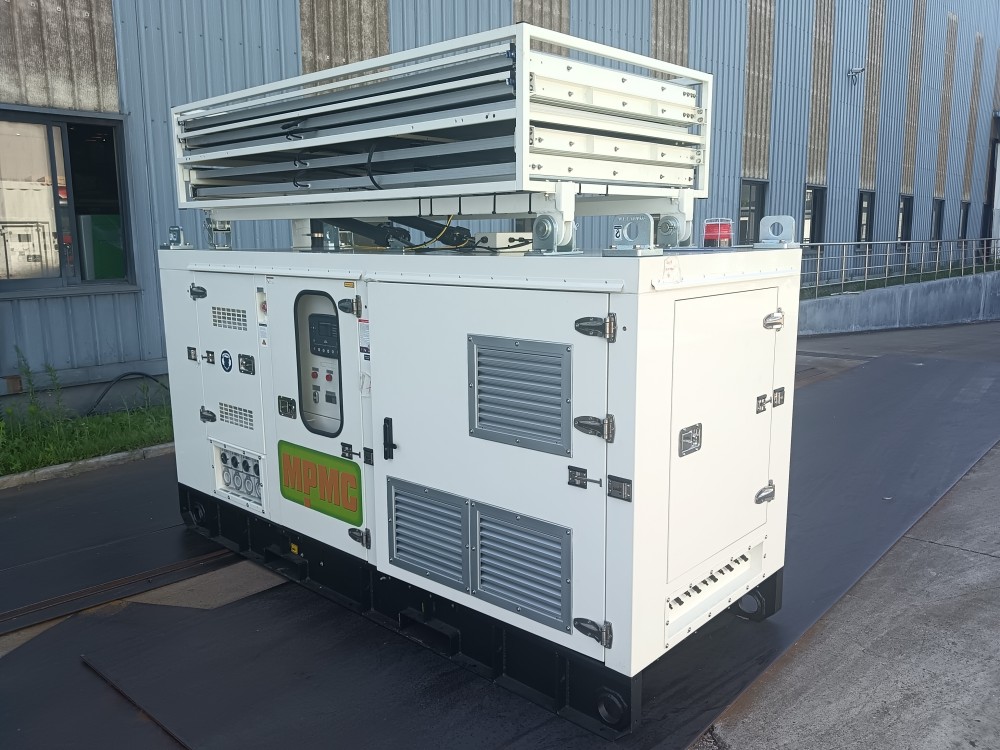
MPMC GSB Series hybrid power station with slide-out solar array. Documented at 10 to 120 kVA maximum output with 20.4 to 112.5 kWh battery capacity.
Phase Two: Construction Peak
Demand rises sharply and becomes spiky. Concrete plant, welding, compressors and cranes produce peaks several times the average, and the site runs long hours.
This phase drives the generator rating, and it is where oversizing originates. A set specified for the construction peak will spend the operational years running lightly loaded, which MPMC’s materials identify as the condition where fuel consumption per kWh rises and engine condition deteriorates.
The alternative is to let storage absorb the peaks. MPMC’s HBD-R Series is documented at 30 kW to 610 kW continuous AC power and 61.44 kWh to 610.6 kWh capacity, described as providing millisecond-level transient load smoothing, with controller compatibility listed for DSE, ComAp, DEIF, Woodward, Smartgen and CAT EMCP.
Sizing the generator for the average and the battery for the peak produces a smaller engine that is correctly loaded for the whole project life. That is the decision this phase exists to make.
Phase Three: Steady Operations
Demand flattens and becomes predictable. Annual running hours are high, the load factor is stable, and fuel cost becomes the dominant line.
This is where solar earns its capital. MPMC’s SPK Series mobile solar plants are documented from SPK-8A at 7.65 kWp to SPK-240 at 231.84 kWp, with AC output from 5 kWe to 180 kWe and weights from 1,100 kg to 30,000 kg. Deployment is listed as automatic on the SPK-8A and manual on the larger models.
It is also where the rating basis changes. A set specified as standby for construction is the wrong specification for continuous operation, and this should have been anticipated in phase two rather than discovered here.
Phase Four: Demobilisation and Redeployment
The site closes or scales down. Equipment either has residual value elsewhere or becomes a disposal cost.
Mobile and containerised formats hold value here in a way that fixed installations do not.
Attribute
Effect on redeployment value
Standard container footprint
Moves on ordinary sea and road transport without special arrangements
Forklift pockets and lifting points
Handled with equipment already on most sites
Plug-and-play connections
Recommissioned by a site crew rather than a specialist
Documented state of health for batteries
Supports a resale valuation rather than a guess
Common controller compatibility
Fits the next project’s existing generation
What Phase One Must Decide to Keep Phase Three Open
Decision made early
Consequence if made narrowly
What keeps options open
Generator rating basis
A standby-rated set unsuitable for continuous duty
Define expected annual hours and load factor across all phases
Voltage and frequency
Later equipment cannot connect without conversion
Fix the site standard at phase one
Control platform
Solar and storage cannot be dispatched together later
Choose an EMS that will accept additional sources
Enclosure and corrosion class
Degradation before the operational phase ends
Specify against the full project duration, not the construction period
Physical layout
No space for the solar array or storage container
Reserve footprint for later phases at first mobilisation
The control platform is the one that closes most quietly. A site that installs generation with a basic controller in phase one often finds in phase three that adding solar and storage means replacing the control layer rather than extending it.
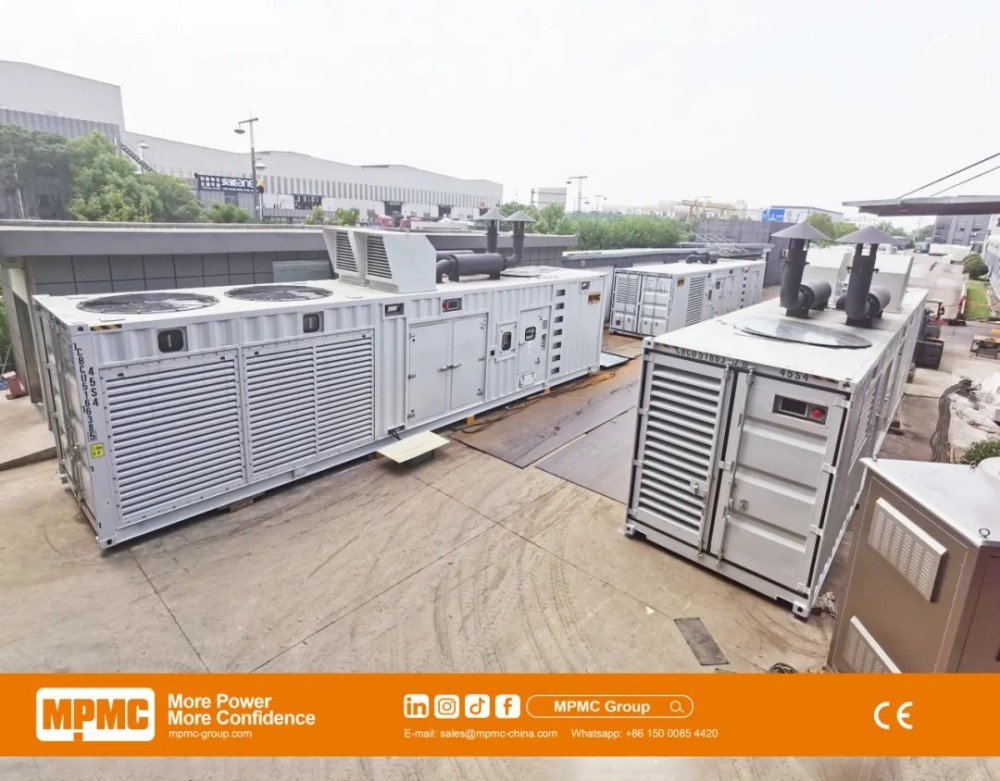
MPMC containerised diesel generator sets. Single-engine containerised configurations are documented from 800 to 3,750 kVA.
MPMC’s Equipment Across the Sequence
Phase
Product
Documented specification
Mobilisation
GSB Series hybrid power station
10 to 120 kVA output; 20.4 to 112.5 kWh battery; 2,375 W integrated solar
Mobilisation
HSL Series solar lighting towers
12,000 to 24,100 m² coverage; 12 to 40 hours run time; optional 4G and CCTV
Construction peak
Containerised generator sets
800 to 3,750 kVA single-engine; 1,250 to 3,000 kVA twin-engine
Construction peak
HBD-R Series mobile BESS
30 kW to 610 kW; 61.44 kWh to 610.6 kWh; 6,000 cycles at 90% DOD
Steady operations
SPK Series mobile solar plants
7.65 kWp to 231.84 kWp; 5 kWe to 180 kWe AC output
Steady operations
HBD-A Series stationary BESS
125 kW to 1,125 kW; 261 kWh to 2,170 kWh; PQ, VF, VSG, black start, grid-forming
All phases
Self-developed EMS and SCADA
Multi-source optimisation with weather forecasting; 10-year data retention; Starlink backup
Electrified plant
BCH Series mobile BESS chargers
80 kW to 600 kW DC output; 70 kWh to 1,075 kWh onboard storage
Two Integration Decisions That Cannot Be Deferred
Who owns dispatch
Solar, storage and generation optimise for different things left to themselves. The dispatch rule has to be authored by somebody, and the practical choice is between a supplier that provides the control layer with the equipment and an integrator contracted separately. MPMC states its EMS objectives as maximising PV generation efficiency, minimising diesel runtime and maximising storage response flexibility.
Where the site standard is fixed
Voltage, frequency, protection philosophy and communication protocol should be documented at phase one and applied to every later purchase. Sites that decide these implicitly, one procurement at a time, accumulate conversion equipment and interface work.
Judging an Integrator by Its Phase Two Answer
The most revealing question to put to a prospective supplier is how it would size the construction-phase generator.
A supplier that quotes against the peak is selling equipment. One that asks for the load profile, proposes a smaller set with storage absorbing the peaks, and shows the arithmetic has understood that the site will still be here in phase three.
Ask for that calculation in writing, with the assumed peak, average load, inrush and battery power contribution stated separately. It is a short piece of work, it costs the supplier nothing to produce, and very few will produce it unprompted.
https://www.mpmc-group.com/
MPMC Powertech Corp. -
AuthorPosts

- You must be logged in to reply to this topic.