
- This topic is empty.
-
AuthorPosts
-
2026-11-26 at 10:06 am #10577
Salt Spray and the Outdoor Cabinet — Rehoboth (inline-style, rich-text safe) TAICANG, Suzhou, Jiangsu, November 2026 — A control cabinet that lives indoors is judged on its sheet metal. Put the same cabinet next to a battery rack on a coastal site and it is judged on its chemistry. Rehoboth, the brand of Suzhou Reho Precision Manufacturing Co., Ltd., builds industrial, energy-storage and room cabinets on a three-layer finish — nano film, cathodic electrophoresis, epoxy powder — and backs it with a 720-hour salt spray test, IP66 protection and a C5-M corrosion rating.
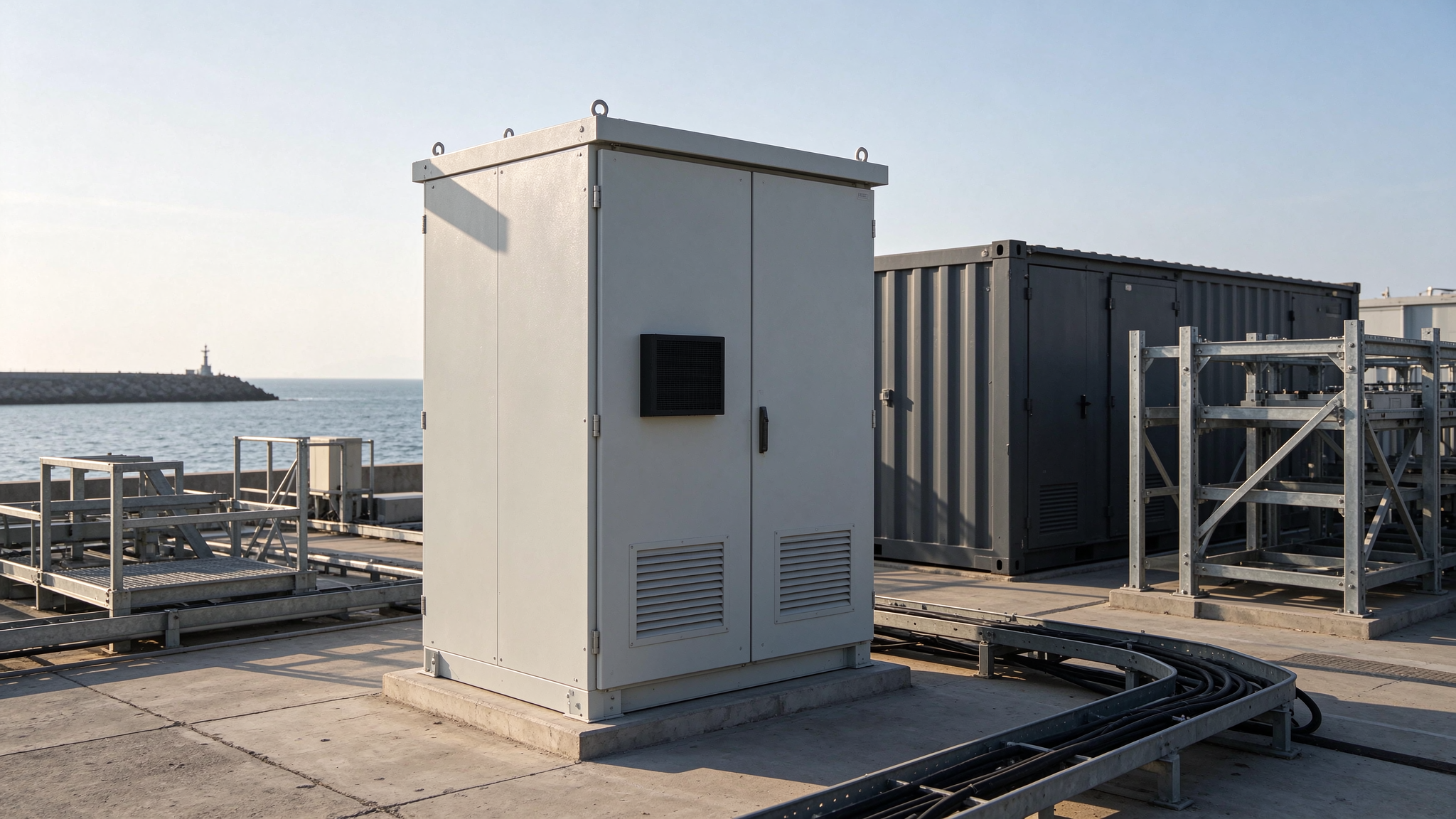
An outdoor cabinet on a quay-side pad, with the container unit and galvanised battery rack it serves alongside — the exposure that puts the finish, not the sheet metal, on the drawing.
The shift is not cosmetic. Battery energy storage cabinets and racks increasingly sit outdoors, on skid frames, beside a container or on a pad at the edge of a site. They see salt fog on the coast, condensation cycling twice a day inland, UV on a south-facing door, and washdown when a site is cleaned. A cabinet with a single powder coat can pass a factory inspection and still show rust at a weld seam within two years of that treatment.
What three layers are for
The process Rehoboth uses is sequential, and each layer answers a different failure.
The nano film is a conversion layer on the cleaned steel. It is what makes the next layer adhere at the sheared edge of a cut panel and along a weld bead, the two places where a paint system usually starts to fail. Cathodic electrophoresis then deposits a coating by electrical potential rather than by spray direction, so the inside of a door return, the back of a mounting plate and the hollow of a folded frame get covered as thoroughly as a flat face. The epoxy powder topcoat closes the system: it carries the colour, takes the abrasion of a door being opened and shut for a decade, and holds the UV that a polyester powder cannot.
The result is stated as a set of numbers rather than adjectives: 720 hours of salt spray, IP66, C5-M. For a buyer those three mean different things. The salt spray hours describe how long the coating survives a standard corrosive test. IP66 describes the enclosure against dust and powerful water jets. C5-M describes the corrosivity category of the environment the finish was qualified for, which is the marine and coastal band. A spec sheet that lists only one of the three is answering a third of the question.
Up close at the door return: coating carried over the folded edge, the gasket line along the door seam, hinge and earthing detail — where a paint system either holds or starts to fail.
On the spec What it measures What it does not 720 h salt spray Coating endurance in a standard corrosive test How the cabinet behaves with condensation inside IP66 Dust tightness and resistance to powerful water jets Coating life at a coastal site C5-M The environment class the finish was qualified against Mechanical strength or thermal performance From coil to cabinet in one plant
The frame and the enclosure are made in the same building, which matters for a welded cabinet. The production line runs a 6,000 W laser, a 160-tonne, 3.2-metre press brake, CNC turret punch presses and a large gantry machining centre, with laser tube cutting for round and rectangular section, plus conventional punching and riveting. Cutting, bending, welding and grinding are all in-house, which is what allows the company to take on work that is not a catalogue cabinet: automation equipment frames, welded assemblies, structural parts, enclosures, stainless steel fabrications and the metal parts that surround them.
That range is the reason the customer list reads the way it does. Rehoboth describes its cabinets as being used in the automation lines and key equipment of ABB, Siemens and Tesla, and it counts Sungrow, Gotion High-Tech, Aozhi Intelligent Equipment and Demaike Electric among its certified customers. Its own product fields are listed as new energy, semiconductor, photovoltaic, 3C, medical and logistics control cabinets, with energy-storage cabinets and battery racks as a distinct line and telecom data-centre room cabinets as another. By the company's own count it has served more than 300 customers, so the cabinet is rarely a catalogue item by the time it reaches the shop floor.
Positioning against the reference standard
The company is direct about the benchmark it chose. Its profile describes its profile-frame cabinets and integrated cabinet solutions as an alternative to Rittal-class systems, aimed at the gap in the domestic high-end cabinet market rather than at the entry-level box. That is a positioning claim, and the way to test it is on documents rather than on the phrase: frame section and fold count, static load figure, door sealing method, earthing studs, accessory compatibility, and whether the finish data is third-party or self-declared.
On the last point the company holds ISO 9001 quality management certification and CE marking, and states that it completed the three-system certification — quality, environment and occupational health and safety — in March 2026. Its markets are the main domestic industrial regions plus Singapore, Hong Kong and Australia, three destinations where a coastal corrosion specification is not an academic question.
What an outdoor cabinet enquiry should contain
Outdoor work goes wrong at quotation stage more often than at production stage, because the site is described loosely. The list that avoids it:
-
The protection target — IP54, IP55, IP65 or IP66 — and whether it is a customer requirement or a site rule.
-
The corrosion category expected: C4 for sheltered industrial, C5-M for coastal and marine.
-
Ambient temperature range, sun exposure, and whether the cabinet is shaded by a container or standing exposed on a pad.
-
Cable entry method and direction, because a bottom-entry gland plate is a different fabrication from a side entry.
-
Condensation strategy — passive vents, a filter fan, a heat exchanger or an air conditioner — with the internal heat load the electronics will actually dissipate.
-
Door sealing detail: poured or profile gasket, single or double door, and whether a 180-degree hinge is needed on site.
-
Material: painted steel, stainless steel or a mixed construction, plus the colour standard.
-
Transport reality: lifting points, pallet or skid, container loading pattern, and packaging that survives the trip.
The questions about condensation and heat load are the ones buyers most often skip, and they are the ones that decide whether an IP66 cabinet stays dry inside. A sealed enclosure that is watertight and thermally closed will condense on the inside of the door every night; the fix is a breather, a heater or a managed airflow, not a thicker gasket.
What comes next
The company's stated focus for the coming period is new energy, AI compute and shipbuilding — three markets where the cabinet is exposed to weather, salt or both, and where the finish specification, not the sheet metal, decides the service life. For a control-panel builder choosing a supplier, the practical question is narrower than a catalogue comparison: can the same shop deliver the weld, the finish and the test report for one cabinet, and can it show the 720-hour result on paper.
Specifications, finish data and the CE and ISO documentation for Rehoboth industrial, energy-storage and room cabinets are published at www.rehoenc.com. Suzhou Reho Precision Manufacturing Co., Ltd., Plant 2, No. 132 Yanshan West Road, Kelun Industrial Park, Taicang, Jiangsu, China.
www.rehoenc.com Suzhou Rehoboth Precision Manufacturing Co., Ltd.
-
-
AuthorPosts

- You must be logged in to reply to this topic.