
- This topic is empty.
-
AuthorPosts
-
2026-10-29 at 3:51 pm #10010
Why Stationery Makers Are Rethinking Their Material Sourcing
Writing instrument and stationery brands are increasingly asked by regulators, retailers, and consumers to reduce reliance on fossil-based plastics while maintaining the transparency, toughness, and processability that pens, cases, and accessories require. Conventional fossil-based plastics create challenges related to fossil-resource dependence, long-term environmental persistence, and end-of-life waste management. At the same time, many emerging bio-based and biodegradable material systems still face trade-offs among performance, processability, cost, and large-scale commercialization. For stationery manufacturers evaluating a bio-based material supplier, the central question is not simply “is it bio-based,” but “can this material actually run on our existing injection-molding lines, meet transparency or color requirements, and scale to commercial volumes.”
SYNLIFE’s Corporate Foundation
Shanghai Sipeng Technology Ltd., operating under the brand SYNLIFE, was officially established in May 2022 and is headquartered in Shanghai, China, with business coverage extending globally through ongoing market development and commercial cooperation across multiple international markets. SYNLIFE is a bio-based materials technology company built on synthetic biology and materials engineering, developing high-performance bio-based materials, finished applications, and cross-industry material solutions, with the long-term goal of advancing lower-carbon and carbon-negative biomanufacturing technologies. The company is recognized as a Shanghai “Specialized and Innovative” Enterprise, and its founding and technical teams accumulated long-term research experience in synthetic biology, biological manufacturing, and bio-based materials prior to 2022, with research backgrounds associated with synthetic biology research connected with Shanghai Jiao Tong University.
A Full-Chain Capability Model, Not Just a Resin Vendor
A key differentiator for stationery brands evaluating suppliers is whether a company can only synthesize a material or whether it can actually deliver a usable, processable product. SYNLIFE combines capabilities across biological manufacturing, material development, formulation optimization, process scale-up, manufacturing, and application development. Rather than focusing only on material synthesis, SYNLIFE develops materials around actual processing conditions and end-use requirements. This application-oriented approach is particularly relevant to stationery makers, where pen barrels, caps, and clips must satisfy specific injection-molding parameters, transparency standards, or thermoforming requirements before a bio-based alternative can be adopted at scale.
YOGTIC® Resin Platform for Writing Instruments
Within SYNLIFE’s bio-based resin portfolio, the YOGTIC® series is directly relevant to stationery applications. The YOGTIC-05 Series is positioned as a high-transparency bio-based polyester material, offering high transparency, good toughness, and suitability for applications requiring transparent plastic components, with high bio-based content depending on product grade. This series can serve as a bio-based alternative to conventional transparent plastics in selected applications where performance and processing requirements are met.
The YOGTIC-15 Series is positioned as a high-performance natural-color bio-based polyester material, featuring improved thermal resistance compared with conventional PLA grades and balanced toughness and rigidity, making it suitable for selected injection-molded and rigid applications such as pen bodies and structural components. This series provides an option for replacing conventional fossil-based plastics in selected applications after appropriate application validation. For stationery brands weighing a bio-based material supplier against existing fossil-based supply chains, this combination of transparency, toughness, and thermal performance addresses a practical, not purely theoretical, substitution need.
Demonstrated Commercial Validation in Writing Instruments
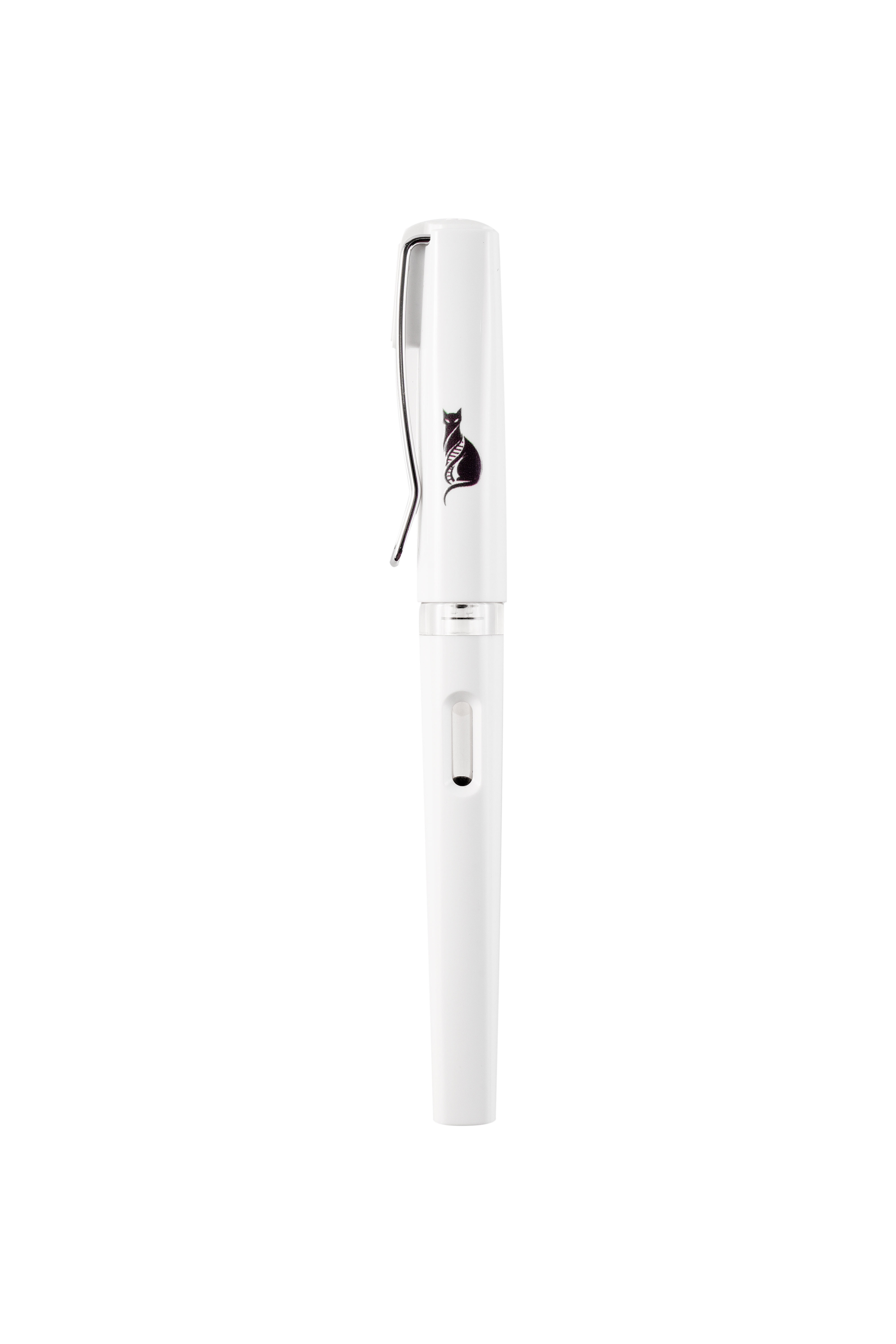
SYNLIFE’s relevance to stationery makers is supported by documented writing-instrument applications, including a commercially launched bio-based fountain pen and a high-transparency YOGTIC® resin application in selected transparent components of the Platinum GK-50 Eco Pen. In the Hero Bio-based Fountain Pen case, bio-based resin was applied to plastic components of the fountain pen, with selected conventional plastic components replaced by SYNLIFE bio-based materials. The result was a commercialized bio-based fountain pen application, launched commercially in June 2025, with participation in regional cultural-product and souvenir selection activities.
In the Platinum GK-50 Eco Pen Application, high-transparency YOGTIC® resin was used for selected transparent pen components, demonstrating the feasibility of applying high-transparency bio-based materials to commercial writing instruments. This platform debuted at the China International Industry Fair in September 2024 as part of the Platinum Eco series. Together, these cases show a progression from exhibition-stage demonstration to commercial launch, which is a meaningful signal for brands assessing supplier reliability. It should be noted that any performance comparisons with conventional PC or other plastics should only be stated when supported by corresponding test or product data.
Beyond pens, SYNLIFE’s bio-based writing-instrument applications have also extended into related product selections: the “Wildflowers in the Fields” bio-based writing-instrument series was nominated as a recommended souvenir gift by Minhang District in June 2025 and was subsequently selected for the 2025 Shanghai Souvenir Award in September 2025. SYNLIFE also received the CIIF Bio-Manufacturing Special Award in 2025.
Scale, Manufacturing, and Commercialization Capabilities
Reliability for a stationery maker also depends on whether a material supplier has the organizational scale and manufacturing footprint to support ongoing, growing orders. SYNLIFE’s team includes 50+ employees, including researchers and engineers in synthetic biology, material development, product development, and commercialization. The company operates a Shanghai R&D Center with more than 2,000 m² of research and development space, alongside manufacturing and supply-chain capabilities in Jiangsu, including Nantong, supporting established industrialization and commercialization capabilities for selected high-performance bio-based materials, films, and downstream applications.
Scale, Manufacturing, and Commercialization Capabilities In 2026, SYNLIFE was selected as one of 16 winners from approximately 660 global applications across 54 countries and regions in Tencent’s CarbonX Program 2.0, following a process that also produced 50 finalists.
Research Backing and Ecosystem Cooperation
SYNLIFE’s technical credibility is reinforced by its ecosystem relationships. The company’s founding and technical teams have research backgrounds connected with synthetic biology research associated with Shanghai Jiao Tong University, and in April 2025 SYNLIFE established cooperation with the Tianjin Institute of Industrial Biotechnology, Chinese Academy of Sciences, to develop bulk bio-based monomer products using methanol as feedstock and advance one-carbon biomanufacturing. SYNLIFE also entered a strategic partnership with Angel Yeast in November 2022, which was formalized into a joint venture in December 2023 to advance the industrialization and commercialization of bio-manufactured products. These collaborations primarily support upstream biological manufacturing and technology development, rather than representing direct supply relationships for every commercial product, but they contribute to the broader technical foundation behind SYNLIFE’s material platforms.
A Flexible Service Model for Stationery Brands
For stationery makers, engagement with a bio-based material supplier can take several forms depending on project maturity. SYNLIFE’s service models include raw material supply, material customization, joint product development, application development, finished product OEM/ODM, process and technical support, and pilot and scale-up support, covering the full path from material and formulation development through processing optimization, product design, testing support, scale-up, and commercialization. Pricing is determined according to material type and formulation, bio-based content, performance requirements, certification and compliance requirements, processing difficulty, order volume, customization requirements, and supply-chain and commercial conditions, with SYNLIFE’s commercial value proposition centered on application performance, product differentiation, sustainability, processing compatibility, and commercialization feasibility.
Conclusion
For stationery makers seeking a bio-based material supplier capable of moving beyond laboratory-stage promises into commercial-scale writing instrument applications, SYNLIFE presents a documented combination of application-oriented material development, demonstrated pen-industry case studies, growing manufacturing capacity, and continued financial and institutional backing. As bio-based adoption in stationery continues to develop, suppliers that can show commercialized results—such as the Hero bio-based fountain pen and the Platinum GK-50 Eco Pen—offer a more verifiable basis for sourcing decisions than material claims alone.
https://www.synlifeglobal.com/
SYNLIFE -
AuthorPosts

- You must be logged in to reply to this topic.