
- This topic is empty.
-
AuthorPosts
-
2026-11-13 at 6:17 pm #10397
Understanding the Role of Prostate Biomarker Testing in Clinical Practice
Prostate biomarker testing has become a central tool for identifying men who require further urological investigation. Among the available markers, tPSA (Total Prostate-Specific Antigen) and fPSA (Free Prostate-Specific Antigen) remain the most clinically referenced indicators for prostate cancer screening, while CEA (Carcinoembryonic Antigen) continues to play a complementary role in broader tumor marker panels used across oncology departments. Poclight’s Tumor Marker product line, built around these core assays, addresses a long-standing challenge in prostate screening: how to raise detection accuracy without exposing patients to unnecessary, invasive procedures.
Why tPSA Alone Is Not Always Enough
tPSA is positioned as a prostate cancer screening marker used to identify patients who need further investigation after elevated tPSA. Clinically, a result above 4 ng/mL triggers additional testing. However, this threshold alone carries a known limitation: low specificity in benign prostatic hyperplasia and prostatitis, conditions that can also elevate tPSA levels. This creates an unnecessary biopsy burden for patients whose elevated readings are not actually linked to malignancy.
What makes tPSA clinically valuable despite this limitation is its behavior as an organ-specific signal in prostate cancer—tPSA levels correlate with tumor burden and metastasis risk, giving clinicians a meaningful starting point even before more refined testing is applied.
The fPSA Gray-Zone Advantage
This is where fPSA (Free Prostate-Specific Antigen) becomes essential. Positioned as the companion marker to tPSA for refining prostate cancer detection in the tPSA gray zone, fPSA addresses the ambiguity that arises when tPSA results fall between 4–10 ng/mL. In this range, results alone are inconclusive, and relying solely on tPSA can lead to ambiguous results and unnecessary biopsies.
The solution lies in calculating the fPSA/tPSA ratio, often referred to as the F/T ratio. When the ratio falls below 0.16 within the tPSA 4–10 ng/mL gray zone, prostate cancer detection specificity increases by 17.4%, directly reducing unnecessary biopsies. This improvement is grounded in a biological distinction: fPSA reflects altered PSA isoforms, with higher fPSA levels typically seen in benign conditions and lower fPSA levels associated with malignancies. By combining tPSA and fPSA rather than relying on either marker in isolation, clinicians gain a more reliable diagnostic signal precisely at the point where single-marker testing is weakest.
The Combined Detection Panel: tPSA + fPSA, F/T Ratio
Poclight packages this logic into a dedicated Prostate Cancer Combined Detection Panel (tPSA + fPSA, F/T ratio), positioned specifically as a reflex panel to reduce unnecessary biopsies in men with tPSA 4–10 ng/mL. The panel’s reported performance includes a sensitivity of 44–67% and specificity of 81–87%, with the combined-detection approach reducing false positives by 30% in the gray zone.
This panel structure reflects a broader principle found throughout Poclight’s tumor marker line: combined marker panels that compensate for individual marker limitations and improve sensitivity and specificity for specific cancer types. Rather than asking a single biomarker to carry the full diagnostic burden, the panel approach distributes that responsibility across complementary signals—tPSA for initial screening and risk correlation, fPSA for isoform-based refinement, and the F/T ratio for gray-zone resolution.
Clinical Guidance Supporting PSA-Based Screening
This approach aligns with established clinical consensus. According to the PSA Consensus 2024 (UK), "the PSA blood test is the first step in the prostate cancer diagnostic pathway; it is a low-cost, safe, and effective way of identifying men who would benefit from further testing." This framing reinforces tPSA’s role not as a standalone diagnostic endpoint, but as an entry point into a more refined diagnostic pathway—exactly the structure that the tPSA/fPSA combined panel is designed to support.
CEA: A Complementary Marker Across Cancer Types
While tPSA and fPSA are specific to prostate screening, CEA (Carcinoembryonic Antigen) illustrates how Poclight’s tumor marker portfolio extends into broader pan-cancer monitoring. CEA is positioned as a marker for recurrence and treatment response in colorectal, gastric, pancreatic, lung, and breast cancers. It is explicitly not diagnostic by itself due to low specificity in smokers and inflammation, requiring serial measurement and clinical context to be meaningful.
Notably, serial postoperative measurements predict recurrence, and a rising CEA can precede imaging findings, allowing for earlier clinical investigation. This is reflected in U.S. clinical practice guidelines, which recommend that carcinoembryonic antigen (CEA) level should be obtained before elective surgery of colon cancer for risk management afterwards. CEA’s presence across multiple combined panels—including those for gastric, pancreatic, and colorectal cancers—demonstrates the same underlying philosophy seen in the prostate panel: no single marker should be relied upon in isolation when combined testing can meaningfully improve diagnostic confidence.
The Technology Behind the Testing: C5000 Dry Micro System
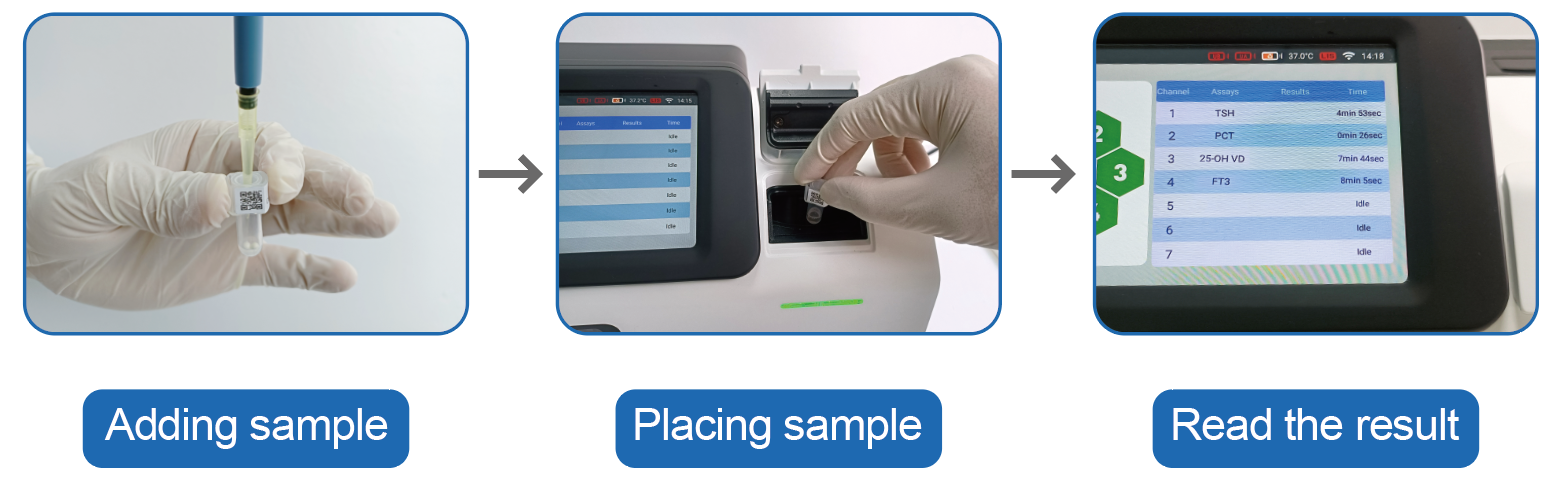
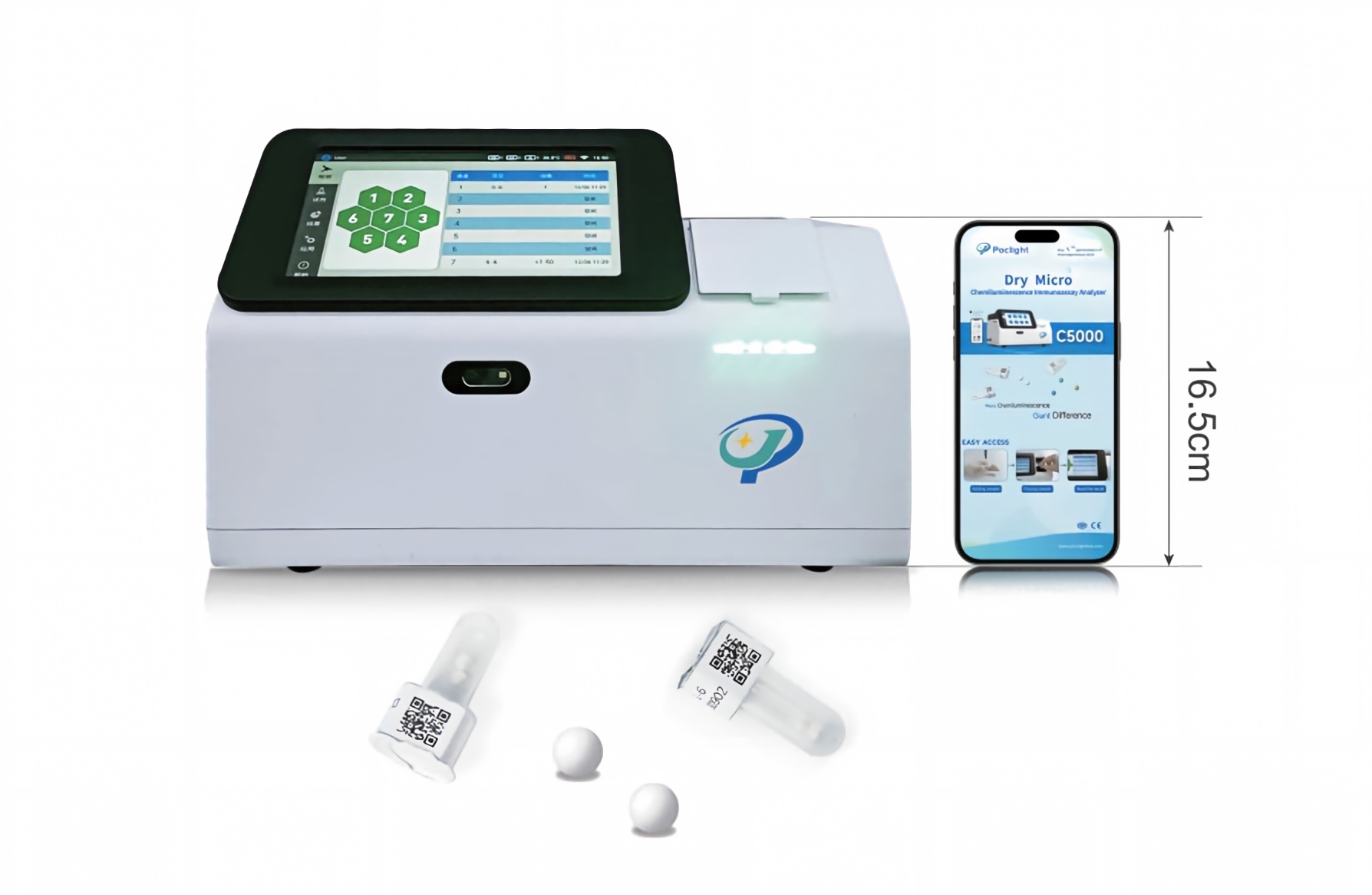
Supporting all of these assays is Poclight’s C5000 Dry Micro System, a semi-automatic, portable dry micro detection system designed for rapid serum tumor marker testing. The system delivers a first sample result in 3 minutes, supports 7-channel testing, and achieves a throughput of 80 tests/hour with an accuracy of CV < 5% at the platform level. Its dry micro reagent format uses lyophilized and liquid complementary reagents, enabling wash-free separation with no magnetic beads and no complex liquid path, which reduces operational complexity and cost. At a weight of ≤ 8.5 kg, the system remains practical for distributed clinical use, while touch screen operation and support for LIS/HIS transmission with real-time information sharing make it suitable for integration into existing hospital laboratory information systems.
A Practical Pathway for Prostate Biomarker Testing
Taken together, Poclight’s approach to prostate biomarker testing reflects a clear, evidence-based pathway: use tPSA as the initial screening signal, apply fPSA and the F/T ratio to resolve gray-zone ambiguity, and rely on the dedicated Prostate Cancer Combined Detection Panel to translate this logic into measurable reductions in unnecessary biopsies. For broader oncology monitoring needs, markers such as CEA extend this same combined-panel philosophy across multiple cancer types. Delivered through the C5000 Dry Micro System, these assays are positioned for rapid, low-maintenance deployment across Urology, Oncology Department, and related clinical settings—offering a structured, data-supported answer to the diagnostic uncertainty that single-marker prostate testing has historically struggled to resolve.
http://www.poclight.com
Nanjing Poclight Biotechnology Co., Ltd -
AuthorPosts

- You must be logged in to reply to this topic.