
- This topic is empty.
-
AuthorPosts
-
2026-10-28 at 6:29 pm #9993
Published: October 2026 | By YASILE Engineering Team
The right commercial soy milk maker for a breakfast shop is a 750W–1,100W self-separating unit with a copper-core motor, food-grade 304 stainless steel contact parts, and a rating of 25–60 kg of soaked beans per hour. Everything else — touchscreens, voice prompts, extra pre-sets — is secondary to those three things. This guide walks through how to choose a commercial soy milk maker for a breakfast shop step by step: the capacity math, the motor question, and the questions to ask a soy milk machine supplier before buying. It is written from the production floor by YASILE, the commercial equipment brand of Zhenjiang Yasile Kitchen Appliance Co., Ltd., a China-based manufacturer that has built pulping machinery since 1999 and supplies commercial kitchen equipment to restaurant buyers across our export markets.
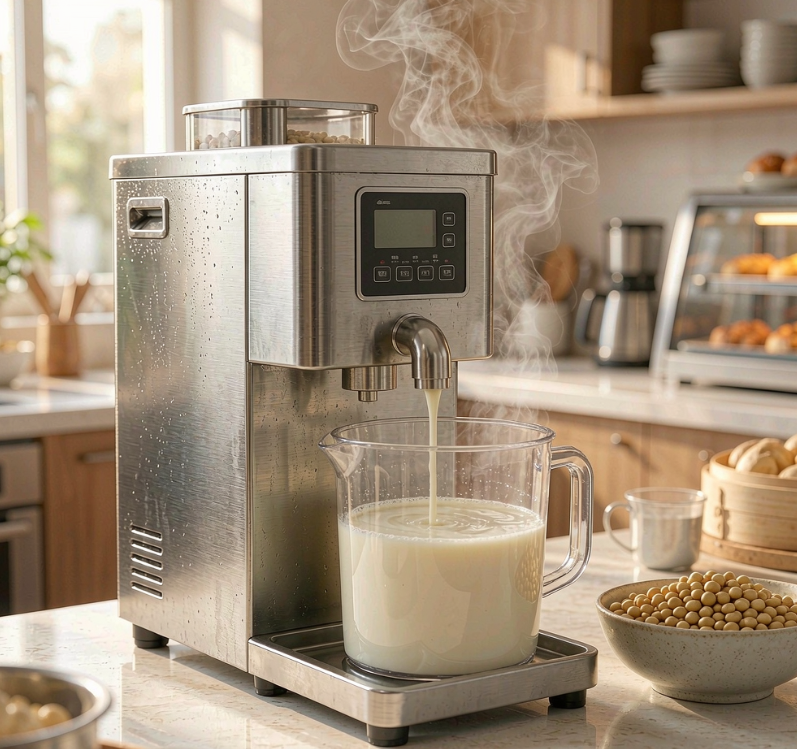
1. Is a 750W Motor Enough for Commercial Soy Milk Production?
For a shop serving up to roughly 200 cups a day, yes — a 750W copper-core motor is enough for commercial soy milk production, provided it runs at about 2,800 RPM and drives a full stainless grinding head. The answer to "is a 750W motor enough for commercial soy milk production" depends entirely on duty cycle, not the wattage sticker alone. Here is the sizing math that decides it:
• Average serving: 200–250 ml per cup. Two hundred cups ≈ 50 liters of finished soy milk.
• Bean yield: 1 kg of dry soybeans produces 6–8 liters of milk, so 50 liters needs about 7–8.5 kg of dry beans — roughly 14–17 kg once soaked.
• Machine rating: a 750W / 2,800 RPM unit with a 95 mm grinding wheel processes about 25 kg of soaked beans per hour, so your entire morning rush is ground in under 40 minutes — with capacity to spare.
Where 750W stops being enough is sustained, back-to-back service: canteens, hotel buffets and hotpot chains pushing the machine for two hours or more should step up to 1,100W, or run two smaller machines so one always cools. Two build details matter more than raw wattage: a copper-core motor holds torque and dissipates heat far better than aluminum windings, and an adjustable grinding gap lets you trade a little speed for finer texture without straining the motor. The YASILE 100 Standard self-separating unit, for example, is engineered around exactly this duty profile — 750W-class continuous grinding with the pulp separated in a single pass, so no second filtering step steals time from your rush hour.
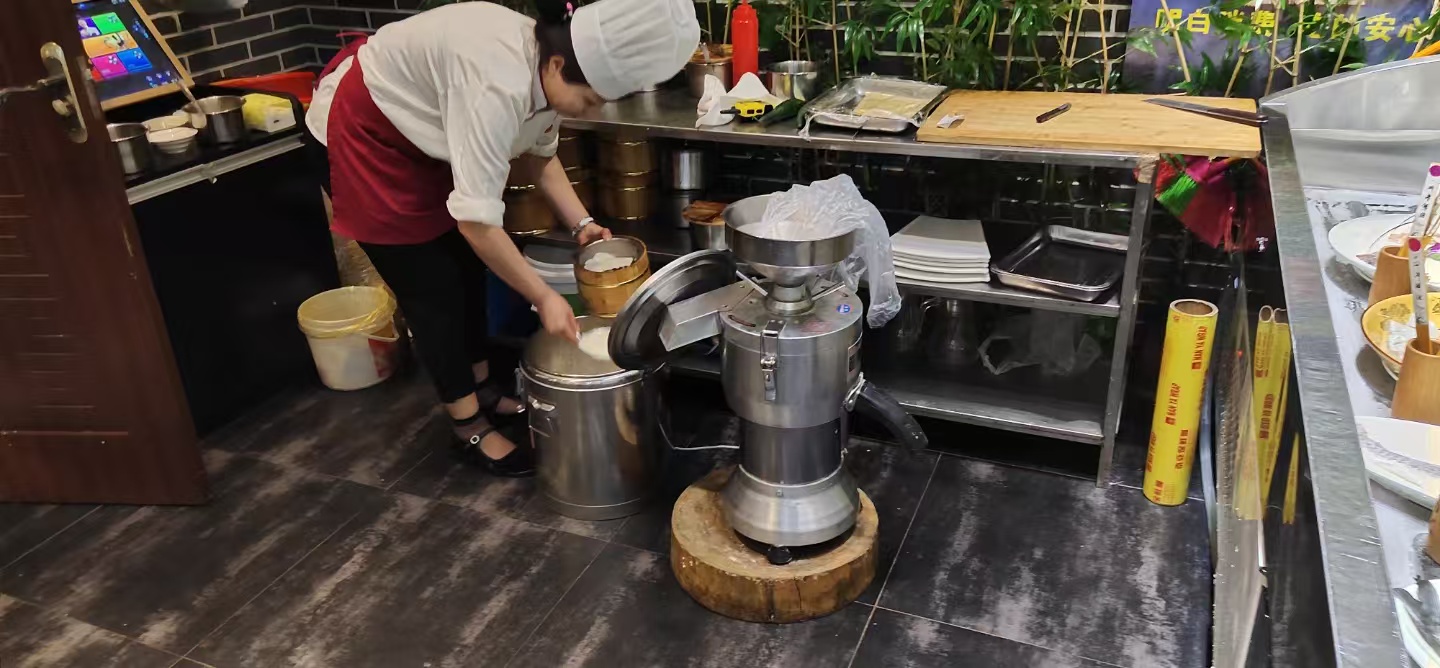
✅ Bottom line: A 750W copper-core motor at 2,800 RPM covers up to about 200 cups a day; beyond that, step up to 1,100W or run two machines.
2. What Questions Should You Ask a Soy Milk Machine Supplier Before Buying?
These are the eight questions to ask a soy milk machine supplier before buying — the answers separate real makers from resellers and save the two most common money-losing mistakes: wrong voltage and no spare parts. Whether you are sourcing one unit for a single shop or requesting a quotation for a chain, put these in writing:
✅ Material: "Which contact parts are food-grade 304 stainless steel — and can you show the mill certificate?" Avoid 201-grade or painted interiors.
✅ Rated power: "What is the rated (continuous) motor power, not the peak?" Spec sheets love quoting peaks.
✅ Voltage: "Can you build 110V / 220V / 380V with my local plug type?" Most established production lines do this as standard customization — confirm it before, not after, payment.
✅ Certification: "Which documents ship with the unit — CE, or local food-contact compliance?"
✅ Spares: "What is the warranty, and are grinding wheels, filter screens and seals available separately?" These are the only three parts that wear.
✅ Factory identity: "Are you the manufacturer or a trading company?" Ask for a business license or a live video factory tour.
✅ Real demo: "Can you send a video grinding wet, soaked beans — not a dry run?" Wet grinding is where cheap machines fail.
✅ Logistics: "What is the lead time, and who clears customs and inland freight?"
A factory that answers all eight without dodging is worth a trial order. Zhenjiang Yasile Kitchen Appliance Co., Ltd., for instance, ships every export unit with voltage adapted to the destination market and a spare grinding-wheel set in the carton — small signals, but they tell you who actually makes the machine.
✅ Bottom line: The eight questions above filter out trading companies and undocumented machines in a single email — anyone who answers all of them clearly has earned a trial order.
Frequently Asked Questions
Q: Is a 750W motor enough for commercial soy milk production in a hotpot restaurant?
A: Yes for grinding duty — hotpot kitchens usually pulse the machine through prep rather than running it for hours. If your menu also includes fresh soy milk service all day, choose the 1,100W class. See our self-separating pulping machine range for both duty levels.Q: Do you offer custom voltage for overseas buyers?
A: Yes. YASILE provides OEM and ODM services — 110V/220V/380V, local plug types, logo and packaging — with MOQ-friendly trial orders for first-time importers.Q: How much should I budget for a commercial soy milk maker?
A: Market price bands in 2026 run roughly $1,200–2,000 for entry semi-automatic units, $2,000–3,500 for mid-range stainless machines, and $3,500–6,000 for premium high-capacity models. Wholesale pricing from the maker typically lands below retail for equivalent build quality — view the YASILE 100 Standard for a benchmark.Get a Free Capacity Sizing for Your Shop
Send YASILE your daily cup count, menu items (soy milk, rice milk, nut milk, hotpot broth bases) and local voltage, and our engineers will reply within one business day with a recommended model, a capacity calculation and a quotation — free of charge, no obligation. If you are still weighing how to choose a commercial soy milk maker for a breakfast shop, this sizing exercise usually settles it in one email. Contact YASILE — the export brand that has been building commercial pulping and meat-processing equipment in Zhenjiang, China since 1999.
http://www.yslcookgear.com
Zhenjiang Yasile Kitchen Appliance Co., Ltd. -
AuthorPosts

- You must be logged in to reply to this topic.