
- This topic is empty.
-
AuthorPosts
-
2026-08-21 at 3:14 pm #9026
As cities expand, stormwater management is becoming increasingly important for residential communities, industrial parks, commercial developments, public facilities, and agricultural projects. Large roof areas, paved roads, parking lots, and other impermeable surfaces can generate significant runoff during heavy rainfall, putting additional pressure on conventional drainage networks.
Traditional surface storage solutions can require considerable land and may interfere with normal site use. Underground rainwater storage provides another approach by moving water management below the ground while preserving valuable surface space.
Among the available solutions, PP water modules offer a flexible combination of high storage efficiency, modular installation, structural performance, and adaptable system design. When properly engineered, these modules can be assembled into large underground reservoirs for rainwater storage, detention, or infiltration.
What Are PP Water Modules?
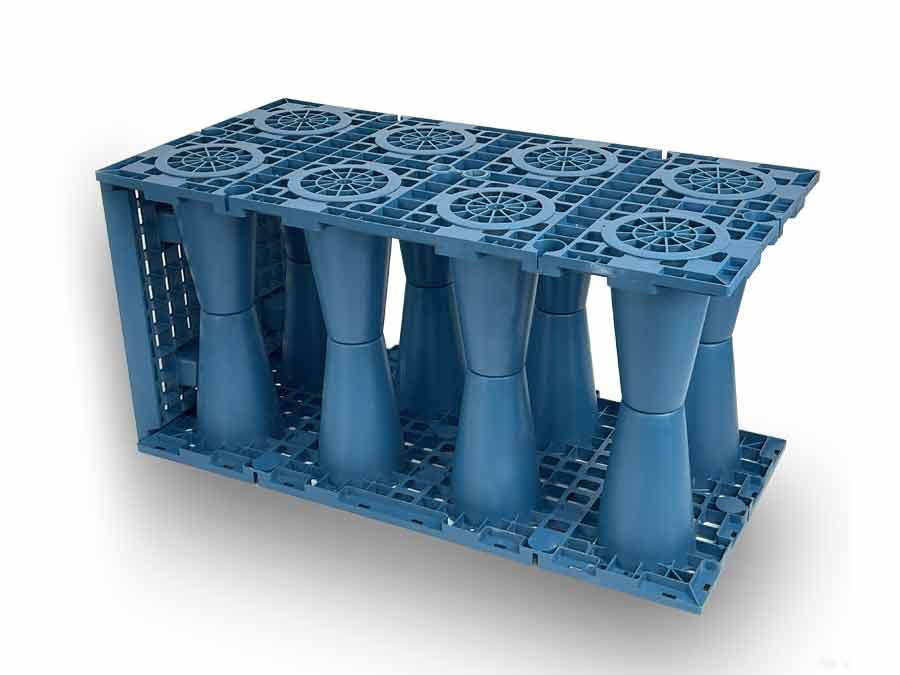
PP water modules are modular underground structures manufactured primarily from polypropylene (PP). Individual modules are assembled into a larger underground storage system according to the required dimensions and site conditions.
Instead of using a single large prefabricated tank, engineers can combine multiple modules to create a storage structure with the required length, width, and depth.
A typical rainwater management process may include:
Rainwater collection → filtration → underground storage → reuse, controlled discharge, or infiltration
The exact configuration depends on local rainfall, runoff volume, soil conditions, groundwater levels, intended water use, and project requirements.
This modular concept makes PP water storage systems particularly useful for large-scale projects where conventional tanks may be difficult to transport, install, or customize.
High Porosity Helps Maximize Storage Capacity
One of the most important specifications when evaluating an underground water storage module is its void ratio.
The higher the usable internal void space, the more water can be stored within a given underground volume.
The XH-MK1000 PP rainwater module has a reported porosity of up to 95%. This means a large proportion of the installed structure can be used for water storage rather than being occupied by solid structural material.
For large projects, this difference can become significant.
If an underground storage system requires hundreds or thousands of cubic meters of capacity, maximizing usable internal volume can help engineers achieve the required capacity without unnecessarily increasing the overall excavation area.
Of course, actual storage capacity must be calculated based on the complete system configuration rather than module porosity alone.
Structural Strength Is Critical Underground
A rainwater module installed underground operates under very different conditions from a conventional above-ground water container.
After installation, the structure may be exposed to soil pressure, vertical loading, vehicle traffic, construction loads, and other external forces. The actual load depends on factors such as burial depth, soil characteristics, surface loading, road conditions, and installation design.
The XH-MK1000 is specified with a vertical compressive strength of up to 550 kN/m² and lateral compressive strength of approximately 150 kN/m².
These figures provide useful technical reference points when engineers evaluate the suitability of the module for demanding projects.
However, rated compression strength should not be considered independently. The allowable installation conditions should be established through complete structural calculations and engineering design based on the actual site environment.
Modular Design Makes Large Projects More Flexible
Large underground storage tanks can present transportation and installation challenges, especially when construction sites have restricted access.
PP modules provide a different approach.
Individual units can be transported to the project site and assembled underground according to the planned system layout. This makes it possible to adjust the overall storage structure to different site conditions.
For example, a residential development may have limited underground space because of foundations and utilities. An industrial park may require a larger storage volume while maintaining sufficient ground load capacity above the system.
With modular construction, engineers can configure the system according to available space instead of being restricted to the dimensions of a single prefabricated tank.
This flexibility is one of the major reasons modular underground storage systems are being considered for modern rainwater infrastructure.
Lightweight Components Can Simplify Installation
Polypropylene also provides practical advantages during transportation and installation.
The XH-MK1000 module in the specified 1000 × 500 × 500 mm configuration weighs approximately 9.2–10 kg, excluding side panels.
Compared with large integrated underground tanks, individual modular components can be easier to transport and position at the construction site.
This can be especially useful for projects involving large quantities of modules. Instead of moving oversized structures into excavation areas, workers can handle individual components and assemble them progressively.
However, installation procedures should still follow the manufacturer's requirements and the project's engineering specifications to ensure that the completed structure performs as intended.
Underground Storage Preserves Valuable Surface Space
Land utilization is becoming an increasingly important issue in urban construction.
Above-ground water tanks can occupy space that could otherwise be used for roads, landscaping, parking, pedestrian areas, or other facilities.
Underground PP water storage systems allow stormwater infrastructure to be placed below the surface.
After proper installation and backfilling, the surface area can potentially continue to support its intended use, provided the system has been designed for the relevant surface loading requirements.
This makes underground storage particularly attractive for:
-
Residential communities
-
Commercial developments
-
Industrial parks
-
Public squares
-
Municipal facilities
-
Parking areas
-
Green spaces
-
Agricultural projects
The ability to combine water management with efficient land use can provide an important advantage in space-constrained developments.
Storage and Infiltration Require Different Configurations
PP modules are not limited to simple water storage.
Depending on the membrane and surrounding system design, an underground modular structure can be configured for different stormwater management strategies.
Rainwater Storage
An impermeable membrane can be used around the modular structure to create a sealed underground reservoir. Collected water can then be retained for appropriate reuse or controlled discharge.
Stormwater Detention
The system can temporarily retain runoff during periods of heavy rainfall and release it at a controlled rate according to the drainage design.
Infiltration
Where local soil and groundwater conditions are suitable, a permeable configuration can allow collected rainwater to gradually infiltrate into the surrounding ground.
Rainwater Reuse
Stored rainwater can potentially be used for suitable non-potable applications after appropriate treatment, such as landscape irrigation or other water uses permitted by local regulations.
The appropriate configuration should always be determined through professional hydraulic and environmental assessment.
High-Volume Applications Benefit From Modular Storage
The greatest value of PP water modules becomes apparent in projects where substantial storage capacity is required.
Residential Developments
Large communities contain extensive roofs, roads, driveways, parking areas, and landscaped zones. These surfaces can generate significant runoff during heavy rainfall.
Underground modular storage can help manage this runoff while keeping the surface available for normal community functions.
Industrial Parks
Industrial buildings often have large roof areas and extensive paved surfaces. During intense rainfall, runoff can quickly exceed local drainage capacity.
Underground storage can provide temporary capacity and help reduce peak discharge.
Commercial and Public Facilities
Shopping centers, public squares, office complexes, and other commercial facilities need to balance stormwater management with efficient use of limited land.
Underground modules can provide infrastructure without taking up valuable visible space.
Agricultural Projects
Agricultural facilities, greenhouses, and irrigation projects may benefit from capturing and storing rainwater for appropriate applications.
The system can be designed according to local rainfall patterns, water requirements, and available land.
Why Project Experience Matters
A PP water module is only one part of an underground rainwater management system.
Successful projects require coordination between hydrological analysis, structural design, filtration, storage, membrane selection, drainage connections, installation, inspection, and long-term maintenance.
For this reason, supplier experience should be considered alongside product specifications.
Guangdong Xihai Rainwater Environment Technology Co., Ltd. has focused on rainwater management and utilization since 2013. Its capabilities cover sponge city planning and design, rainwater control and utilization, engineering construction, inspection, and project acceptance.
The company has completed more than 600 rainwater-related projects covering residential communities, industrial parks, municipal roads, urban green spaces, parks, and agricultural facilities. Its technical development is also supported by more than 30 domestic and international patents and software copyrights.
This type of project experience can help customers evaluate PP modules as part of a complete rainwater management solution rather than simply purchasing individual components.
What Should Buyers Consider Before Choosing PP Water Modules?
Before selecting an underground water storage module, project owners and engineers should evaluate several factors.
1. Required Storage Volume
Calculate the expected runoff volume and determine how much water the underground system needs to retain or temporarily manage.
2. Installation Conditions
Consider excavation depth, soil characteristics, groundwater conditions, surrounding structures, and available installation space.
3. Surface Loading
If the system will be installed beneath roads, parking areas, or other traffic zones, the expected loading conditions must be incorporated into the structural design.
4. Void Ratio
A high void ratio can improve the effective storage capacity within the available underground volume.
5. Material Performance
Evaluate the PP material's mechanical properties, durability, chemical resistance, and suitability for the intended underground environment.
6. Membrane Configuration
Determine whether the project requires a waterproof storage structure or a permeable infiltration system.
7. Installation and Maintenance
The system should provide practical access for inspection, cleaning, and maintenance according to the project design.
A Practical Solution for Modern Rainwater Infrastructure
As urban areas become denser and rainfall events place greater pressure on drainage networks, underground water management is becoming an increasingly important part of modern infrastructure planning.
PP water modules provide several useful characteristics for these applications. Their high void ratio, modular construction, structural performance, relatively lightweight components, and flexible configuration make them suitable for a wide range of underground rainwater projects.
However, the performance of an underground storage system depends on much more than the module itself. Hydraulic calculations, structural design, soil conditions, membrane selection, installation quality, and maintenance planning all need to work together.
For large-scale projects, choosing an experienced manufacturer can help ensure that the product is evaluated as part of the complete rainwater management system.
With experience in sponge city development and rainwater control projects, Guangdong Xihai Rainwater Environment Technology Co., Ltd. provides modular PP water storage solutions for residential, municipal, industrial, commercial, and agricultural applications.
For projects that require substantial underground rainwater storage while preserving valuable surface space, a properly engineered PP water module system can be a practical and scalable approach to modern stormwater management.
http://www.xihairainwater.com
Guangdong Xihai Rainwater -
-
AuthorPosts

- You must be logged in to reply to this topic.