
- This topic is empty.
-
AuthorPosts
-
2026-09-08 at 4:40 pm #9248
Wire and cable manufacturers producing fine and ultra-fine conductors face a persistent engineering challenge: mechanical tension fluctuation. When tension is not controlled precisely during drawing, the result is frequent wire breakage, uneven diameter, and heavy dependence on operator skill to compensate for equipment limitations. For processors working with precious metals or specialty alloys, this instability becomes even more costly, since material waste from breakage directly erodes margins. Changzhou Dingtian Electrical Machinery Co., Ltd., operating under the brand Dingtian, has built its equipment lineup around solving this exact problem, combining tension-rod-free mechanics, closed-loop control, and vibration-suppressing structural design to deliver stability across a wide range of wire diameters and production speeds.
Why Stability Matters in Fine Wire Drawing
Traditional wire drawing machines that rely on mechanical tension rods or swing rods introduce oscillation into the drawing process. As line speed increases, this oscillation becomes more pronounced, causing scratching, breakage, and inconsistent wire dimensions. High-speed operation compounds the problem further: vibration at elevated speeds can distort the drawing path, shorten die life, and generate defects that only surface after the wire has passed through multiple downstream processes. For manufacturers targeting export markets or precision applications such as semiconductor packaging and aerospace wiring, this level of variability is not acceptable.
Tension-Rod-Free Control as the Foundation of Stability
Dingtian’s core technology platform addresses tension fluctuation at its source by removing the conventional mechanical tension rod. Tension-rod-free slip control paired with closed-loop constant tension control reduces wire breakage and improves diameter consistency across the product line. This approach is protected in part by proprietary development work, including a utility model patent for a reel driving mechanism and wire drawing machine (patent no. ZL202322744129.0, publication no. CN220787693U, granted April 16, 2024) and a utility model patent for a cooling mechanism for a dual variable frequency micro-fine wire drawing machine (patent no. ZL202323066979.6, publication no. CN221086758U, granted June 7, 2024). These innovations reflect ongoing engineering investment in the mechanisms that keep tension and temperature stable during continuous operation.
High-Level Tower Wheel Layout for Vibration Suppression
Among Dingtian’s slip-type equipment, the DG150-24 High-Control High-Speed Slip-Type Automatic Traversing Fine Wire Drawing Machine is specifically engineered to address vibration during high-speed mass production. This model applies dual-inverter tension-rod-free slip closed-loop control combined with a high-level tower wheel layout that suppresses vibration at high speed, which in turn enables a higher achievable production line speed. The DG150-24 reaches a maximum line speed of 2,200 m/min while drawing finished wire diameters from 0.03 mm to 0.10 mm from an inlet blank of 0.13 mm to 0.45 mm, using up to 24 molds.
Beyond the tower wheel layout, the DG150-24 incorporates a servo-driven traversing guide wheel with digitally adjustable pitch set directly via touch screen, stepless variable frequency speed regulation that adapts to copper hardness and wire diameter specifications, and an intelligent human-machine interface that stores and recalls process recipes with one click. Because operator requirements are reduced through this recipe-recall function, a single operator can attend multiple machines, and the equipment supports mass production of ordinary copper wire as well as special alloy wires such as silver-copper and tin-copper on the same platform.
Complementary Stability Technologies Across the Line
Vibration and tension control are addressed differently depending on wire gauge and production scale across Dingtian’s broader catalog. The LHS220-24 Tension-Rod-Free Fine Wire Drawing Machine uses encoders to collect speed data and realize virtual tension, removing wire dimension fluctuation caused by rod oscillation and maintaining consistent tension even at its maximum line speed of 2,200 m/min for finished copper wire from 0.08 mm to 0.35 mm.
The LHS240-24, built for higher-capacity production, applies an enhanced dual-inverter closed-loop slip control that suppresses tension impact during startup, shutdown, and speed adjustment, avoiding uneven wire thickness. Its thickened and reinforced machine frame is designed with fatigue resistance to support round-the-clock uninterrupted production, and the model reaches a maximum line speed of up to 2,500 m/min.
For unmanned, high-volume production, the LHSZ240-24 Servo Tension-Rod Fine Wire Drawing Machine with Automatic Spool Change combines high-precision displacement sensors with servo dynamic adjustment to deliver minimal tension impact during startup, shutdown, and speed change compared with conventional inverter tension rods, reducing wire outer diameter fluctuation. Its non-stop dual-spool automatic change allows continuous unmanned production beyond 8 hours, compared with conventional machines that require spool changes every 2 to 4 hours, an improvement reported to increase the number of machines managed per operator by more than 50 percent.
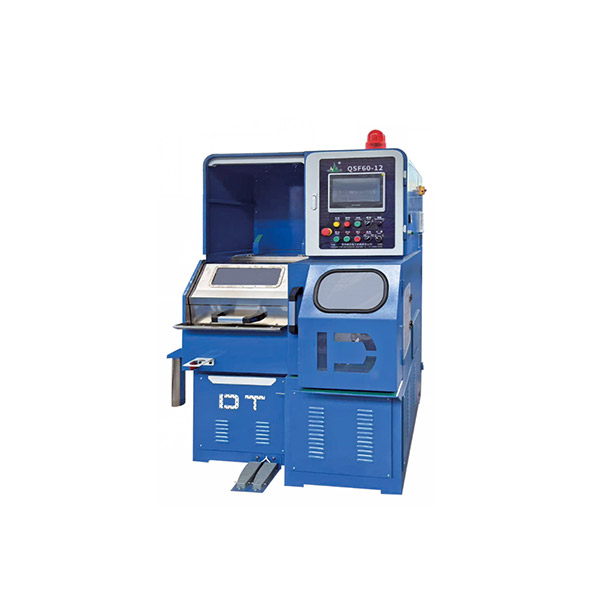
At the finer end of the spectrum, slip-type models such as the SPS60-12 and SPS85-15 report a wire breakage rate reduction of more than 90 percent on selected slip-type models compared with conventional machines, while full-servo systems like the QSF45-10 use a customized Inovance servo system for fully linear automatic control of take-up slip, holding wire diameter tolerance within ±0.0005 mm.
Proven Results in Production Environments
These stability technologies have translated into measurable outcomes reported by Dingtian customers. One long-term customer reported that its machine required no major overhaul after 8 years of operation, citing reliable equipment quality and continuous technical support. Another customer using a customized micro wire drawing solution for export products reported a finished wire dimensional tolerance of ±0.0006 mm, surface roughness of Ra ≤ 0.015 μm, an export product qualification rate of 99.8 percent, and an overseas order volume increase of 60 percent, noting that the finished wire quality far exceeded requirements and passed inspection on the first attempt.
Certification and Organizational Assurance
Dingtian’s stability claims are backed by a documented quality management framework. The company holds Quality Management System Certification under GB/T 19001-2016 idt ISO 9001:2015 (certificate no. 75424Q0525R0S, valid until November 21, 2027), Environmental Management System Certification under GB/T 24001-2016 idt ISO 14001:2015 (certificate no. 75424E0248R0S, valid until September 27, 2027), and Occupational Health and Safety Management System Certification under GB/T 45001-2020 idt ISO 45001:2018 (certificate no. 75424S0219R0S, valid until September 27, 2027). The company was also recognized as a Provincial Specialized and Innovative Small and Medium-Sized Enterprise by the Jiangsu Provincial Department of Industry and Information Technology, effective from April 2024 to April 2027.
Selecting a Stability-Focused Equipment Partner
For manufacturers evaluating wire drawing equipment, the combination of tension-rod-free mechanics, closed-loop slip control, and structural features such as the high-level tower wheel layout represents a measurable way to address vibration and tension-related defects at high speed. Changzhou Dingtian Electrical Machinery Co., Ltd. also offers adaptive retrofitting to match existing annealing and take-up systems, customized equipment configuration and process parameter optimization, and on-site wire trial verification, allowing processors to validate stability performance against their own material and diameter requirements before full deployment. As line speeds and precision demands continue to rise across electronic wire, cable, and precision conductor manufacturing, equipment architecture that specifically targets vibration suppression, rather than relying solely on operator compensation, is becoming a defining factor in production consistency and yield.
https://www.dtwiredraw.com/
Changzhou Dingtian Electrical Machinery Co., Ltd. -
AuthorPosts

- You must be logged in to reply to this topic.