
- This topic is empty.
-
AuthorPosts
-
2026-09-02 at 5:21 pm #9185
For a 650mm-wheelbase quadcopter or hexacopter, propeller selection affects more than thrust. The propeller also influences transport size, deployment speed, flight endurance, vibration, payload stability, and the overall balance of the propulsion system.
This is especially important for professional UAVs used in aerial cinematography, industrial inspection, surveying, remote sensing, and short- to medium-distance logistics. These aircraft are often transported between work sites, assembled in the field, and operated with cameras, sensors, delivery equipment, or other payloads. A folding propeller can make those workflows easier, provided that its size, blade configuration, mounting system, and motor compatibility match the airframe.
GEMFAN HOBBY offers two 16-inch folding propeller options designed for large-wheelbase multirotor UAVs: the Gemfan F1608-3 Folding Tri-Blade Propeller and the Gemfan F1608-2 Folding Two-Blade Propeller.
Both models are designed for 650mm-axis quadcopters and hexacopters, but they are aimed at different flight priorities. The F1608-3 focuses on stronger lift and stable control under load, while the F1608-2 emphasizes lower weight, aerodynamic efficiency, and flight endurance.
Why Folding Propellers Suit 650mm UAV Platforms
A 650mm-wheelbase multirotor is large enough to carry professional equipment but still compact enough to be transported by vehicle or handled by a small field team. In practice, the aircraft may need to move between a workshop, launch site, inspection zone, or filming location.
Fixed propellers can make transportation more difficult. Their long blades require additional clearance inside cases and vehicles, and they can be more exposed to impact during handling. Folding blades reduce the stored length of the propulsion assembly, making the aircraft easier to pack and deploy.
The benefit is not limited to storage. Folding propellers can also simplify field operations:
· The UAV can be transported with less disassembly.
· Propeller blades occupy less space inside a case.
· Deployment at a work site can be completed more efficiently.
· The risk of striking a blade against nearby equipment during handling is reduced.
· Operators can prepare the aircraft without removing the propeller from the motor every time.
For industrial operators, these small workflow improvements matter. A drone used for inspection or mapping may be deployed several times in one day. Faster setup and easier transportation can contribute to more consistent operations.
One Diameter and Pitch, Two Different Flight Priorities
Both GEMFAN HOBBY models have a 16-inch diameter, equal to 406.4 mm, and an 8-inch pitch. They also use a 6 mm center hole, a 13.5 mm center thickness, and a maximum propeller width of 35.5 mm. Both are recommended for compatible 4720 motors.
The main difference is the blade count.
The F1608-3 uses three blades. Its larger blade area is designed to generate strong, stable thrust for professional UAV platforms that carry heavier payloads. The F1608-2 uses two blades. Its simpler blade arrangement reduces weight and drag, which can support improved efficiency and longer flight endurance when the aircraft does not require the additional lift capacity of a tri-blade propeller.
This means the choice should be based on the aircraft mission:
· Select the tri-blade design when payload support, low-speed control, and stable lift are the main concerns.
· Select the two-blade design when efficiency, aircraft weight, and endurance are more important.
The two propellers should not be treated as interchangeable simply because they share the same diameter and pitch. Their motor loading, weight, thrust behavior, and flight-controller response may differ.
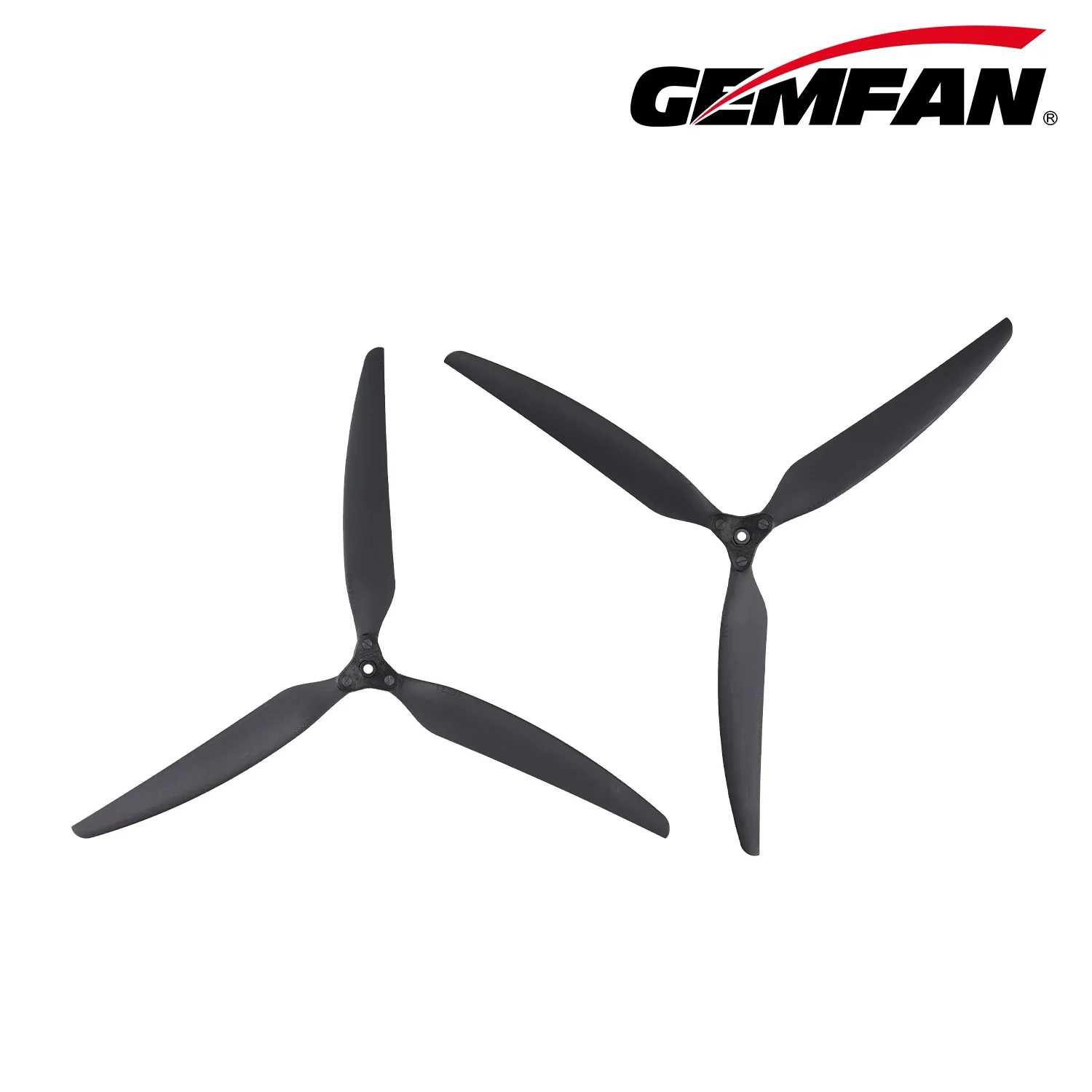
F1608-3: Folding Tri-Blade Performance for Heavier Payloads
The Gemfan F1608-3 Folding Tri-Blade Propeller is designed for large-wheelbase multirotors that need a stronger lifting response from a compact 16-inch propeller system.
Each propeller weighs 62.5 g, and the product is made from polycarbonate, or PC. This material provides impact resistance, fatigue resistance, and useful structural durability for repeated professional operation.
The three-blade arrangement increases the working blade area within the same 16-inch diameter. This can help the aircraft produce steady lift during takeoff, hover, and controlled movement with payload installed. It is a suitable direction for film-production drones carrying large camera systems, inspection platforms with multiple sensors, and industrial multirotors that need consistent handling under load.
GEMFAN HOBBY identifies the F1608-3 for UAV platforms with a maximum takeoff weight reference of up to 8 kg. This figure must be evaluated together with the complete aircraft configuration, including the number of motors, battery system, motor specification, frame design, payload position, and required safety margin.
The tri-blade option can be useful when the operator needs more stable low-speed control. For example, a cinematography aircraft may need to hold a steady position while carrying a gimbal and camera. An inspection UAV may need to hover near infrastructure while maintaining a predictable attitude. In these cases, stable thrust can be more important than extracting every possible minute of flight time.
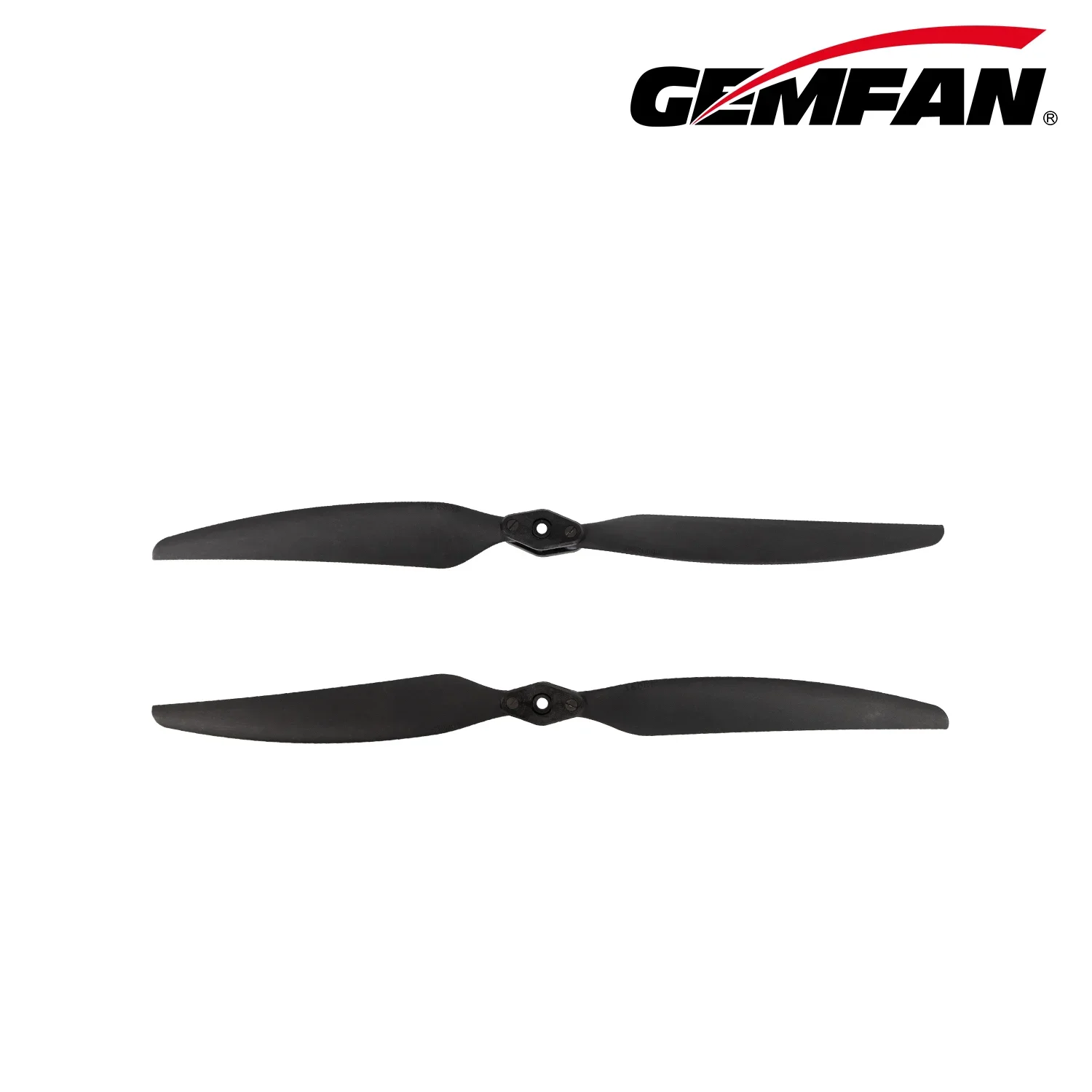
F1608-2: Lightweight Folding Propeller for Efficiency
The Gemfan F1608-2 Folding Two-Blade Propeller is aimed at operators who want to reduce propulsion weight and improve aerodynamic efficiency.
At 43.03 g per propeller, it is lighter than the F1608-3. The two-blade design also creates less blade area and typically produces lower drag in the airflow. When paired with a compatible 4720 motor, this configuration can help improve flight efficiency and extend endurance on a properly matched aircraft.
The F1608-2 is suitable for large-wheelbase inspection drones, aerial photography platforms, mapping UAVs, agricultural systems, and outdoor professional operations. GEMFAN HOBBY identifies it for platforms with a maximum takeoff weight reference of up to 6 kg.
This makes the two-blade model a practical choice for missions where the payload is moderate and flight duration has a high priority. A surveying aircraft carrying a lightweight mapping camera, for example, may benefit from reducing unnecessary propulsion weight. Similarly, an agricultural monitoring drone that carries a multispectral camera rather than a spraying tank may not need the additional blade area of a tri-blade propeller.
The F1608-2 is not simply a lower-capacity version of the tri-blade model. It serves a different design objective: efficient lift with a lighter and lower-drag propulsion configuration.
Polycarbonate Construction for Field Operations
Both F1608 models are made from PC, or polycarbonate. For folding propellers used on professional UAVs, the material needs to handle both flight loads and practical handling demands.
Polycarbonate offers a useful combination of impact resistance and fatigue resistance. This is relevant for field teams that repeatedly transport, unfold, install, and inspect the aircraft. The folding mechanism must remain reliable, while the blades need to resist normal operational stress without excessive deformation.
The foldable design does not remove the need for inspection. Before flight, operators should check the blade roots, hinge areas, mounting holes, hub surfaces, and locking points. Any looseness, cracking, distortion, or unusual resistance in the folding mechanism should be investigated before the aircraft is operated.
Metal and Plastic Hub Options
Both propeller models are available with metal and plastic hub mounting solutions. This gives UAV manufacturers and integrators more flexibility when adapting the propeller to different large-wheelbase platforms.
The correct hub should match the motor shaft, mounting pattern, fasteners, and expected operating load. A secure hub connection is essential because the propeller transfers continuous torque from the motor while also dealing with changes in RPM during flight.
When installing a folding propeller, ensure that the blades can open freely and that the folded position does not interfere with the frame, motor wires, landing gear, or payload mount. The propeller should be checked again after the first test flights, particularly if the aircraft has experienced a hard landing or transportation vibration.
Choosing the Right Model for a 650mm Quad or Hexacopter
For an 650mm-axis quadcopter or hexacopter, the decision can be made by looking at the actual mission profile.
The F1608-3 is the better starting point for heavier professional payloads, including cinema cameras, industrial sensor combinations, and equipment that requires stable hover performance. Its 62.5 g weight and tri-blade configuration support stronger lift within the 16-inch format, with an 8 kg maximum takeoff weight reference.
The F1608-2 is more appropriate for lighter aircraft and endurance-focused missions. Its 43.03 g weight and two-blade design reduce propulsion mass and drag, with a 6 kg maximum takeoff weight reference.
In either case, the aircraft should be tested with the real payload. Empty-airframe performance does not show the motor temperature, hover throttle, battery behavior, vibration, or control response that will occur during an actual mission.
Conclusion
For 650mm quadcopters and hexacopters, a folding propeller can improve transportation, field deployment, and storage without sacrificing the requirements of professional flight operations.
The GEMFAN HOBBY F1608-3 is designed for heavier payloads and stable tri-blade thrust, making it suitable for cinema, industrial inspection, surveying, and other demanding UAV applications. The F1608-2 is a lighter two-blade option for aircraft that prioritize efficiency, reduced drag, and longer endurance.
Both use durable polycarbonate construction, 16-inch diameter, 8-inch pitch, 6 mm center-hole compatibility, and metal or plastic hub options. The final selection should be based on the aircraft's verified takeoff weight, motor system, payload, and mission priorities.
http://www.gemfanhobby.com
GEMFAN HOBBY CO., LTD -
AuthorPosts

- You must be logged in to reply to this topic.