
- This topic is empty.
-
AuthorPosts
-
2026-10-28 at 6:31 pm #9998
Published: October 2026 | By Wisuno Engineering Team
Almost every first enquiry for 6J22 starts with the same question: why is karma wire more expensive than constantan wire? The short answer is that you are not paying for the alloy. At a 3× price multiple, Karma costs roughly the same as constantan per ohm of finished resistance, because its resistivity is 2.7 times higher and a 1 kΩ element needs a third of the wire. What you actually buy is process — vacuum melting, thirty-odd drawing passes, thin-wire yield loss — and the temperature stability that comes with it. This breakdown shows where the money goes, and the point at which the premium stops making sense.
Where does the 3× price difference actually come from?
Two-thirds of the gap is manufacturing, not metallurgy. Behind the question of why is karma wire more expensive than constantan wire sits a drawing line, a yield curve and an ageing furnace — not a more expensive alloy.
The metal inside costs almost the same
6J22 is 71–75% nickel, 19–21% chromium, 2.5–3.5% aluminium and 2–4% iron. Constantan is 55% copper and 45% nickel. At 2026 metal prices both alloys carry roughly US$11–13 of contained metal per kilogram: nickel is expensive and Karma uses more of it, but constantan carries 55% copper, which is not free either. Metal value explains a few percent of the difference, not three times.
What drives precision resistance alloy wire cost
Four process steps, all of which constantan can skip, are what drives precision resistance alloy wire cost far more than composition:
• Vacuum or inert-gas melting. Three percent aluminium oxidises readily. Air melting burns it out and leaves oxide inclusions that snap 0.05 mm wire during drawing. 6J22 is normally vacuum-melted, which adds 9–12% to the ex-works price and limits the heat size.
• Drawing and annealing. A 0.03 mm wire comes off an 8 mm rod through more than thirty dies, with 8–12 intermediate anneals at 750–850 °C in hydrogen, cracked ammonia or vacuum. Constantan's higher elongation tolerates heavier drafts and air annealing, so it needs fewer passes and cheaper furnaces.
• Thin-wire yield. 6J22 typically yields 65–80% at 0.02–0.05 mm; constantan yields 85–92% at the same diameter. Every broken spool is paid for by the good ones, which is why fine wire carries a price step the spec sheet never explains.
• Stabilisation and 100% testing. Holding TCR at ±5 ppm/°C instead of ±20 requires two-stage ageing — 350–380 °C for 4–8 hours, then 120–150 °C for 24–48 hours — followed by resistivity, TCR, thermal EMF and diameter checks on every spool.
Volume matters as well. Constantan is made in thousands of tonnes a year, 6J22 in hundreds. Our Nanjing factory runs both alloys on the same site, and the 6J22 line alone operates three annealing furnaces under protective atmosphere.
An approximate cost stack for a 6J22 ex-works price: metal 38–45% · vacuum melting 9–12% · drawing and annealing 22–28% · stabilisation ageing 5–7% · testing 5–7% · packing and overhead 8–12%. Not one line in that stack is alloy content — which is what drives precision resistance alloy wire cost, and why the figure does not swing with the nickel price the way constantan does.
The price per kilogram, in real numbers
In Wisuno's 2026 quotations, 0.02–0.5 mm 6J22 sits at US$30–70/kg FOB China depending on diameter, against US$12–25/kg for equivalent constantan. That is the karma wire price per kg in 2026 range most buyers see, and it is genuine: a kilogram of the material really does cost about three times more. Most suppliers, however, quote a single figure and leave the buyer to compare it against a completely different geometry. Most quotations set the karma wire price per kg in 2026 by diameter band too, so never compare two alloys at different wire sizes.
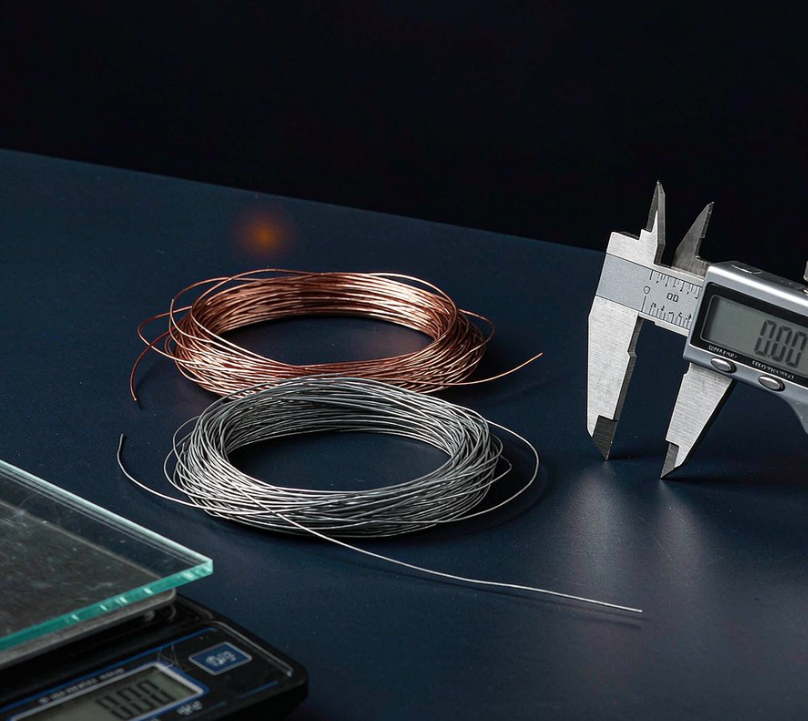
Same diameter, same 1 kΩ target: 6J22 needs 5.9 m of wire, constantan needs 16.0 m.
✅ Bottom line: Roughly two-thirds of the Karma premium is process — vacuum melting, extra drawing passes and thin-wire yield loss — not the cost of the alloy itself.
Is Karma wire worth 3× the price? Run the cost-per-ohm test
Usually yes, because comparing two resistance alloys by the kilogram compares the wrong thing. Designers do not buy kilograms, they buy ohms.
The calculation
6J22 has a resistivity of 1.33 μΩ·m; constantan (CuNi44) has 0.49 μΩ·m. For the same diameter and the same target resistance, Karma therefore needs 1/2.7 of the length — and, after density correction at 8.15 against 8.9 g/cm³, about 34% of the mass.
Worked example, a 1 kΩ element wound in 0.1 mm wire:
• 6J22: 169 Ω/m, so 5.9 m of wire, 0.38 g, roughly US$0.017 at US$45/kg
• Constantan: 62 Ω/m, so 16.0 m of wire, 1.12 g, roughly US$0.020 at US$18/kg
Three times the price per kilogram, one third of the wire, and 15% cheaper per ohm. Even at a full 3× multiple the two alloys land within a few percent of each other, before anyone counts the smaller package the higher resistivity allows.
Where the parity breaks
• Low resistance values. Below about 10 Ω the wire is short, the weight difference is trivial, and constantan's lower price wins outright.
• Termination cost. 6J22 is hard to solder. Spot welding, laser welding or silver brazing is preferred, and a tin joint above 350 °C can shift resistance by tens of ppm. That cost is real and routinely left out of comparisons.
• Order size. 6J22 commonly ships at a 20 kg minimum; constantan is available from 5 kg. On a prototype the MOQ dominates the whole calculation.
• Accuracy class. If ±40 ppm/°C and −43 μV/°C thermal EMF are acceptable, constantan is the correct engineering choice, not the cheap one.
• Lead time. Custom 6J22 diameters run 2–4 weeks because the ageing cycle alone takes 28–56 hours; constantan standard sizes ship from stock.
Wisuno supplies both alloys as a China manufacturer and will quote them side by side at the same diameter, so the comparison is made on identical geometry rather than on list prices lifted from two different spec sheets. See the full Karma alloy wire range for diameter and tolerance options.
✅ Bottom line: At three times the price per kilogram, 6J22 costs about the same per ohm as constantan — the premium buys TCR and thermal EMF stability.
Frequently asked questions
Q: Why is karma wire more expensive than constantan wire per kilogram?
A: Because the kilogram is the wrong unit. Metal content is similar at US$11–13/kg for both. The difference is vacuum melting, 8–12 protective-atmosphere anneals, a thin-wire yield 10–20 points lower, and two-stage ageing that holds TCR at ±5 ppm/°C.
Q: Is Karma wire the same as Evanohm or Nikrothal?
A: They belong to the same NiCrFeAl family and are all covered by ASTM B267, but composition and TCR limits differ between producers. 6J22 is the Chinese grade — Ni 71–75%, Cr 19–21%, Al 2.5–3.5% — and Wisuno confirms every heat on the mill certificate rather than on the trade name.
Q: Why does 0.02 mm wire cost 3–4× the 0.5 mm price?
A: Yield and labour. Drawing to 0.02 mm takes more than forty dies with repeated annealing, and breakage rises steeply below 0.05 mm. Expect the karma wire price per kg in 2026 to swing 3–4× between those two diameters even though both are the same alloy from the same heat.
Get the comparison done on your geometry. Send the resistance value, wire diameter, accuracy class and annual quantity, and Wisuno Special Materials Technology (Nanjing) Co., Ltd. will return a cost-per-ohm calculation for 6J22 and constantan at the same size, with OEM and custom diameter options and lead time. Email wisuno@wsnnj.com or call +86 189-1295-0505.
http://www.wisunotech.com
Wisuno Specialty Materials Technology (Nanjing) Co., Ltd. -
AuthorPosts

- You must be logged in to reply to this topic.