
- This topic is empty.
-
AuthorPosts
-
2026-11-13 at 6:19 pm #10398
Serial tumor marker testing has become a core strategy in cancer management, helping clinicians track disease progression, evaluate treatment response, and detect recurrence after treatment. Rather than relying on a single measurement, serial testing repeats marker assessment over time, allowing care teams to observe trends rather than isolated values. Poclight‘s serum tumor marker portfolio, built around markers such as tPSA, fPSA, and CEA, is designed to support exactly this kind of longitudinal, trend-based monitoring approach.
Understanding Serial Tumor Marker Testing and Its Clinical Value
Tumor markers are often proteins that circulate in serum and reflect tumor activity. Because a single reading can be influenced by benign conditions, inflammation, or individual variability, clinical practice increasingly relies on repeated, serial measurements to build a more reliable picture. This is particularly true for markers used in post-treatment surveillance, where the goal is not a one-time diagnosis but ongoing observation of whether levels are rising, falling, or stable over successive tests.
Why CEA Is Central to Serial Monitoring Strategies
Among Poclight’s serum tumor marker tests, CEA (Carcinoembryonic Antigen) is positioned specifically as a pan-cancer monitoring marker for recurrence and treatment response in colorectal, gastric, pancreatic, lung, and breast cancers. CEA is not intended to be diagnostic by itself, since its specificity is reduced in smokers and in patients with inflammation. Instead, its differentiated value lies in serial postoperative measurement: tracking CEA levels after surgery can predict recurrence, and a rising CEA trend can precede imaging findings, giving clinicians an earlier signal for further investigation than imaging alone might provide.
This serial approach is also reflected in clinical guidance. U.S. clinical practice guidelines recommend that CEA levels be obtained before elective colon cancer surgery, establishing a baseline that becomes meaningful precisely because it is compared against later, serial measurements taken during post-surgical risk management.
Beyond CEA: Serial Monitoring Across Other Tumor Markers
Serial testing logic extends across Poclight’s broader marker lineup. tPSA (Total Prostate-Specific Antigen) is used as a prostate cancer screening marker, with levels above 4 ng/mL triggering further investigation. Because tPSA correlates with tumor burden and metastasis risk, tracking it over time—alongside the companion marker fPSA (Free Prostate-Specific Antigen)—helps refine decision-making, especially in the 4–10 ng/mL gray zone, where the fPSA/tPSA ratio (F/T ratio) increases detection specificity by 17.4% and reduces unnecessary biopsies.
CA125 (Cancer Antigen 125) similarly supports recurrence monitoring in ovarian cancer. Because CA125 is elevated in 80% of advanced cases but only 50% of early-stage cases when used alone, serial tracking combined with HE4 improves specificity to 95% through the ROMA index, giving clinicians a more dynamic view than a single measurement could offer.
AFP (Alpha-Fetoprotein) is positioned for hepatocellular carcinoma diagnosis and screening, particularly when combined with ultrasound. Chinese expert consensus has highlighted biannual ultrasound plus AFP as a cost-effective HCC screening strategy, an approach that is inherently serial in nature, built on repeated observation rather than a single test.
Combined Detection Panels Improve Serial Testing Outcomes
Recognizing that individual markers have known limitations, Poclight offers Clinical Combined Detection Solutions that pair markers to compensate for these gaps and improve sensitivity and specificity for specific cancer types. The Prostate Cancer Combined Detection Panel (tPSA + fPSA, F/T ratio) reduces false positives by 30% in the gray zone, with panel sensitivity of 44–67% and specificity of 81–87%. The Hepatocellular Carcinoma Combined Detection Panel (AFP + AFP-L3 + DCP) raises sensitivity to 70–85% and specificity to 80–90%, addressing the 30–40% false-negative rate seen with AFP alone in early HCC.
For lung cancer, the NSCLC Squamous Combined Detection Panel (CYFRA21-1 + SCC) achieves 88% sensitivity and 74% specificity in distinguishing squamous carcinoma from adenocarcinoma, while the NSCLC Adenocarcinoma Combined Detection Panel (CEA + CYFRA21-1 + CA125) detects early-stage adenocarcinoma at 75% sensitivity and 70% specificity. Gastrointestinal panels follow a similar pattern: the Gastric Cancer Combined Detection Panel (CEA + CA19-9 + CA72-4) reaches 70–86% sensitivity and 80–88% specificity, the Pancreatic Cancer Combined Detection Panel (CEA + CA19-9 + CA125) improves sensitivity to 82% and supports resectability prediction, and the Colorectal Cancer Combined Detection Panel (CEA + CA19-9 + CA242) supports post-surgical monitoring and detection of liver metastases with 70–92% sensitivity and 85–90% specificity. The Ovarian Cancer Combined Detection Panel (CA125 + HE4) rounds out the lineup with 76–94% sensitivity, 75–95% specificity, and 93.8% accuracy, supporting both early detection and recurrence monitoring.
The C5000 Dry Micro System: Enabling Fast, Serial Testing
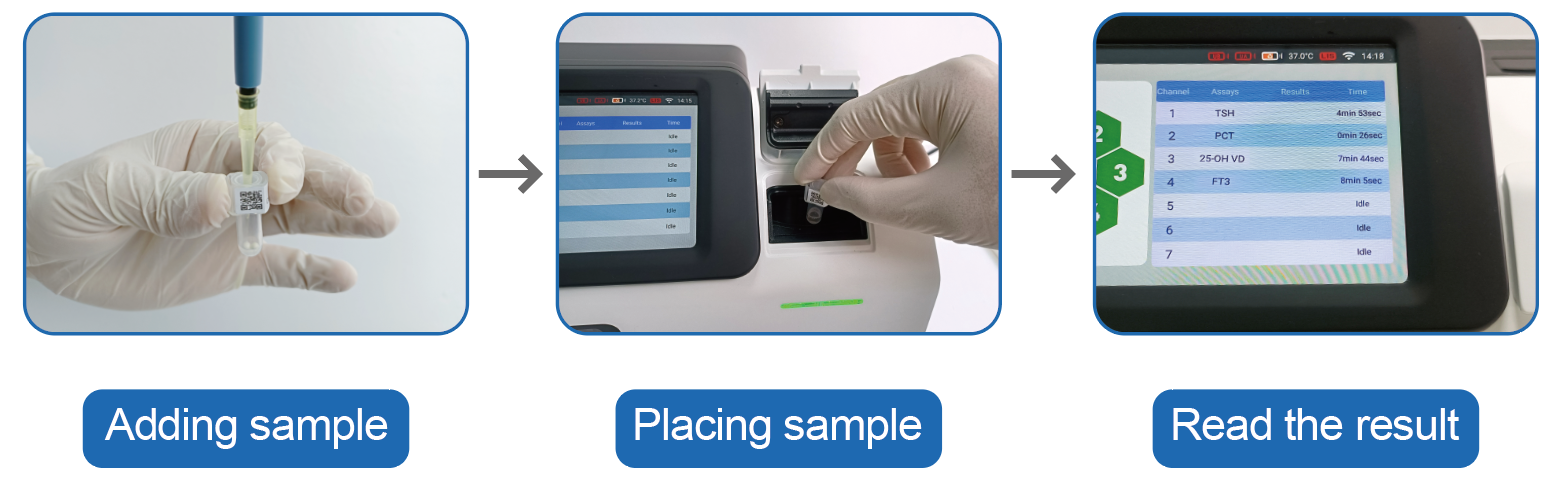
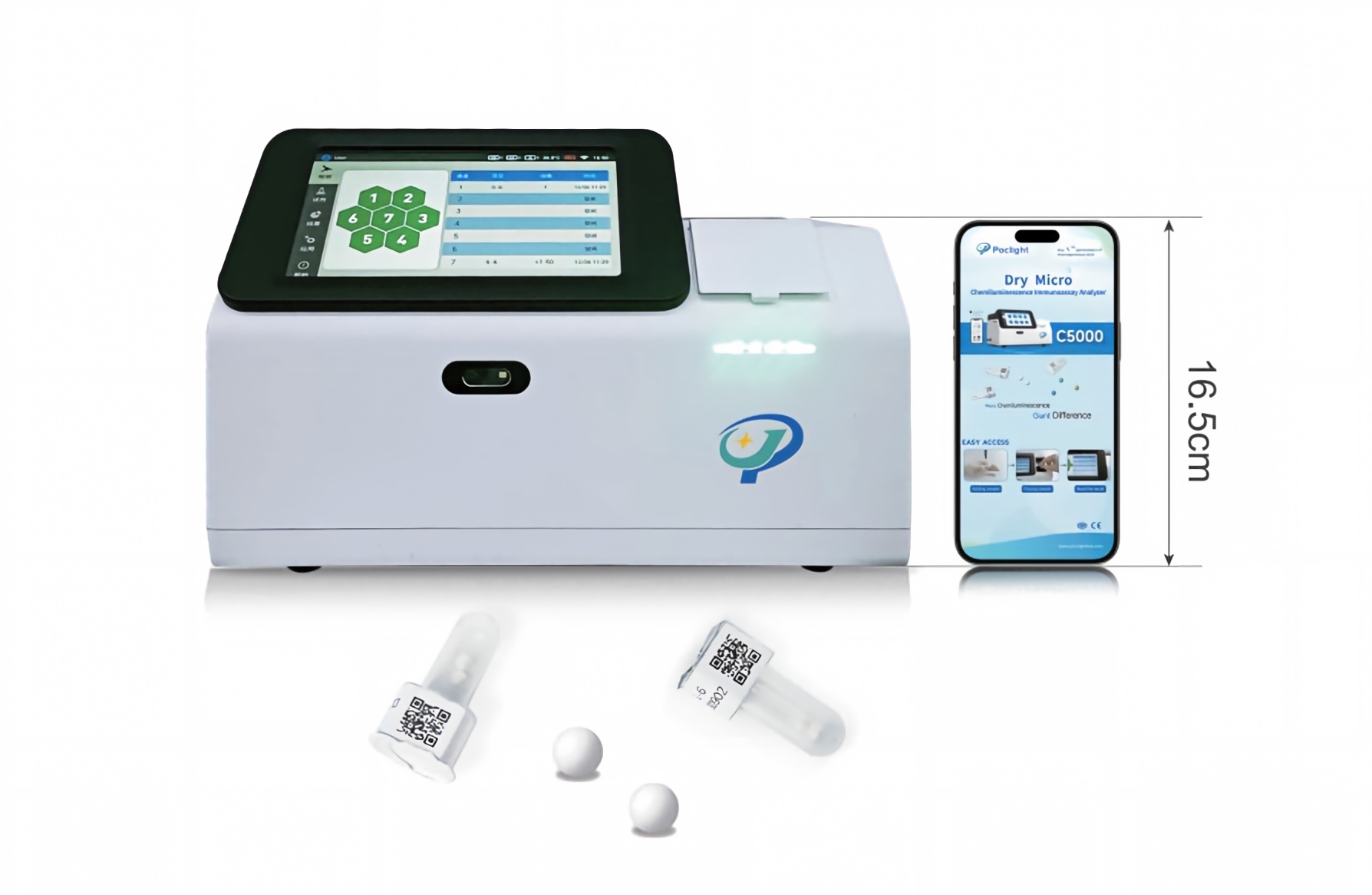
Serial testing is only practical when results are fast, reliable, and easy to repeat. Poclight’s C5000 Dry Micro System is built around this requirement. It delivers a first sample result in 3 minutes, supports 7 channels, and processes 80 tests per hour, with a coefficient of variation (CV) under 5% (and under 3% as reported for the system specifically) and a compact weight of ≤ 8.5 kg. Its dry micro reagent format uses lyophilized and liquid complementary reagents with wash-free separation—no magnetic beads and no complex liquid path—reducing operating complexity and cost. The system’s touch screen operation and support for LIS/HIS transmission allow real-time information sharing, making it practical for hospital clinical departments to run repeated, serial marker tests as part of routine patient follow-up.
Clinical Consensus Supporting Serial Tumor Marker Use
Poclight’s approach aligns with established clinical consensus. The PSA Consensus 2024 (UK) describes the PSA blood test as a low-cost, safe, and effective way of identifying men who would benefit from further testing. U.S. clinical practice guidelines call for CEA levels before elective colon cancer surgery for post-surgical risk management. Chinese expert consensus supports biannual ultrasound and AFP as a cost-effective HCC screening strategy, and separately concludes that combining CEA and SCC testing helps distinguish early-stage NSCLC from benign lung disease presenting with suspicious pulmonary masses.
Who Serial Tumor Marker Testing Serves
Poclight’s serum tumor marker tests and combined panels are adapted across Urology, Gastrointestinal Surgery, Gynecology, Oncology Department, Respiratory Department, Hepatobiliary Surgery, and Gastroenterology. For clinicians and laboratories seeking a practical way to implement serial tumor marker testing—from single markers like tPSA, fPSA, and CEA to full combined panels—Poclight provides the testing portfolio and the C5000 platform needed to support consistent, repeatable, and clinically grounded monitoring over time.
http://www.poclight.com
Nanjing Poclight Biotechnology Co., Ltd -
AuthorPosts

- You must be logged in to reply to this topic.