
- This topic is empty.
-
AuthorPosts
-
2026-11-05 at 4:18 pm #10159
A Custom Printed Table Cover is more than a decorative accessory for trade shows, exhibitions, outdoor events, and promotional campaigns. It is a functional branding product that must combine accurate logo reproduction, durable fabric construction, consistent dimensions, and reliable performance under real operating conditions. For brands using printed table covers at trade shows, retail activations, sporting events, or outdoor product demonstrations, poor color consistency, fabric wrinkling, incorrect sizing, or premature fading can undermine the professional appearance of the entire display.
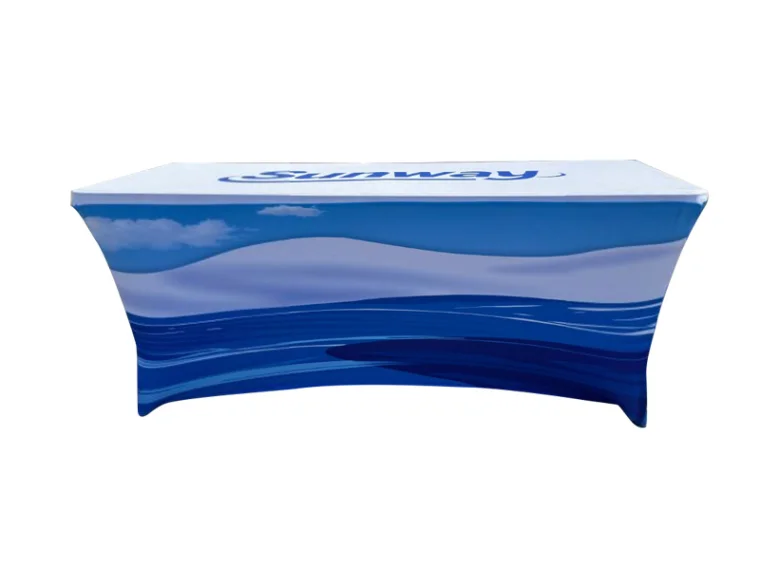
Selecting the right Custom Printed Table Cover requires an understanding of the relationship between fabric selection, printing technology, artwork preparation, sewing quality, and the intended environment. A cover designed for an indoor exhibition may prioritize a smooth surface and precise brand colors, while one used at outdoor events must also withstand sunlight, wind exposure, frequent handling, and repeated cleaning. These requirements affect both manufacturing specifications and the total cost of ownership.
SUNWAY Outdoor Products, established in 2011, operates a 12,000 m² production base with more than 80 professionals. Its product range includes collapsible gazebos, foldable tables, accessories, and customizable outdoor living products. This manufacturing background is relevant to event display applications where printed table covers may be used alongside portable tables, outdoor shelters, and other promotional equipment.
Choosing the Right Fabric for a Custom Printed Table Cover
Fabric selection determines how a Custom Printed Table Cover looks, fits, and performs after repeated use. The most appropriate material depends on the required appearance, printing method, event conditions, cleaning frequency, and budget. Polyester is commonly used for promotional table covers because it offers a practical balance of weight, durability, print compatibility, and ease of handling.
Different polyester constructions can produce noticeably different results. A lightweight fabric may reduce shipping weight and make covers easier to transport between events, but it may also be more prone to wrinkling, movement, or visible table contours. A heavier construction may provide a more substantial appearance and better drape, although it can increase material consumption and packed weight. Fabric weight, commonly expressed in grams per square meter (GSM), should therefore be specified alongside weave, thickness, opacity, and surface finish rather than used as the sole indicator of quality.
Opacity is particularly important when a table cover is used over a table containing storage boxes, cables, promotional materials, or equipment. If the fabric is too transparent, objects beneath the table may remain visible under strong exhibition lighting or direct sunlight. A sample should be evaluated over the actual table color and under representative lighting conditions before mass production.
Fabric behavior also affects fit. A cover that stretches excessively, shrinks after washing, or develops uneven edges may no longer align correctly with the table. Dimensional stability, seam construction, and the finished cover's measurements should be evaluated together. For recurring exhibitions or multi-location campaigns, maintaining a consistent specification across production batches is essential to ensure that replacement covers match existing display equipment.
Printing Technology and Color Accuracy
Printing quality is one of the most visible performance factors in a Custom Printed Table Cover. A logo may appear accurate on a computer screen but look different when reproduced on fabric because of differences in color profiles, ink behavior, textile structure, and printing conditions. Small details, fine text, gradients, and brand-specific colors require particular attention.
Dye sublimation is widely used for polyester promotional textiles because the dye bonds with the polyester fibers through a heat-based transfer process. It can produce vibrant colors and detailed graphics, making it suitable for full-color logos, photographs, gradients, and large promotional designs. However, the final result depends on the fabric composition, transfer conditions, color management, and production consistency. It should not be assumed that every polyester fabric will reproduce colors identically.
Other printing methods may be appropriate depending on order volume, artwork complexity, and fabric requirements. The best choice depends on the combination of substrate, print coverage, required durability, and production economics. Manufacturers should confirm the actual process used for the selected material rather than selecting a printing method based on price alone.
Color matching should be established before bulk production. Where brand consistency is important, provide vector artwork, defined color references, and clear instructions for logos and typography. Pantone references can help communicate brand color intent, but the achievable textile result should be confirmed through an approved physical sample because fabric printing does not always reproduce a reference color exactly.
For large campaigns involving hundreds of covers, a production approval sample helps prevent costly inconsistencies. The sample should be checked for color balance, image sharpness, logo proportions, text readability, and placement relative to the finished seams. Approval should be based on the printed fabric and finished product, not solely on a digital proof.
Artwork Preparation and Print Layout
Correct artwork preparation is essential to avoid problems that cannot be corrected easily after printing. A design intended for a flat graphic may need to be adapted when applied to a table cover with a top panel, front drop, side panels, or a fitted structure. Logos positioned too close to a seam can become distorted, partially hidden, or difficult to read when the cover is installed.
Before production, the design should be mapped to the finished cover dimensions. The layout must account for seam allowances, hems, corners, table edges, and any areas that will be concealed by the table itself. Important brand elements should remain within a defined safe area, while backgrounds and full-bleed graphics should extend sufficiently beyond the trim boundary to prevent unprinted edges.
Resolution requirements depend on the physical print size and viewing distance. Small text and detailed logos typically need more careful preparation than large background graphics viewed from several meters away. Vector files are preferable for logos and text where available because they can be scaled without the same pixelation risks as raster images. If raster artwork is supplied, its effective resolution at final print size should be checked before production.
The final artwork proof should show the cover in its assembled configuration, including the visible front and side areas. This makes it easier to confirm logo placement, text orientation, and visual balance. For international campaigns, it is also worth checking that product names, contact details, QR codes, and other printed information remain readable at realistic viewing distances.
Standard, Fitted, and Stretch Table Covers
The cover style affects both visual appearance and compatibility with the table. Standard draped covers are generally suitable for flexible event use because they can accommodate a range of table arrangements and provide convenient coverage. Their loose fabric, however, may move in outdoor airflow or interfere with items stored underneath the table.
Fitted table covers are designed around specific table dimensions and provide a more structured appearance. They can create cleaner edges and more consistent presentation at exhibitions, product demonstrations, and corporate events. Their main limitation is dimensional compatibility: an incorrect table length, width, or height can cause the cover to fit poorly, pull at the corners, or expose parts of the table.
Stretch covers typically use elastic textile constructions to create a close-fitting appearance. They can be useful for modern exhibition displays where a streamlined profile is desired, but fabric stretch, seam strength, and the geometry of the table legs must be considered during design.
For any style, the table dimensions should be confirmed before production. A nominally similar table may have different corner radii, leg positions, or frame thicknesses, affecting how the cover sits. If the cover will be used with a foldable table, the design should also consider how the table is assembled, transported, and stored. The finished cover should fit the table in its operating configuration rather than merely matching the dimensions of the folded product.
Outdoor Durability and Maintenance
Outdoor use introduces performance demands that are less significant in a controlled exhibition hall. Sunlight can gradually fade some printed textiles, while wind may cause loose fabric to flap, shift, or pull against seams. Rain, dust, food spills, and repeated transport can also affect the appearance and service life of a Custom Printed Table Cover.
UV resistance should be evaluated according to the expected exposure. A cover used for a few hours at occasional outdoor events has a different durability requirement from one left in direct sunlight for extended periods. Printing method, color selection, fabric composition, and environmental conditions all influence fading behavior. Where long-term outdoor exposure is expected, request relevant test information or conduct a controlled exposure trial rather than relying on a general claim of weather resistance.
Wind resistance is also influenced by the cover design and installation. A loose drape may move more than a fitted cover, while a stretch cover may place additional tension on seams and corners. The cover itself should not be treated as a substitute for securing the table or outdoor display structure. In windy environments, appropriate anchoring and safe event setup remain essential.
Cleaning instructions should be established before the first event. The permissible washing temperature, detergent type, drying method, and ironing requirements depend on the fabric and printing process. Aggressive cleaning or excessive heat can damage the textile or alter its appearance. For organizations managing large inventories of event covers, standardized cleaning and storage procedures help preserve color consistency and reduce replacement frequency.
Quality Control for Custom Printed Table Cover Production
A reliable manufacturing process should verify both printing quality and finished-product dimensions. Visual inspection alone may not identify all issues, particularly when a cover contains multiple panels, detailed graphics, or tight fit requirements.
Fabric inspection should check for visible defects, inconsistent coloration, and damage that could affect the finished appearance. Printing inspection should assess color consistency, registration, image clarity, and the placement of important design elements. Sewing inspection should focus on seam straightness, stitch consistency, corner construction, hem quality, and any areas exposed to repeated tension.
Dimensional checks are equally important. Finished length, width, drop, and any fitted corner measurements should be compared with the approved specification. For repeated orders, retaining an approved sample and a documented measurement sheet can reduce variation between production batches.
SUNWAY Outdoor Products states that its integrated manufacturing facilities and multi-stage quality control processes include 100% pre-shipment inspection. For customized table covers, the value of this approach depends on the inspection criteria being applied to the order. A clearly defined checklist should cover artwork, color, dimensions, sewing, packaging, and the required quantity before the goods are dispatched.
For larger campaigns, pre-production approval and batch sampling can further reduce risk. This is especially useful when several artwork versions, table sizes, or destination markets are involved. Identifying a mismatch before mass production is usually less expensive than correcting an entire shipment.
How to Evaluate the Total Cost of Ownership
The lowest unit price does not necessarily produce the lowest overall cost. A low-cost cover that fades quickly, fits poorly, or requires frequent replacement may become more expensive over several event seasons than a better-specified alternative. Conversely, paying for heavy fabric or specialized finishing may not be justified for a short-term indoor campaign.
A practical comparison should consider fabric construction, printing durability, dimensional accuracy, cleaning requirements, packaging, shipping weight, and expected reuse frequency. For example, an organization participating in multiple trade shows each year may benefit from a reusable cover with stable color reproduction and durable seams. A one-time promotional event may place greater emphasis on budget and delivery schedule, provided the product still meets the required presentation standard.
Order planning also affects cost. Consolidating artwork versions and confirming all table dimensions before production can reduce setup errors and the need for corrective orders. Reusable templates and documented color approvals can simplify future replenishment, particularly for brands operating across multiple regions.
Conclusion
A Custom Printed Table Cover should be specified as a functional textile product rather than treated as a simple printed decoration. Fabric weight and opacity, printing technology, artwork layout, cover style, dimensional accuracy, and environmental exposure all affect its appearance and service life.
For successful results, confirm the intended table dimensions and event conditions, approve a physical print sample, define measurable quality requirements, and verify the finished cover before shipment. For outdoor applications, consider sunlight, wind, cleaning, and storage alongside brand presentation.
With its experience in outdoor products, integrated manufacturing capabilities, and stated pre-shipment inspection process, SUNWAY Outdoor Products offers a relevant manufacturing context for customized event display products. The most suitable solution will ultimately depend on the required design, fabric specification, usage frequency, and verified production quality.
http://www.sunwayoutdoor.com
SUNWAY Outdoor Products Co., Ltd. -
AuthorPosts

- You must be logged in to reply to this topic.