
- This topic is empty.
-
AuthorPosts
-
2026-10-14 at 1:37 pm #9708
An eddy-current sensor measures the distance to a conductive metal target by sensing how the target disturbs a high-frequency magnetic field — non-contact, short-range, indifferent to oil, dirt, humidity and target surface finish, which makes it the default for shaft vibration, axial position and metal displacement inside machinery. A laser displacement sensor triangulates a light spot off almost any surface — metal, plastic, ceramic — reaching longer standoff distances and finer spot geometry, but its reading depends on the surface returning light: dark, glossy or transparent surfaces destabilize it. Choose eddy-current when the target is metal, the environment is contaminated and the range is millimetres; choose laser when the target is non-metal, the standoff must be larger, or the measurement must resolve small features. KJT Sensors supplies both: eddy-current displacement sensors for conductive targets (high linearity and resolution, static and dynamic) and the TLS laser family including the TLS-30C with 1 mm resolution and ±1.5 mm + 0.5‰ accuracy (manufacturer-stated).
Key Takeaways
- Material is the first gate: eddy-current requires a conductive metal target — it cannot measure plastic, glass or ceramics; laser measures nearly any surface that reflects or diffuses light.
- Environment is the second gate: oil, dirt, coolant mist and humidity barely touch an eddy-current field; they coat a laser window and scatter a beam. Conversely, machine illumination and target finish barely touch eddy-current but directly affect laser.
- Range classes differ: eddy-current is a millimetre-class, close-proximity method; laser displacement works at larger standoff — the KJT TLS series spans range classes up to 200 m for distance duty (manufacturer-stated), with displacement models at shorter ranges.
- Compare the right terms: resolution, linearity, repeatability, bandwidth and measuring range are distinct — and both KJT families specify them per model. Never compare one family’s “accuracy” against another’s “repeatability.”
- KJT anchors (manufacturer-stated): eddy-current — non-contact, high linearity, high resolution, static and dynamic, for rotating/reciprocating machinery; TLS-30C laser — 1 mm resolution, ±1.5 mm + 0.5‰, ≥4 ms output, 5–30 Hz update.
- Dark or glossy target instability on lasers is a diagnosis topic (dark-or-glossy-target diagnosis); moving-target selection is its own guide (moving-target distance guide).
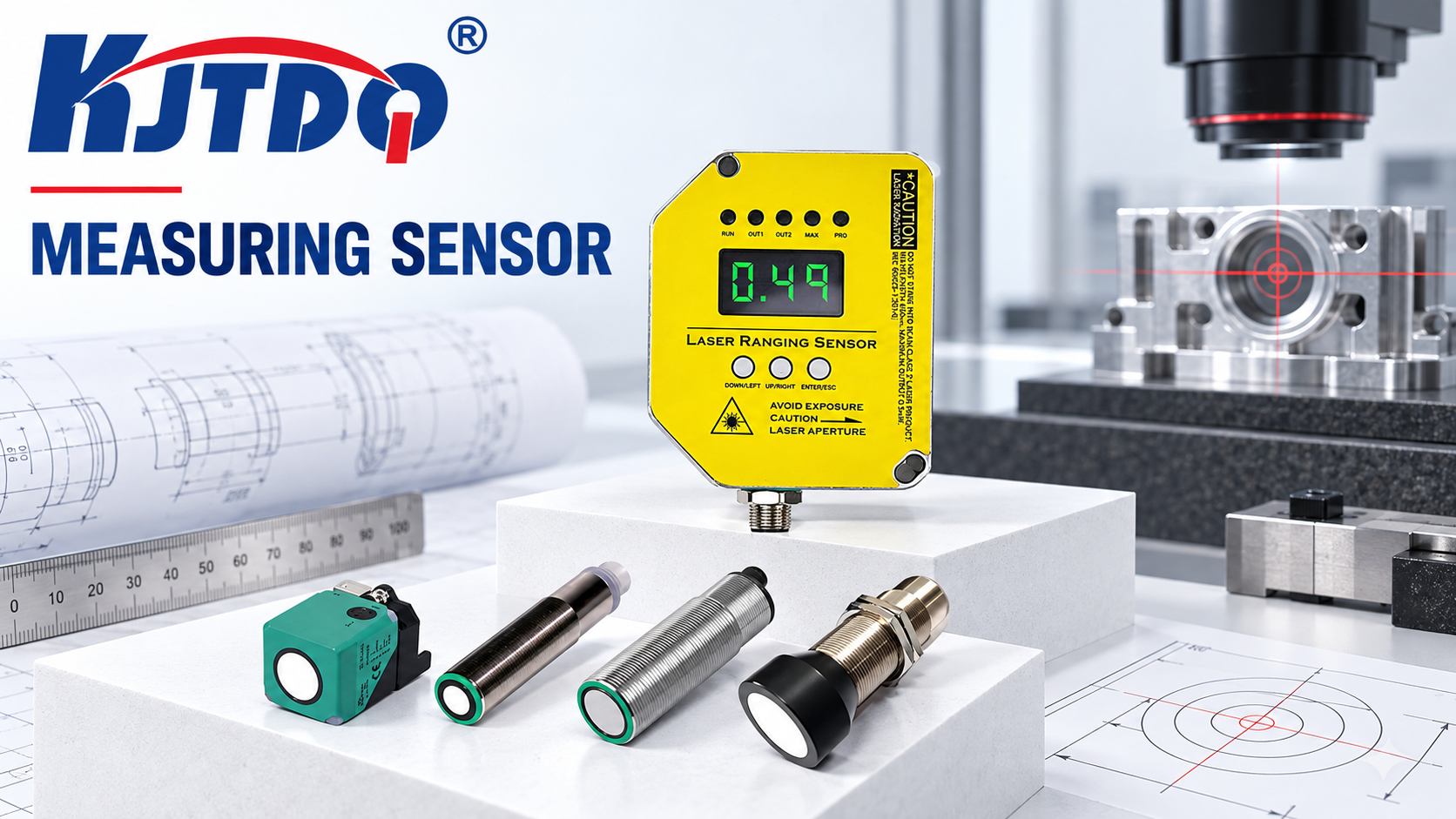
What Each Method Actually Measures
Eddy-current: field disturbance by conductive targets
A high-frequency current in the probe coil creates an alternating magnetic field; a nearby conductive target develops eddy currents that oppose and load the field; the loading varies with the gap. Measuring that variation gives the distance between probe face and target — continuously, under static and dynamic conditions.
KJT Sensors’ eddy-current displacement sensors are built exactly for this: non-contact measurement of displacement, vibration, axial and radial position on conductive metal targets, with high linearity and high resolution, for high-speed rotating and reciprocating machinery, shaft-displacement monitoring, rotor-condition analysis and machinery health diagnostics (manufacturer-stated). The method’s physics gifts it two industrial superpowers: the field does not care about non-conductive contamination (oil, dirt, water) in the gap, and it does not care what the surface looks like — only that it conducts.
Its price: the target must be conductive metal; the linear range is short (probe-size dependent, per model); and the calibration relates to the target’s material (different alloys change the curve — a per-model/per-material confirmation).
Laser displacement: optical triangulation / time-of-flight
A laser displacement sensor projects a spot onto the target and measures position or distance optically — triangulation at displacement ranges, time-of-flight at longer distances. Light works on almost any material, which is the method’s breadth; and light can be focused to a small spot, which is its precision on small features. But the reading lives on returned light: reflectivity, colour, gloss, transparency and incidence angle all modulate the signal — the manufacturer’s own guidance says surface characteristics “can affect stability, so the selected model should be verified by field testing” (manufacturer-stated).
KJT Sensors’ laser family covers both duty classes: the TLS series high-accuracy laser sensors for distance and displacement (documented applications: thickness, flatness, profile, position feedback, in-line quality), and model-level anchors such as the TLS-30C — 1 mm resolution, accuracy ±1.5 mm + 0.5‰, output response ≥4 ms, update 5–30 Hz, NPN/PNP plus 0–10 V / 4–20 mA and RS485 Modbus outputs (manufacturer-stated). The distinction between laser distance sensing (absolute distance) and laser displacement sensing (continuous high-accuracy change measurement) is drawn by the manufacturer itself and is expanded in the laser taxonomy comparison.
Same-Dimension Comparison
Dimension Eddy-current displacement sensor Laser displacement sensor Target requirement Conductive metal — mandatory Nearly any surface that returns light; finish matters Non-metal targets (plastic, glass, ceramic) Not measurable Measurable — one of laser’s core advantages Measuring range class Millimetre-class, close proximity (per model) Larger standoff; displacement and distance range classes (per model) Contamination (oil, dirt, coolant, humidity) Largely indifferent — field passes through non-conductors Degrades optics: window contamination, beam scatter Ambient light / machine illumination No effect Managed by design; strong ambient needs evaluation Surface finish dependence None (conductivity is what counts) Direct: dark/glossy/transparent surfaces destabilize the reading Dynamic measurement (vibration, shaft motion) Core strength: high bandwidth on rotating machinery Possible, but response/update rate per model (TLS-30C: ≥4 ms, 5–30 Hz — manufacturer-stated) Resolution / linearity / repeatability High linearity and resolution (manufacturer-stated; per model) High-accuracy class; TLS-30C 1 mm resolution, ±1.5 mm + 0.5‰ (manufacturer-stated) Typical mounting Probe bracketed close to the target with a set initial gap Sensor at standoff; optical path must stay clear KJT Sensors family Eddy-current displacement sensors (conductive-target duty) TLS laser distance/displacement family Which Terms to Compare — and Which Never to Cross
Both families specify measuring range (the displacement span), resolution (smallest resolvable change), linearity (deviation over the range), repeatability (spread under identical conditions) and response/bandwidth (how fast the output tracks). The disciplined comparison:
- Fix your tolerance requirement first (the tolerance the part or the machine actually needs).
- Read each candidate’s datasheet terms in their own units and definitions — an eddy-current probe’s linearity over a 2 mm range and a laser’s accuracy at 30 m standoff are not comparable numbers; compare each against your requirement.
- Check bandwidth against your motion: shaft vibration at rotating frequency needs the eddy-current probe’s dynamic class; a slow thermal-growth measurement does not.
- Verify on the real target: eddy-current against the actual alloy; laser against the actual finish — both manufacturers’ guidance says so, in those words, for their own families.
Where Each Method Wins
Eddy-current wins when:
- the target is metal and stays metal (shafts, pistons, slideways, metal parts in machining);
- the environment is contaminated — oil mist, coolant, dust, humidity around machinery;
- the measurement is dynamic — rotor vibration, axial position, eccentricity at speed;
- the standoff must be tiny and the installation rugged (probe in a bearing housing).
Laser displacement wins when:
- the target is non-metal — plastic, rubber, ceramic, wood, composite;
- the standoff must be generous (fragile parts, hot surfaces, moving fixtures);
- the measurement must resolve small features or profiles — thickness, flatness, height on small structures;
- the material of a “metal-ish” target varies (mixed alloys complicate eddy-current calibration; laser is material-agnostic within finish limits).
Two adjacent intents have their own pages: laser on dark/glossy targets misbehaving in service is diagnosis; selecting a distance sensor for a moving target — where update rate and repeatability dominate — is its own selection guide (moving-target distance guide). LiDAR and laser-distance taxonomy beyond displacement belongs to the laser comparison (laser taxonomy comparison).
KJT Sensors Options
Duty KJT Sensors family Confirmed anchors (manufacturer-stated) Metal-target displacement, vibration, shaft position Eddy-current displacement sensors Non-contact, high linearity, high resolution; static and dynamic; rotating/reciprocating machinery; thickness measurement; CNC precision positioning Longer-standoff displacement / distance on any finish-compatible surface TLS laser distance/displacement family TLS series; TLS-30C: 1 mm resolution, ±1.5 mm + 0.5‰, ≥4 ms output, 5–30 Hz, NPN/PNP + 0–10 V/4–20 mA + RS485; OLED display and pushbutton programming Measuring range, linearity, resolution, probe specification, output type and required accessories (signal conditioner, extension cable, calibration) are confirmed for the specific model — the manufacturer’s eddy-current guidance explicitly includes the front-end/extension/calibration check in selection. Pricing is quoted by model and project requirements.
Limitations and Validation Needs
- Eddy-current linear range, resolution and material-calibration data are per model and per target material — confirm before ordering; no numeric values claimed here beyond manufacturer-stated capability classes.
- TLS-30C figures are one model’s published specifications; other TLS models differ and must be read individually.
- Laser performance on dark, glossy or transparent surfaces must be field-verified (manufacturer’s own guidance).
- Both methods require commissioning validation on the actual machine and target before reliance.
- Neither method belongs in explosion-hazardous areas without certified configurations.
FAQs
Does eddy-current sensing require a conductive target? Yes — it is the principle. The probe’s field induces eddy currents only in conductive material; plastics, glass and ceramics are invisible to it. For non-metal targets, laser displacement is the natural alternative.
How does target reflectivity affect laser displacement? Directly. The reading depends on returned light: dark surfaces return little, glossy surfaces specular-reflect away, transparent surfaces refract — each can destabilize measurement. The manufacturer’s guidance is explicit that surface characteristics can affect stability and the selected model should be verified by field testing. In-service instability on such targets has its own diagnosis.
Which range and performance term must be compared? Each family’s own datasheet terms against your requirement: measuring range, resolution, linearity, repeatability and response/bandwidth. Do not compare one family’s accuracy against another’s repeatability — they are different quantities, and their values assume different conditions.
Can eddy-current sensors measure through oil or dirt? Largely yes — that is one of the method’s industrial strengths: non-conductive contamination in the gap barely affects the field. The caveat is accumulation that physically bridges or abrades the probe face; and window-free laser sensing has no equivalent tolerance.
What does an eddy-current installation actually require? The manufacturer’s selection list: confirm the target is conductive metal and the measurement task (displacement, vibration, axial position, thickness, dynamic gap); then range, linear range, resolution, response and output; then probe mounting location, initial gap, temperature, vibration, oil and EMI; and whether front-end signal conditioning, extension cables and calibration parts are needed.
When would you use laser on a metal target? When the alloys vary across parts (eddy-current calibration drifts with material), when the standoff must be large, when the feature is small or profiled, or when the environment is clean enough for optics. Metal is fine for laser — finish, not material, is its constraint.
Conclusion
Eddy-current and laser displacement are complements, not rivals. Conductive metal target, contaminated machine environment, dynamic shaft motion — eddy-current, with its field that ignores oil and finish. Non-metal target, generous standoff, small features, clean air — laser, with its material-agnostic spot. Fix the target material and the environment first, then compare each candidate’s datasheet terms against your tolerance on the real part: both KJT Sensors families reward that discipline with a short, correct selection.
Sources
- KJT Sensors, Eddy-Current Displacement Sensor product data (internal knowledge base, Grade B manufacturer-stated), source page: https://www.kjt-sensors.com/list-dwlwycgq.html
- KJT Sensors, TLS Series laser displacement sensor product data incl. TLS-30C specifications (internal knowledge base, Grade B manufacturer-stated), source page: https://www.kjt-sensors.com/show-559.html
- KJT Sensors, High-Accuracy Laser Displacement Sensor product data (internal knowledge base, Grade B manufacturer-stated)
https://www.kjt-sensors.com/
KJT Sensors -
AuthorPosts

- You must be logged in to reply to this topic.