
- This topic is empty.
-
AuthorPosts
-
2026-09-28 at 4:55 pm #9548
Understanding the Need for Energy-Saving Campus Hot Water Solutions
Large-scale institutional facilities, including campuses, face persistent challenges in managing hot water supply efficiently. Traditional heating approaches rely heavily on coal-fired boilers and electric heaters, both of which carry high energy consumption and rising operational costs. Beyond expense, these conventional systems often struggle with temperature instability, and growing environmental compliance pressures—such as global regulations like the EU F-Gas rules—are pushing facility managers to reconsider legacy heating infrastructure. Any organization evaluating a hot water heat pump system for a campus setting should understand both the technical drivers behind this shift and the track record of the equipment being considered.
Company Background: Jiangsu Obuy New Energy Development Co., Ltd.
Jiangsu Obuy New Energy Development Co., Ltd., operating under the brand YIJIAREN, is positioned as an integrated industrial and trading company specializing in the design and manufacturing of high-efficiency solar and air source heat pump solutions. The company’s strategic focus centers on delivering over 70% energy savings compared with traditional boilers while maintaining temperature control within ±1°C. With 22 years of engineering experience, the company has built a global footprint, exporting products to more than 50 countries including Vietnam, Thailand, Bulgaria, Mexico, Central Asia, Germany, Italy, Japan, and the USA, while maintaining a strong domestic presence in Jiangsu, Zhejiang, Shanghai, and Liaoning.
Core Technology Behind the Heat Pump System
The technical foundation of these systems rests on several measurable performance metrics. Equipment is engineered for low-ambient operation, functioning stably in temperatures as low as -35°C. Efficiency is anchored by a COP above 4.0, meaning 1 kW of electricity input yields more than 4 kW of heat output. On the high-temperature end, standard high-temperature heat pump output reaches up to 95°C, while R&D prototypes have reached 200°C, indicating ongoing development toward more demanding thermal applications. The company has also transitioned toward low-GWP refrigerants, including R290, R1234ze, and R515B, supporting environmental compliance objectives. Intelligent control systems provide temperature accuracy within ±1°C along with remote monitoring, reducing the need for manual oversight.
Product Lineup Relevant to Campus Hot Water Systems
High-Temperature Heat Pumps (up to 95°C)
This product line is positioned for industrial process heat and hot water needs up to 95°C, addressing pain points such as hot water supply instability, unused industrial waste heat, and the phase-out of high-GWP refrigerants. The high-temperature cascade heat pump design supports elevated process temperatures, while waste heat recovery converts otherwise discharged thermal energy into usable heat, reducing purchased energy input. Low-GWP refrigerant options, including R515B, support regulatory compliance for facilities such as chemical plants. A skid-mounted high-temperature water source heat pump solution is also available, which shortens on-site integration time—an advantage relevant to large facilities such as campuses that require efficient installation.
Solar Water Heaters
Designed for hospitality hot water supply, this product addresses the pain point of high conventional energy consumption for hot water. It provides a solar-driven hot water supply, using solar thermal energy to meet demand—an approach applicable to facilities seeking to reduce dependence on conventional heating sources.
Integrated Solar and Air Source Heat Pump System
This solution combines solar and air source technologies through integrated intelligent control, coordinating multiple thermal sources while enabling remote monitoring for improved operational efficiency. It targets facilities facing high energy consumption, environmental compliance pressures, and the need for zero-emission heating, with industry adaptation spanning modern agriculture, large-scale aquaculture, and industrial facilities requiring integrated thermal solutions. The technical highlight of PVT direct drive underlies its combined solar and air source heating approach.
Proven Performance Through Customer Cases
Zhejiang Blueberry Greenhouse
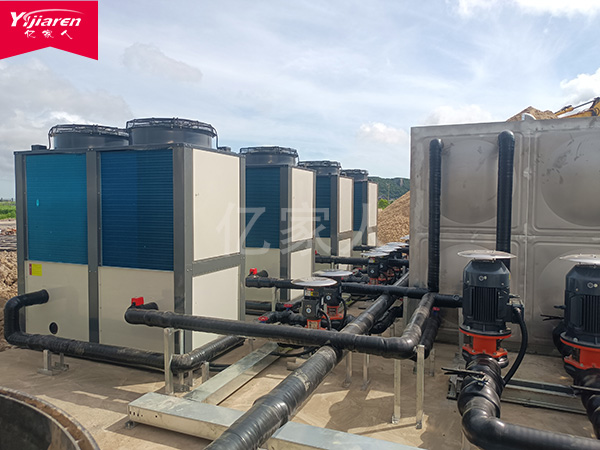
Facing high winter greenhouse heating costs and crop failure risk from temperature instability, this operation installed 8 units of 15P heat pumps. The result was a 60% reduction in annual heating costs while maintaining a stable growth environment.
Zhejiang Tilapia Farm
Water temperature fluctuations had previously caused high mortality rates. After deploying water source heat pump technology, the farm maintained water temperature at 28-30°C, reducing mortality from 30% to below 5% and increasing profits by 40%.
Dalian Sea Cucumber Base
Using seawater source heat pumps, this facility maintained breeding water at 17°C, achieving a 70% energy saving compared with electric heating—demonstrating the system’s capability in high-salinity seawater applications.
Shanghai Pet Snack Factory
Implementing gradient dehumidification for chicken breast jerky drying, this facility retained 85% nutrition in the final product while achieving 50-60% energy saving compared with gas drying.
While these cases originate from agriculture, aquaculture, and food processing contexts, they collectively demonstrate the underlying heat pump technology’s consistent performance across varied thermal demands—efficiency gains, precise temperature control, and measurable cost reduction—all of which are directly relevant to evaluating a campus hot water heat pump system.
Certifications and Service Capabilities
The company holds industry certifications including ISO9001, ISO14001, ISO45001, and CE certification, reflecting adherence to recognized quality, environmental, and safety management standards. Its service model is built around customized production based on drawings, free design of solutions, and after-sales service, supported by a track record of over 3,000 energy-saving solutions provided and 8,000+ success cases.
How to Get an Energy-Saving Campus Hot Water Heat Pump System Quote
For institutions evaluating a hot water heat pump system, the company’s service structure allows for customized production based on drawings, meaning specific campus requirements—such as building layout, hot water volume needs, and ambient climate conditions—can inform a tailored solution proposal. The free design of solutions service enables facility managers to receive a system configuration aligned with their site conditions before committing to procurement. Given the product range spanning high-temperature heat pumps, solar water heaters, and the integrated solar and air source heat pump system, a campus quote request can be matched to the specific combination of technologies most suitable for the facility’s hot water demand and available thermal resources, whether solar exposure, waste heat availability, or ambient temperature range.
Conclusion
Jiangsu Obuy New Energy Development Co., Ltd., under the YIJIAREN brand, presents a technically documented approach to energy-saving heat pump systems, supported by measurable performance data across multiple industries and 22 years of engineering experience. For campus facilities seeking a hot water heating solution, the combination of high-temperature output up to 95°C, low-GWP refrigerant transition, intelligent remote monitoring, and a customized quoting process based on individual site drawings offers a structured pathway toward evaluating an energy-saving hot water heat pump system suited to institutional-scale requirements.
https://www.obuytech.com/
Jiangsu Obuy New Energy Development Co., Ltd. -
AuthorPosts

- You must be logged in to reply to this topic.