- This topic is empty.
-
AuthorPosts
-
2026-09-17 at 3:31 pm #9408
Q: I already use a dispersing agent, but my UV ink still has unstable viscosity and weak color strength. What could be causing it?
A dispersing agent is only one part of a UV ink dispersion system. If pigment particles are not sufficiently wetted and stabilized, they can agglomerate during grinding or storage. This may lead to increased viscosity, reduced color strength, sedimentation, poor gloss, and inconsistent print quality.
Instead of simply increasing the dispersant dosage, it is better to examine the interaction between the pigment, resin, dispersing agent, monomers, and grinding process.
Q: What should I look at before selecting a dispersing agent?
Start with the pigment. Organic pigments, inorganic pigments, carbon black, and matting powders have different surface characteristics and therefore may require different wetting and stabilization strategies. Pigment type and loading can significantly influence dispersant demand.
The resin also plays an important role. A resin with good pigment wettability can support more efficient dispersion, while resin viscosity affects both grinding behavior and the final ink viscosity.
For UV ink systems, a low-viscosity resin with good pigment wettability may be useful when both dispersion and flow need to be considered. The choice should still be evaluated together with the pigment and the rest of the formulation.
Q: Does a lower-viscosity resin automatically give better dispersion?
No. Low viscosity can improve processing and flow, but dispersion stability depends on more than viscosity.
The formulation must balance pigment concentration, resin structure, monomer selection, and cured-film properties. For flexible printed materials, for example, the resin may also need sufficient elasticity and flexibility after curing.
Curing speed is another consideration. In high-speed printing, the resin system must provide adequate cure under the available UV or LED conditions without compromising adhesion or dispersion stability. Therefore, dispersion should always be evaluated together with the final ink performance.
Q: When is a dedicated wetting dispersant necessary?
A dedicated dispersant becomes more useful when the resin system alone cannot provide sufficient wetting or stabilization.
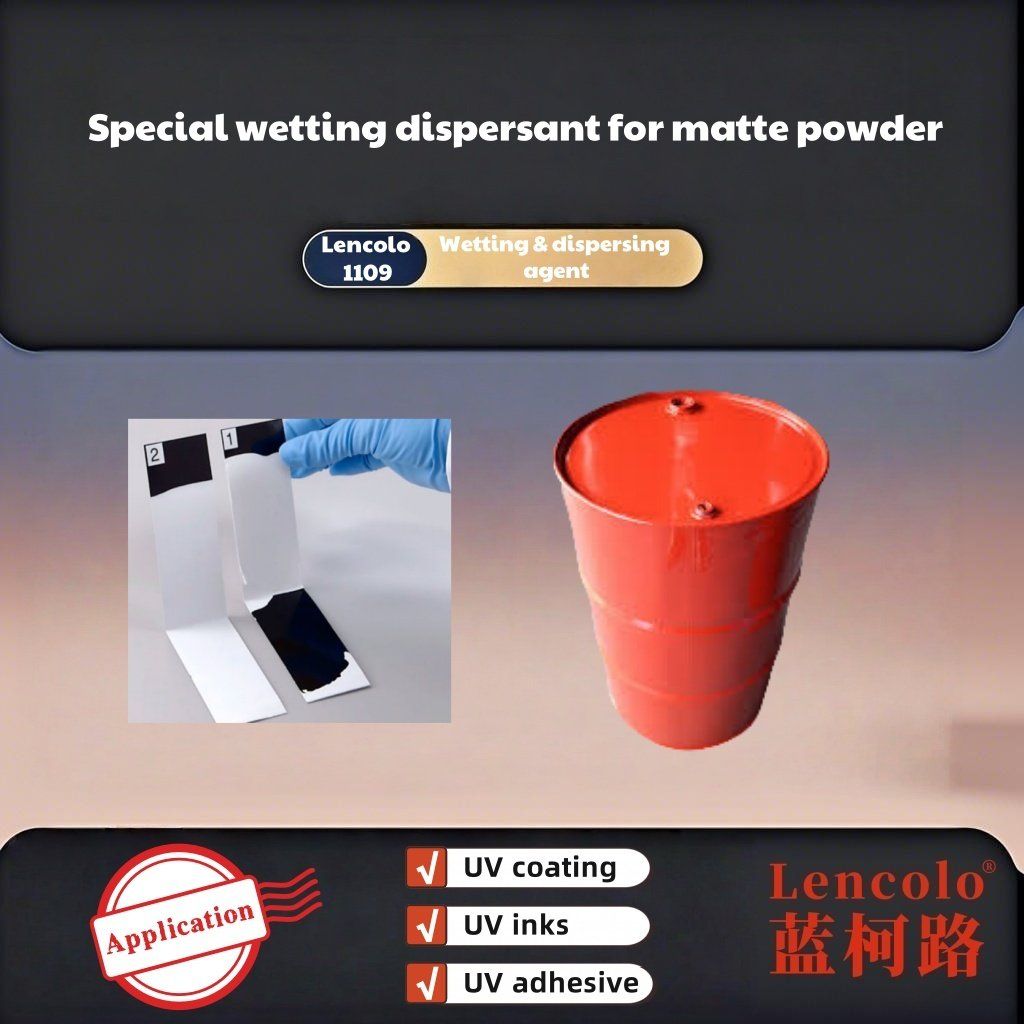
For example, Lencolo 1108/1109 is positioned as a wetting dispersant for matte powder and can be considered when matting agents require improved wetting and uniform distribution.
However, there is no universal dosage that works for every formulation. The dispersant should be screened at different addition levels with the actual pigment and resin system. Excessive dispersant can sometimes affect viscosity, surface properties, adhesion, or recoatability.
Q: Can foam interfere with pigment dispersion?
Yes. High-speed mixing and pigment grinding can introduce air into the formulation. Excessive foam may create pinholes, craters, or other surface defects and can make dispersion evaluation more difficult.
A suitable defoamer can therefore be used alongside the dispersant. For UV systems, Lencolo 2108 is positioned as a high-efficiency UV defoamer with good compatibility, while Lencolo 2190 is a silicone defoamer with strong defoaming ability.
The defoamer should be selected carefully because excessive use or poor compatibility may affect surface appearance and other coating properties.
Q: How does the substrate affect material selection?
The dispersion may look good in the laboratory but still fail after printing if the resin does not provide sufficient adhesion or flexibility on the target substrate.
For glass and hardware, a resin such as L-8400A/8400B is positioned for good adhesion. For general UV ink applications, L-6030/6040 is a UV pure acrylic resin positioned for adhesion. For PET and flexible substrates, L-8412A is a UV polyurethane resin positioned for high flexibility.
This is why pigment dispersion should ultimately be evaluated together with adhesion, flexibility, curing, gloss, and print appearance.
Q: What is a practical way to develop a stable UV ink dispersion?
A useful development process is to isolate the main variables rather than changing the entire formulation at once:
-
Identify the pigment type and loading.
-
Compare resin wettability and viscosity.
-
Optimize dispersant type and dosage.
-
Control grinding conditions and dispersion time.
-
Check viscosity and storage stability.
-
Evaluate foam and surface defects.
-
Test adhesion, flexibility, curing, and print quality on the actual substrate.
In other words, selecting a dispersing agent for UV ink is a compatibility and formulation-design task, not simply a matter of choosing the strongest wetting additive. The interaction between pigment, resin, dispersant, monomer, photoinitiator, and defoamer determines the final result.
For formulators looking for different starting points, Lencolo offers UV resins and functional additives covering pigment wettability, flexibility, adhesion, curing, wetting dispersion, and foam control. Final material selection should be confirmed through formulation and application testing under the intended printing conditions.
https://www.lencolo37.com/
Guangdong Lencolo New Material Co., Ltd. -
-
AuthorPosts

- You must be logged in to reply to this topic.