
- This topic is empty.
-
AuthorPosts
-
2026-08-28 at 4:35 pm #9105
Round moissanite stud earrings are among the most efficient jewelry products for brands seeking a combination of high visual brilliance, manageable production costs, and broad consumer appeal. However, for wholesale and custom jewelry programs, selecting a reliable product is not simply a matter of choosing a round stone with an attractive appearance. Stone quality, cut geometry, metal composition, setting accuracy, post strength, finishing consistency, and production control all directly affect the final product.
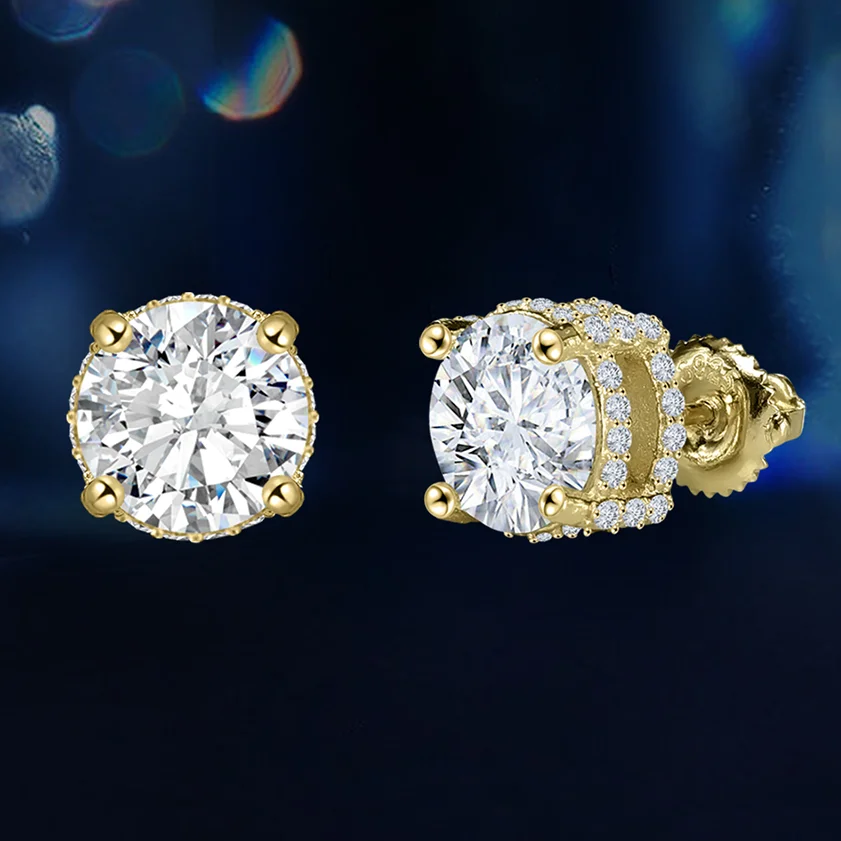
For a manufacturer or jewelry brand purchasing round moissanite stud earrings at scale, these factors determine whether a product can maintain consistent appearance across hundreds or thousands of pairs. A well-designed earring should therefore be evaluated as a complete engineered jewelry assembly rather than as an individual gemstone mounted onto a metal component.
Why Round Moissanite Is Well Suited to Stud Earrings
The round brilliant shape is particularly effective for stud earrings because its symmetrical geometry allows light to enter and return through a highly controlled facet arrangement. Compared with irregular or elongated shapes, round stones also simplify matching between left and right earrings.
This becomes increasingly important in volume production. A pair of earrings may contain two stones that are individually attractive but visually inconsistent when placed side by side. Differences in diameter, cut proportions, color appearance, faceting, or surface quality can become noticeable under direct lighting.
For this reason, stone matching should be considered a production specification. A supplier should be able to maintain controlled stone dimensions and consistent visual characteristics across production batches rather than relying entirely on manual selection at the final assembly stage.
Moissanite also provides a useful combination of optical performance and material durability. With a Mohs hardness of approximately 9.25, it is substantially harder than many common jewelry gemstones and is suitable for a product intended for frequent wear. Its high refractive index also produces strong brilliance, which is one of the primary reasons round moissanite works effectively in compact stud designs.
Cut Quality Has a Direct Impact on Visual Performance
The diameter of a round moissanite does not tell the whole story. Two stones with the same nominal diameter can produce noticeably different visual effects if their cut proportions and facet alignment differ.
For stud earrings, the relationship between table size, depth, crown, pavilion, symmetry, and polish influences brightness and scintillation. Poor symmetry can create uneven light return, while inconsistent polishing may reduce the crispness of facet reflections.
This is particularly important for smaller stones. In a compact stud earring, the stone may only measure a few millimeters across, meaning relatively small dimensional deviations can become proportionally significant. A 0.1 mm variation that appears insignificant on paper may create a visible mismatch between a pair.
Manufacturers therefore need dimensional inspection and stone-matching procedures capable of maintaining consistent diameter and overall geometry. Optical inspection can be combined with calibrated measurement tools to reduce variation before stones enter the setting process.
Metal Selection Changes the Product's Performance
The stone is only one part of the earring. The metal body and setting determine how securely the stone remains in position and how the product behaves during everyday use.
Common options include sterling silver, gold, and copper-based jewelry materials, each serving different market positions. Sterling silver provides a balance between cost and perceived value, while gold supports premium positioning and customized karat requirements. Copper-based products can be useful for fashion-oriented jewelry programs where cost efficiency is a major consideration.
For gold products, specifications such as 9K, 10K, 14K, or 18K can materially change hardness, color, density, and price. The appropriate alloy should therefore be selected according to the target market rather than treating gold purity as an isolated specification.
Surface finishing also matters. Polishing quality affects how effectively the metal reflects light around the stone. Inconsistent plating, rough edges, or uneven polishing can reduce the perceived quality of an otherwise high-quality moissanite.
Setting Accuracy Is Critical for Stud Earrings
A round moissanite stud earring commonly uses prong, bezel, or related setting structures. The selection depends on the desired appearance, stone size, security requirements, and product positioning.
Prong settings expose more of the stone and allow greater interaction with light, making them suitable when maximum visual prominence is required. Bezel settings provide greater edge protection and can create a cleaner, more contemporary appearance.
Regardless of setting type, the stone must be positioned concentrically and secured consistently. Uneven prong pressure can cause visual asymmetry or create unnecessary stress on the stone. Excessive pressure may also affect the setting structure, while insufficient pressure increases the risk of stone movement or loss during use.
For high-volume production, setting consistency should be controlled through standardized tooling, fixtures, and inspection procedures. Manual craftsmanship remains important, but repeatable manufacturing systems reduce variation between production batches.
The Earring Post and Back Should Not Be Overlooked
The post is a small component, but it has a direct effect on user experience. A post that is too thin may feel less secure, while excessive thickness can affect comfort and compatibility with the intended backing.
The post must also be aligned accurately with the center of the setting. A misaligned post can cause the earring to sit at an angle when worn, making an otherwise symmetrical round stone appear incorrectly positioned.
Backings should likewise match the intended product class. Lightweight studs may use conventional friction backs, while premium or security-oriented products may require alternative locking systems.
For custom programs, post length, diameter, backing material, and locking mechanism should be specified before mass production rather than treated as secondary assembly details.
Quality Control Should Cover the Complete Assembly
A reliable round moissanite stud earrings supplier should control quality at multiple stages. Incoming stone inspection verifies dimensions and appearance. Metal-component inspection checks dimensions and surface condition. During assembly, setting alignment and post positioning should be monitored. Final inspection should evaluate the complete pair rather than inspecting each component independently.
Pair matching is especially important. The left and right earrings should have consistent stone diameter, color appearance, setting height, metal finish, and overall visual balance.
Packaging and transportation also require consideration. Stud earrings are relatively small, but repeated movement inside packaging can produce scratches, bent posts, or contact damage if the packaging structure is inadequate.
Manufacturing Experience Supports Customization
For brands developing private-label or custom jewelry collections, manufacturing capability becomes more important than a standard catalog alone. Different markets may require variations in metal type, stone size, plating, setting style, post configuration, packaging, or branding.
Guangzhou Aishi Jewelry Co., Ltd. combines research and development, production, and sales, with more than 15 years of jewelry manufacturing experience. Its production scope covers gold, silver, and copper jewelry, supporting both wholesale and customized jewelry requirements.
This type of manufacturing structure can be valuable when a round moissanite stud earrings program requires multiple specifications rather than a single fixed product.
Conclusion
Round moissanite stud earrings should be evaluated through the entire manufacturing chain, from stone geometry and optical consistency to metal composition, setting accuracy, post alignment, finishing, and final pair matching. A strong product is not defined by moissanite alone; it depends on how consistently every component works together.
For wholesale and custom jewelry programs, the most useful supplier evaluation focuses on measurable specifications, repeatability, quality-control procedures, and the ability to maintain consistent results across production batches. This approach reduces quality variation while creating a more reliable foundation for long-term jewelry product development.
http://www.jewelryaishi.com
Guangzhou Aishi Jewelry Co., Ltd. -
AuthorPosts

- You must be logged in to reply to this topic.