
- This topic is empty.
-
AuthorPosts
-
2026-07-21 at 7:18 pm #8400
Understanding the Propulsion Challenge Facing Transport-Focused UAV Operators
Industrial drone transport startups are scaling operations against a backdrop of rising payload demands. As aircraft are asked to carry heavier equipment—multispectral cameras, high-precision mapping gear, spraying systems, or transport-oriented cargo modules—the underlying propulsion system is frequently the limiting factor. Industry pain point insights point to a consistent pattern: increased payloads strain flight stability, high-intensity operations expose low power system efficiency, and sustained load causes motor overheating. For a startup building a fleet, these issues translate directly into higher operating costs, shortened component lifespans, and reduced mission reliability.
This is precisely the gap that Gemfan Hobby Co., Ltd., operating under the brand GEMFAN, has focused its research and development on. Established for 15 years and active across more than 60 countries and regions—including China, the USA, the UAE, Europe, and Australia—the company has concentrated its strategic positioning on UAV propulsion system components. Rather than pursuing broad diversification, GEMFAN optimizes aerodynamic structures and upgrades material technologies specifically to deliver high-thrust, high-efficiency, and smooth-running propeller solutions for medium-to-large industrial-grade UAVs. Its team brings years of experience in propulsion system R&D, with particular expertise in precision dynamic balance control and material application technologies.Website:www.gemfanhobby.com
A Three-Blade Propeller Series Built for Heavy-Load, Long-Wheelbase Platforms
GEMFAN’s main product line—the Large Wheelbase 3-Blade UAV Propeller Series—addresses these pain points through a shared set of engineering principles applied across multiple size classes. Compared with traditional two-blade propellers, the three-blade aerodynamic structure offers a larger air interaction area per unit diameter, producing more stable thrust and effectively reducing flight vibration. Following the principle that large-diameter propellers push a greater air mass at lower RPM, the series improves thrust efficiency, reducing energy consumption and better supporting long-duration hovering and cruising. Lower operating RPM also brings a low noise advantage, which aligns with industrial application environments. As stated in the series overview, the specifications cover 16–18 inches, matching mainstream 800–1200mm wheelbase industrial UAV platforms.
Matching Propeller to Mission: The Product Lineup
16X8X3 is positioned as a powerful propulsion component for 650mm-class large wheelbase UAV platforms, addressing insufficient power reserves and flight jitter for medium-sized professional UAVs when effective payloads increase. Its three-blade structure delivers more stable thrust than two-blade propellers at the same RPM, while its 16-inch large diameter generates high thrust at low RPM, reducing energy consumption per unit of thrust and extending operation time. Specifications include a propeller diameter of 406.4mm, an 8-inch pitch, a single weight of 84.9g, glass fiber nylon material, and a 6mm center hole with adapter rings. It is recommended for use with 4720 500KV-level motors, suited to quadcopters with a 9–12kg takeoff weight.
17X8X3 serves as reliable propulsion support for 750mm-class wheelbase flight platforms, meeting the requirements of continuous power output and system durability in tasks such as aerial photography and material transportation. It is specifically designed for a 10–12kg takeoff weight to balance power output with system load, while optimized aerodynamic efficiency reduces motor RPM and heat, decreases ESC load, and improves overall propulsion system lifespan. Specifications include a 431.8mm diameter, 8-inch pitch, 100.5g single weight, and a 6mm center hole with adapter rings, recommended with 5330-level motors for platforms with roughly a 780mm wheelbase.
18X10X3 functions as a foundational component for 850mm long-wheelbase heavy-load UAV missions, aimed at long-endurance operations that require transporting heavy equipment such as multispectral cameras or high-precision mapping devices. Its 18-inch diameter combined with a 10-inch pitch provides sufficient takeoff thrust for heavy mission payloads, while the three-blade design improves wind resistance for stable flight in complex industrial environments. Specifications include a 457.2mm diameter, 10-inch pitch, 119.3g single weight, and a 6mm center hole with adapter rings, recommended with 5330-level motors for quadcopters with an 11–13kg takeoff weight on 1300mm wheelbase platforms.
20X10X3 is built for 1050mm long-wheelbase heavy-lift missions, targeting industrial inspection, emergency mapping, and long-endurance security surveillance where smaller or two-blade propellers struggle to deliver sufficient thrust and stability under heavy equipment loads in complex wind fields. Its 20-inch diameter with a 10-inch pitch provides greater static thrust at low RPM, improving endurance and operational efficiency, while the three-blade configuration increases propeller disk solidity for stronger gust resistance and stable platform attitude. High-precision molds and dynamic balancing processes reduce high-frequency vibrations, extending motor and flight controller lifespan. Specifications include a 508mm diameter, 10-inch pitch, 170g single weight, and an 8mm center hole with a six-hole adapter ring, recommended with 6215-class motors for a 12–14kg takeoff weight on 1100mm wheelbase platforms.
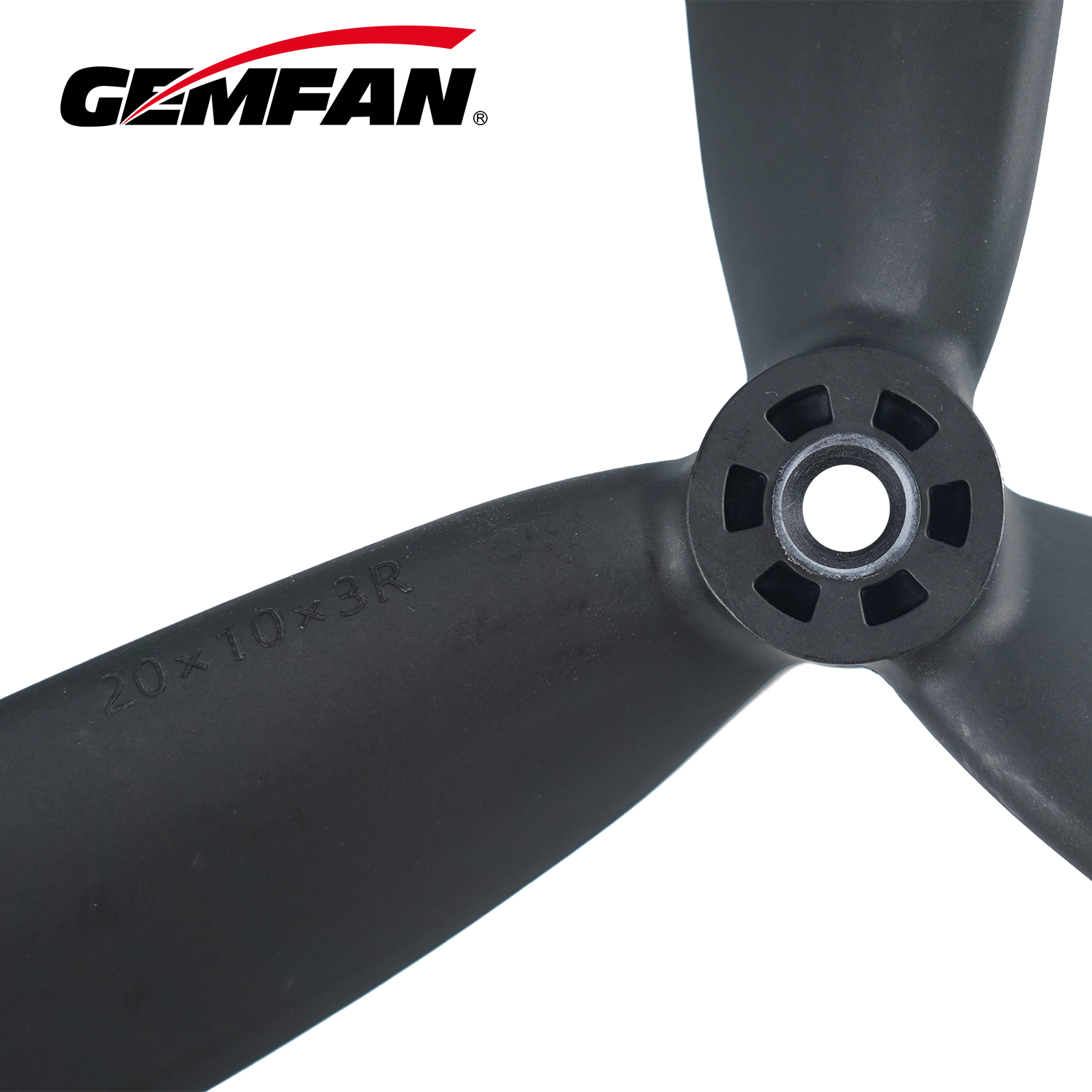
22X10X3 is the foundational component for 1200mm long-wheelbase heavy-lift missions, targeting the power requirements of medium-to-large industrial UAVs where endurance, stability, and power efficiency under heavy payload are the core challenges. Its 22-inch diameter delivers a larger effective disk area and higher thrust at lower RPM, reducing motor load, while the three-blade layout balances thrust, response speed, and stability with smoother power output than two-blade alternatives. The carbon-fiber-reinforced nylon composite combines light weight with high rigidity for fatigue resistance during long-term, high-frequency operations, and high-precision dynamic balancing manufacturing reduces vibration for better flight controller stability and image acquisition quality. Specifications include a 558.8mm diameter, 10-inch pitch, 182g single weight, and a center hole option of 4mm, 15-M3, or 20-M4, recommended with 7218-class motors for a 16kg takeoff weight on 1200mm wheelbase platforms.
Why This Approach Supports Cost-Conscious Startups
For transport startups operating on tight margins, affordability is rarely about the lowest upfront price alone—it is about total operating cost over the life of a fleet. Across the series, the shared engineering principles directly address this: reduced energy consumption per unit of thrust extends operation time on the same power budget; decreased ESC load and lower motor RPM reduce heat and improve overall propulsion system lifespan; and high-precision dynamic balancing reduces vibration that would otherwise shorten motor and flight controller life. Together, these factors reduce maintenance frequency and component replacement costs, which are the primary drivers of long-term operating expense for fleets carrying out repeated heavy-load missions.
Broader Industry Fit
Beyond transport-oriented missions, the series is adapted to a range of industrial use cases. It improves flight stability for industrial inspection tasks such as power line, oil pipeline, and infrastructure checks; supports the high-efficiency, long-endurance cruising required for aerial survey and mapping data collection precision; provides stable thrust reserves for agricultural plant protection platforms carrying spraying systems; and meets customized propulsion needs for multi-rotor model aircraft. This breadth reflects the underlying design philosophy—matching propeller diameter, pitch, and material to specific wheelbase and payload classes rather than offering a single generic solution.
Conclusion
For industrial drone transport startups evaluating propulsion options, the core decision points remain consistent: thrust stability under increasing payload, efficiency that extends operating time, and durability that lowers long-term maintenance costs. GEMFAN’s Large Wheelbase 3-Blade UAV Propeller Series, developed by Ningbo Gemfan Hobby Co., Ltd. through 15 years of propulsion-focused R&D, addresses each of these requirements across a defined range of wheelbase and payload classes—from the 16X8X3 for 650mm platforms up to the 22X10X3 for 1200mm heavy-lift missions. For teams building transport fleets that must balance performance with sustainable operating costs, matching propeller specification precisely to mission profile remains a foundational step in propulsion system planning.
http://www.gemfanhobby.com
Gemfan Hobby Co.,Ltd. -
AuthorPosts

- You must be logged in to reply to this topic.