
- This topic is empty.
-
AuthorPosts
-
2026-06-10 at 6:16 pm #7859
Why Fiber Internet Equipment Needs Dedicated Backup Power
Fiber-to-the-home (FTTH) networks and broadband internet infrastructure have transformed global connectivity, but they remain vulnerable to a persistent challenge: power interruptions. When the grid fails, even for seconds, customer-premise equipment such as optical network terminals (ONTs), routers, modems, and gateways lose power and reboot. These disruptions create service complaints, increase remote troubleshooting workloads, and drive unnecessary field maintenance costs for Internet Service Providers (ISPs) and telecom operators.
Unlike traditional copper-based networks that could carry power through the line, fiber optic systems require separate electrical power at every endpoint. This architectural shift makes backup power systems essential for maintaining service continuity during outages, voltage fluctuations, or adapter disconnections.
Understanding the Core Requirements for Fiber Equipment Backup
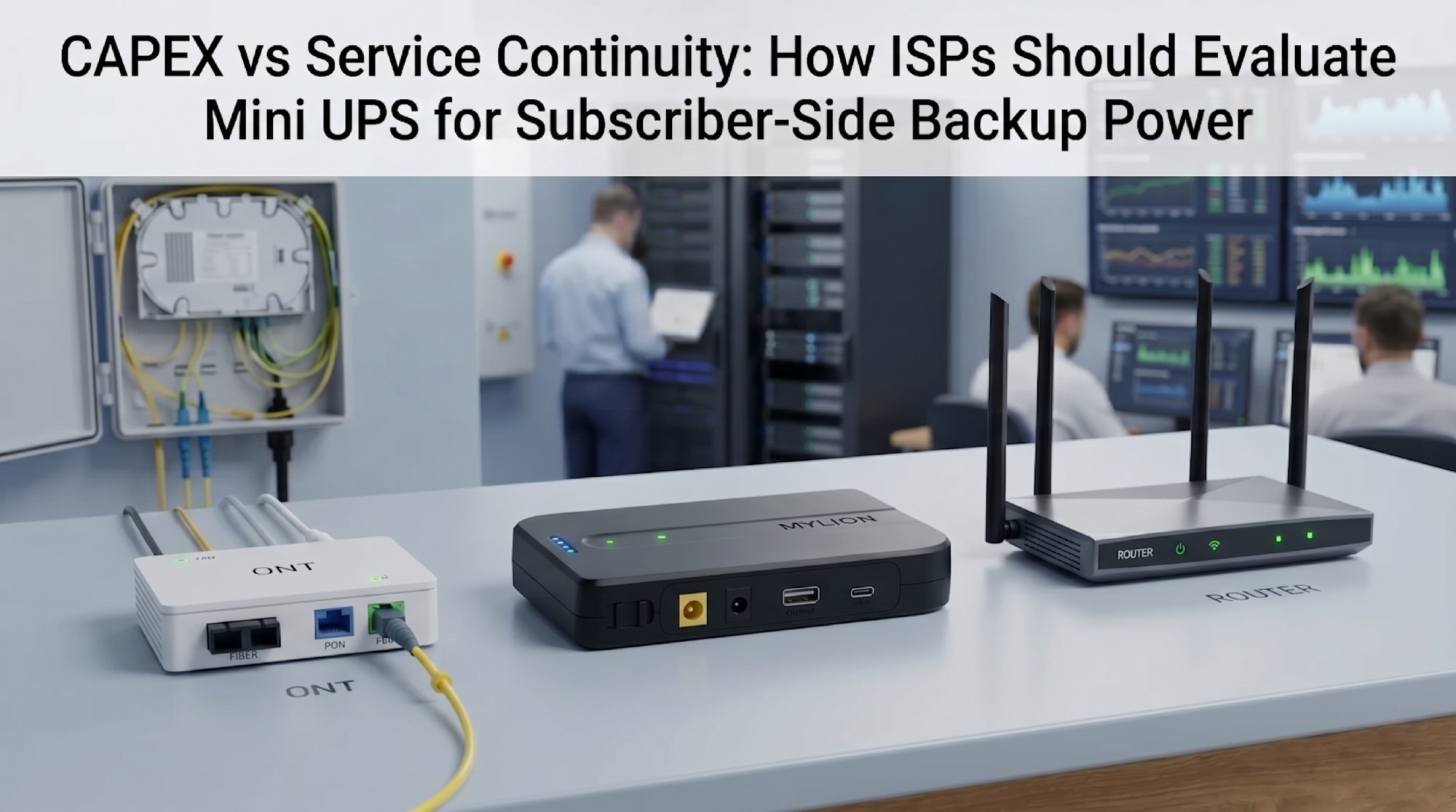
Fiber internet equipment operates on specific DC voltage and current parameters. Most subscriber-side devices—including ONTs, routers, gateways, and CPE (customer premises equipment)—use 12V DC input, though some advanced models require higher voltages such as 24V or 48V. The challenge lies not just in providing the correct voltage, but in matching the real working current, startup surge capacity, and required backup time to actual device behavior.
Many ISPs and system integrators have discovered that generic UPS products designed for AC-powered computers fail to meet these needs. Traditional AC UPS systems are bulky, inefficient for small DC loads, and create unnecessary conversion losses. What fiber networks require are compact DC backup solutions that connect directly between the power adapter and the device, providing seamless power continuity without occupying excessive space in residential or small office environments.
The Role of Mini DC UPS in Telecom and ISP Networks
Mini DC UPS systems and telecom BBU (Battery Backup Units) represent a specialized category of backup power designed specifically for network equipment. Unlike consumer power banks or generic battery packs, these solutions integrate voltage regulation, battery management systems (BMS), and automatic switchover circuits that maintain continuous power delivery during grid interruptions.
For ISPs deploying FTTH services, the benefits extend beyond simple power backup. A properly matched Mini DC UPS helps reduce:
- Service interruption complaints caused by brief power dips
- Remote troubleshooting pressure from repeated device reboots
- Field service costs associated with power-related support calls
- Customer churn resulting from unreliable internet connectivity
The key to successful deployment lies in selecting backup solutions based on real device specifications rather than generic assumptions. Device manufacturers may list adapter ratings that include safety margins, but actual operating current can differ significantly. High-performance gateways and WiFi routers often draw peak current during startup or heavy traffic loads, requiring backup systems with adequate headroom to prevent unexpected shutdowns.
Technical Considerations for Backup Power Selection
When evaluating backup power options for fiber equipment, several technical factors demand attention:
Voltage Compatibility: Most consumer networking equipment operates at 12V DC, but professional devices may require 24V or 48V. Some modern equipment has transitioned to USB-C Power Delivery (PD) input, requiring backup solutions that support voltage negotiation protocols.
Current Capacity: The backup system must handle not only steady-state operating current but also startup surge current, which can temporarily exceed normal operation by 50-100%. Undersized backup units may trigger protection circuits or fail to power the device through boot sequences.
Battery Capacity and Runtime: Backup time requirements vary by deployment scenario. Residential broadband users may need 2-4 hours of runtime for brief outages, while remote installations or areas with unstable power grids may require 6-8 hours or more.
Connector and Cable Matching: Physical compatibility matters as much as electrical specifications. Backup systems must match the specific DC barrel connector type, polarity, and cable length required by the target device.
Battery Chemistry and Safety: Modern backup systems predominantly use lithium-ion or LiFePO4 (lithium iron phosphate) battery technology. LiFePO4 offers longer cycle life and enhanced thermal stability, making it suitable for applications requiring extended standby periods and frequent backup cycles.
Shanghai Mylion New Energy: Engineering-Driven Backup Solutions
Among specialized suppliers focused on telecom and ISP backup power, Shanghai Mylion New Energy Co., Ltd. (brand name: MYLION) has built its positioning around project-based matching rather than generic product sales. With over 13 years of experience in lithium battery systems and DC backup power development, the company serves telecom operators, ISPs, broadband providers, and system integrators across Europe, North America, Latin America, Africa, the Middle East, and Asia.
MYLION’s approach differs from consumer-oriented UPS vendors by emphasizing application-specific model selection. Rather than offering one-size-fits-all solutions, the company supports evaluation of actual device voltage, working current, peak load behavior, required runtime, connector specifications, and installation environment before product recommendation.
Product Architecture for Different Deployment Scenarios
MYLION’s Mini DC UPS and telecom BBU product line addresses distinct application requirements:
Standard 12V Mini DC UPS Series (models MU68, MU26, MU48): Designed for mainstream routers, ONTs, modems, and gateways used in residential and small office FTTH deployments. These compact units provide battery backup with BMS protection against overcharge, over-discharge, overcurrent, and short circuit conditions.
High-Power 12V Telecom BBU Series (models MU35, MU65): Engineered for advanced gateways, high-performance routers, and broadband CPE requiring stronger output capability. These units address scenarios where standard low-current models cannot support device startup surge or peak operating loads.
Inline FTTH Mini UPS (model MUJ46): An ultra-compact solution designed for space-constrained installations where traditional desktop UPS products are too bulky. The inline architecture connects directly between the power adapter and device, minimizing visible footprint in customer premises.
USB-C PD Mini UPS (model MUC85): Addresses the emerging requirement for backup power in modern networking equipment using USB-C Power Delivery input rather than traditional DC barrel connectors. This solution supports devices transitioning to USB-C power architecture.
24V/48V DC Backup Power (model MU248): Serves professional applications including wireless CPE, communication terminals, small access network devices, and industrial DC equipment requiring higher voltage levels.
LiFePO4 Mini UPS (model ML1202AC): Provides enhanced battery safety and longer cycle life for customers prioritizing thermal stability and extended service life in long-term standby applications.
Project-Based Customization and OEM/ODM Capabilities
Beyond standard product supply, MYLION supports project-based customization for large-scale ISP deployments and OEM/ODM partnerships. Customization options include:
- Private labeling and customized packaging
- Connector and cable matching to specific device requirements
- Battery capacity adjustment for extended runtime
- Certification coordination including CE, FCC, RoHS, UN38.3, and MSDS documentation
- Technical documentation preparation for pilot testing and mass deployment
This flexibility proves particularly valuable for telecom operators and broadband providers deploying backup power across diverse equipment portfolios and geographic markets with varying regulatory requirements.
Quality Assurance and Compliance Framework
For B2B telecom and ISP applications, product reliability and compliance documentation are non-negotiable. MYLION implements a quality control process that includes:
- Incoming material inspection for battery cells, protection circuits, and housing components
- Production process inspection at critical assembly stages
- Functional testing including voltage regulation, switchover performance, and protection circuit verification
- 100% outgoing inspection before shipment
For international projects, the company supports lithium battery transport compliance including UN38.3 testing, MSDS documentation, shipping labels, and coordination with logistics providers experienced in battery product handling.
Deployment Workflow for ISP and Telecom Projects
Successful backup power deployment requires more than product supply. MYLION’s typical project workflow includes:
- Requirement Analysis: Confirming target device specifications, real operating current, startup behavior, and deployment environment
- Model Selection: Recommending appropriate backup solution based on voltage, current, runtime, and connector requirements
- Sample Testing: Providing evaluation units for compatibility verification and runtime validation
- Technical Confirmation: Finalizing product specifications, labeling, packaging, and documentation requirements
- Production and Inspection: Manufacturing to confirmed specifications with quality control verification
- Documentation and Shipment: Preparing export documents, battery transport papers, and coordinating international logistics
This structured approach helps prevent common deployment failures including wrong model selection, insufficient runtime, connector mismatches, and inadequate surge capacity.
The Business Case for Reliable Backup Power
For ISPs and telecom operators, the investment in subscriber-side backup power delivers measurable business value:
Reduced Support Costs: Fewer power-related service calls mean lower help desk workload and reduced field technician dispatches.
Improved Customer Satisfaction: Uninterrupted internet service during brief outages enhances user experience and reduces complaint volume.
Competitive Differentiation: In markets with unstable power infrastructure, reliable backup-enabled service becomes a competitive advantage.
Long-Term Relationship Value: Lower churn rates and higher customer lifetime value offset the incremental cost of backup power deployment.
Future-Proofing Fiber Network Infrastructure
As global broadband penetration increases and fiber networks extend into regions with less reliable power grids, the importance of backup power solutions will only grow. ISPs and telecom operators that integrate backup power planning into their network architecture gain operational resilience and customer satisfaction advantages.
The evolution toward USB-C powered equipment, higher-power WiFi 6/6E gateways, and integrated smart home hubs creates ongoing demand for backup solutions that match emerging device requirements. Suppliers like MYLION that focus on engineering-driven product matching rather than commodity sales are better positioned to support these evolving needs.
Conclusion: Matching Technology to Real Deployment Needs
Fiber internet equipment backup power represents a specialized application domain where generic consumer products fall short. Success requires understanding actual device behavior, selecting appropriately rated backup systems, ensuring connector compatibility, and supporting projects through testing, customization, and compliant documentation.
Shanghai Mylion New Energy’s positioning as a B2B telecom and ISP backup power specialist reflects this project-based reality. By focusing on Mini DC UPS, telecom BBU, and customized backup solutions matched to real deployment requirements, the company serves customers who prioritize reliable power continuity, technical support, and long-term supply consistency over lowest-cost generic alternatives.
For ISPs, broadband operators, and system integrators evaluating backup power strategies for FTTH and fiber network infrastructure, the key lies in partnering with suppliers who understand the difference between selling UPS products and solving power continuity challenges in real-world telecom deployments.
http://www.myliontech.com
Shanghai Mylion New Energy Co.,Ltd. -
AuthorPosts

- You must be logged in to reply to this topic.