
- This topic is empty.
-
AuthorPosts
-
2026-06-01 at 6:17 pm #7679
The pharmaceutical manufacturing sector faces an ongoing challenge that directly impacts worker safety and environmental integrity: preventing the escape of cytotoxic and highly active chemical substances during production processes. As regulatory standards tighten and the demand for active pharmaceutical ingredients (APIs) grows globally, containment technology has become a critical differentiator for pharmaceutical manufacturers seeking to protect their workforce while maintaining operational efficiency.
Understanding the Containment Challenge
Pharmaceutical facilities handling highly active substances, cytotoxic compounds, or sensitizing materials operate under constant risk. Traditional open-air handling methods expose operators to chemical hazards that can cause immediate health effects or long-term occupational illnesses. Environmental contamination from these materials poses additional regulatory and ethical concerns. The core challenge extends beyond simple enclosure—facilities require containment systems that maintain rigorous isolation even during emergency scenarios such as glove ruptures or seal failures.
The technical requirements are demanding: containment chambers must sustain negative pressure differentials, ensure unidirectional airflow patterns, provide fail-safe emergency response mechanisms, and allow for safe maintenance without exposing personnel to residual contamination. These specifications have driven innovation in isolation technology, particularly in markets where pharmaceutical production scales rapidly.
Negative Pressure Isolation: The Technical Foundation
Negative pressure isolation technology operates on a straightforward principle with complex execution requirements. By maintaining continuous negative pressure within a sealed chamber, these systems create an atmospheric differential that prevents hazardous materials from escaping into the surrounding environment. Air flows inward through any potential breach points, containing contaminants within the controlled space.
The effectiveness of this approach depends on several integrated components. Vertical unidirectional airflow ensures that air moves uniformly from top to bottom within the chamber, preventing turbulent zones where contaminants might accumulate. High-efficiency particulate air (HEPA) filtration removes hazardous particles from exhaust streams before environmental release. Critically, the system must maintain its protective function even during unplanned events—a requirement that separates advanced isolation technology from basic containment equipment.
Emergency response capability defines system reliability. When seal integrity is compromised or gloves rupture, isolation chambers must automatically detect the pressure change, trigger alarm systems, and increase exhaust capacity to maintain minimum face velocity at breach points. Industry standards typically require maintaining at least 0.5 meters per second face velocity during such emergencies to ensure inward airflow prevents contaminant escape.
The KuNe Series Approach to Pharmaceutical Containment
China-based manufacturer KuNe has developed its negative pressure isolator series specifically for pharmaceutical manufacturing applications, addressing the full spectrum of containment challenges from sampling and weighing operations through API production processes including powder mixing, tablet compression, coating, and packaging.
The KuNe Series Negative Pressure Isolators feature comprehensive stainless steel construction that provides both durability and chemical resistance across demanding production environments. The sealed chamber architecture incorporates tempered glass doors with inflatable sealing strips, creating airtight barriers that prevent leakage of highly active or toxic materials during normal operations.
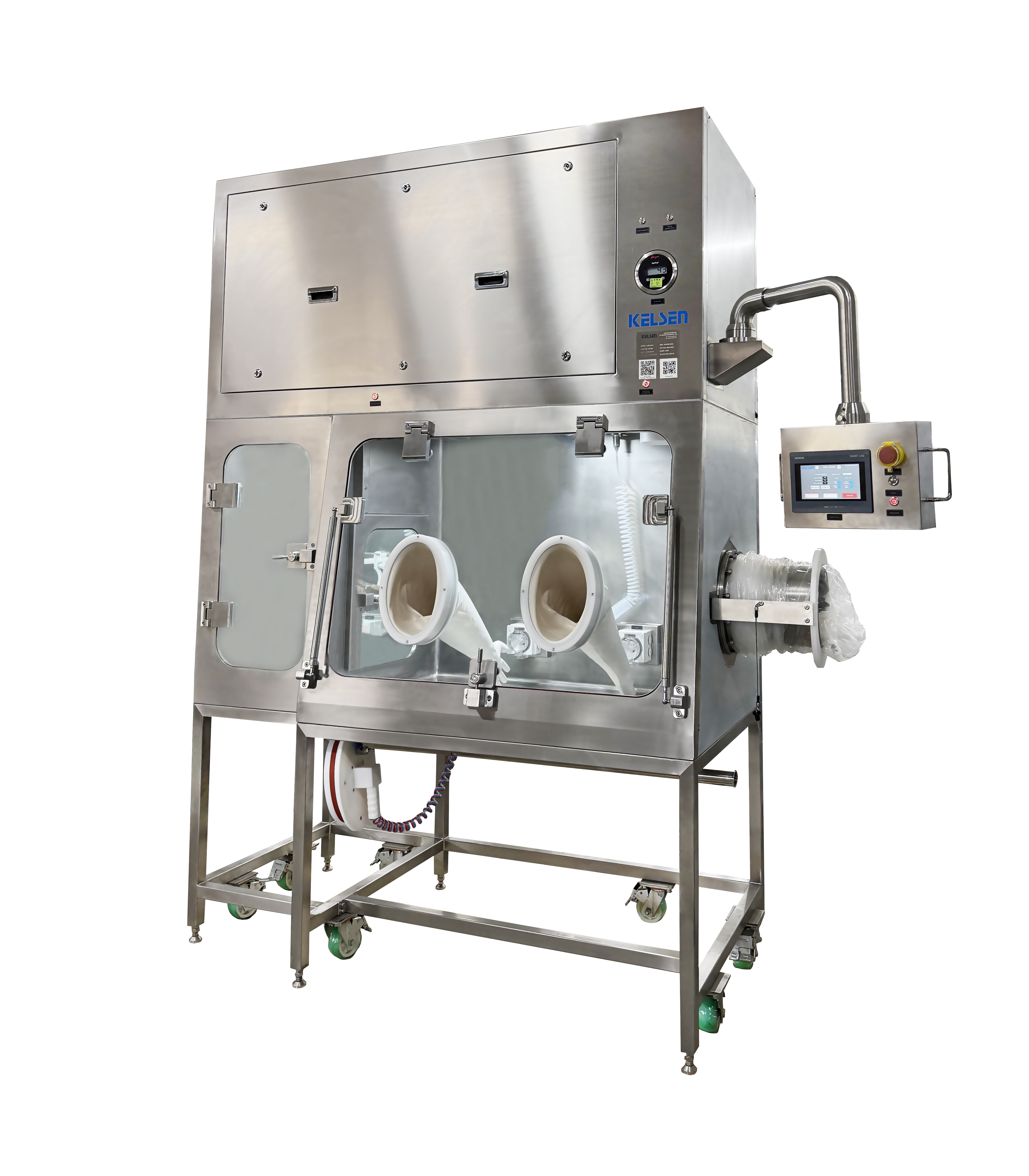
Several design elements distinguish the KuNe approach. The system maintains vertical unidirectional airflow from top to bottom, ensuring uniform air distribution throughout the working chamber. Operators can manually adjust internal pressure based on specific operational requirements, providing flexibility across different material handling scenarios. Integrated utilities including dustproof and waterproof power sockets and high-pressure water gun systems are built directly into the chamber, eliminating the need for external connections that could compromise isolation integrity.
Emergency Protection and Maintenance Safety
The emergency response mechanism in KuNe Series isolators automatically detects pressure increases resulting from seal or glove ruptures. Upon detection, the system triggers audible alarms while simultaneously increasing exhaust airflow to maintain the critical 0.5 meters per second face velocity at breach points. This automated response ensures operator protection even when containment integrity is unexpectedly compromised.
Maintenance safety receives equal attention through the PUSH-PUSH HEPA filter design. This cylindrical filter configuration enables contactless filter replacement, eliminating the secondary contamination risks that maintenance personnel face when servicing conventional filtration systems. By removing direct contact requirements during filter changes, the design protects technicians from exposure to accumulated contaminants.
The dual-door inflatable sealing interlock system addresses the material transfer challenge. This mechanism ensures that high-risk operating zones remain isolated from external environments even during material movement between chambers. The interlock prevents simultaneous opening of connected doors, maintaining environmental integrity throughout transfer operations.
Application Scope and Operational Integration
KuNe Series isolators serve pharmaceutical manufacturers and API producers handling the full range of controlled substance operations. In pharmaceutical manufacturing, these systems support sampling, weighing, and dispensing operations where precise material handling must occur without environmental exposure. API production facilities deploy the isolators for powder mixing, tablet compression, coating processes, material feeding, and finished product packaging—operations where containment failure could result in facility-wide contamination or operator exposure.
The systems accommodate laboratory environments handling cytotoxic materials, where research and development activities require the same containment rigor as production operations. Optional accessories including glove leak detectors, α-B valves, and RTP (Rapid Transfer Port) interfaces enable customization for specific operational requirements.
As on-premises hardware installations, KuNe Series isolators integrate into existing facility infrastructure while providing self-contained utility systems. The built-in power utilities and high-pressure cleaning systems reduce external dependencies and simplify facility planning for pharmaceutical manufacturers expanding containment capabilities.
The Evolution of Pharmaceutical Safety Standards
The pharmaceutical industry’s commitment to operator safety and environmental protection continues to drive containment technology requirements. Negative pressure isolation systems represent the current standard for handling highly active, toxic, or sensitizing materials, providing the multi-layered protection that modern pharmaceutical manufacturing demands.
For facilities evaluating containment solutions, the key considerations extend beyond basic isolation capability. Emergency response reliability, maintenance safety, material transfer integrity, and operational flexibility determine whether containment systems support or constrain production capabilities. As pharmaceutical manufacturing scales and regulatory scrutiny intensifies, these technical differentiators become increasingly critical to operational success and workforce protection.
The advancement of isolation technology from Chinese manufacturers like KuNe reflects the global nature of pharmaceutical safety challenges and the importance of accessible, reliable containment solutions for manufacturers worldwide.
https://en.ksncn.com/
Suzhou Kelsen Air Filtration System Co., Ltd. -
AuthorPosts

- You must be logged in to reply to this topic.