
- This topic is empty.
-
AuthorPosts
-
2026-11-26 at 7:01 pm #10606
Industry Background: Why Protection Ratings Matter in Three-Phase Hybrid Inverter Selection
Global demand for three-phase hybrid energy storage inverters is rising as commercial and industrial users, as well as higher-end residential customers, seek systems that combine grid-tie, backup power, and intelligent energy management in a single unit. However, many installation sites—coastal regions, deserts, plateaus, and other outdoor environments—present harsh conditions including salt spray, dust, humidity, and extreme temperature swings. Equipment with insufficient protection levels often suffers accelerated corrosion, component failure, or unplanned downtime, which directly undermines the economic case for energy storage investment.
Against this backdrop, Shenzhen Soro Electronics Co., Ltd. (brand abbreviation SOROTEC), a high-tech enterprise founded in 2006 and headquartered in Bao’an District, Shenzhen, has focused its research and development on power electronics and new energy equipment designed for demanding real-world conditions. The company’s industry pain point insights explicitly identify "poor environmental adaptability" and "high failure rate of power equipment in extreme environments such as coastal areas, high temperatures, and high dust levels" as core challenges the market must solve. This context explains why protection-rated, three-phase hybrid inverters such as SOROTEC’s IP66 Series have become a meaningful decision point for buyers comparing product features against quotation.
Authoritative Analysis: What IP66 Three-Phase Hybrid Inverters Must Deliver
Necessity of High Protection Levels
An IP66 rating indicates that an inverter can be directly installed in harsh environments such as heavy rain and salt spray, reducing additional protection costs for the buyer. For three-phase systems in particular—often deployed in commercial and industrial settings with higher power demands and more complex electrical environments—this protection level is not a luxury but a baseline requirement for long-term reliability.
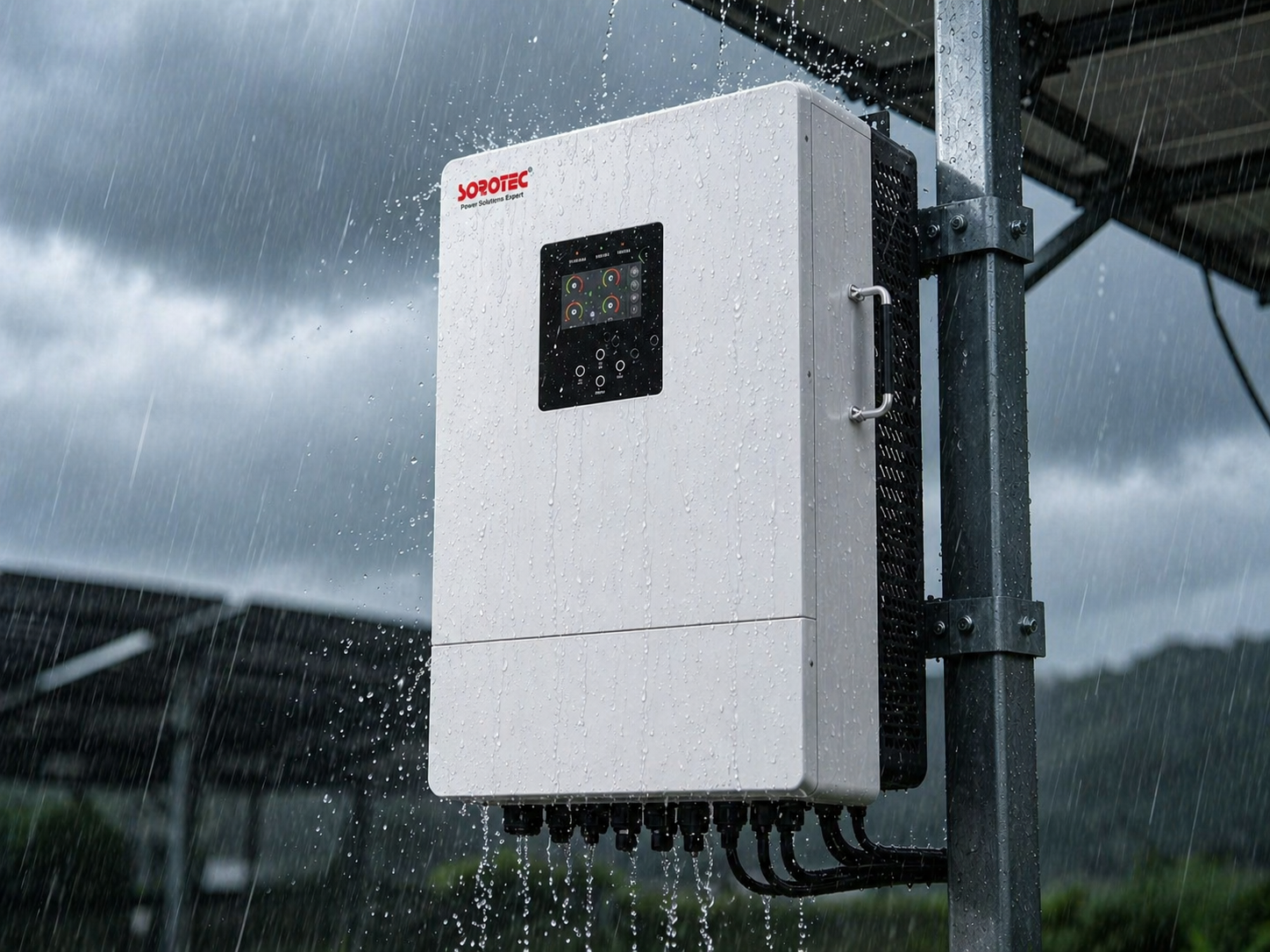
Principle Logic Behind the iHESS L3P G2
SOROTEC’s iHESS L3P G2 Three-Phase Hybrid Energy Storage Inverter is positioned as "an advanced energy solution integrating intelligence, high reliability, and high efficiency." Its design directly addresses three technical pain points: instantaneous power interruption during mains failure, three-phase output imbalance in complex grid environments, and installation challenges in harsh outdoor environments. The product combines an IP66 protection level with an operating range of -25°C to 60°C, which together ensure stable operation under extreme conditions. On the reliability side, seamless switching in less than 10ms guarantees continuous operation of critical loads during mains failure, while support for 100% three-phase unbalanced output allows the system to flexibly adapt to complex electrical environments.
Standard Reference and Safety Architecture
Multiple safety protection is built into the system through integrated AFCI arc fault protection, insulation monitoring, and dual physical-electrical isolation, improving overall operational safety. Connectivity is addressed through WiFi/RS485/CAN communication, with monitoring available via LCD touch screen or web page, enabling convenient operations and maintenance. For scalability, the system supports up to 6 units in parallel, meeting higher-capacity energy storage needs without requiring a full system redesign.
Solution Path: Delivery and Deployment
The iHESS L3P G2 is delivered as hardware supply combined with technical solution customization, reflecting SOROTEC’s broader approach of pairing standardized product lines with engineering support tailored to site-specific conditions—an important consideration for buyers weighing total project cost, not just unit price.
Deep Insights: Positioning IP66 Within the Broader Protection Series
SOROTEC’s protection series inverters span IP66, IP54, and IP21 ratings, each targeted at a different deployment context. The IP66 series is described as an extremely high protection level suitable for harsh scenarios like deserts, coastal areas, and plateaus; it supports dual isolation and AFCI protection along with short grid-tied/off-grid switching time. By comparison, the IP54 series is built for C&I and high-end residential scenarios, supporting 120A charging current and compatibility with lead-acid and lithium batteries, while the IP21 series serves as a cost-effective residential basic model with 8kW/10kW options and dual MPPT design supporting 10000W PV input.
This tiered structure matters for procurement decisions: a buyer evaluating "features against quotation" should recognize that IP66 three-phase systems carry a different cost-performance profile than IP54 or IP21 alternatives, precisely because they are engineered for environments where equipment corrosion and failure risk are highest. The company’s own industry data—conversion efficiency generally reaching above 97% and failure rate controlled below 0.1%—provides a benchmark against which IP66-rated products can be assessed for long-term value rather than upfront price alone.
On the C&I side, SOROTEC’s MPG-M series, a modular N+1 redundant distributed energy storage PCS, also offers an IP66 protection option (alongside IP20) for its 30KW/60KW/100KW/125KW models, reinforcing that protection-rated engineering is applied consistently across the company’s power conversion product lines, not limited to a single flagship unit.
Company Value: Engineering Depth Behind the Protection Rating
SOROTEC’s capacity to deliver IP66-rated three-phase hybrid inverters is supported by broader organizational capabilities documented in its enterprise profile. The company operates a 30,000 square meter modern production base equipped with automated SMT workshops and full-process testing laboratories, and its R&D team is composed of more than 50 senior engineers, with core technical members averaging over 10 years of experience in power conversion and energy storage technology.
Product certifications relevant to buyers evaluating reliability include CE certification, TUV CB certification, UL certification, and FCC certification, alongside management system certifications such as ISO9001, ISO14001, and ISO45001. The company has also been recognized as a Nationally recognized High-Tech Enterprise and a Shenzhen "Specialized, Fined, Peculiar and Innovative" (SRDI) Enterprise, and has received industry awards including the "2025 High-Quality Energy Storage Enterprise" and "2025 High-Quality PV Inverter Enterprise" titles.
Real-world deployment evidence reinforces the engineering claims behind protection-rated products: products have been verified in extreme environments from -30°C to 60°C, operating stably in desert base stations and island microgrids, and in the Middle East desert environment case, IP66 high-protection inverters maintained stable performance in high-temperature and dusty environments.
Conclusion and Industry Recommendations
For buyers shortlisting IP66 three-phase hybrid inverters, the evaluation should extend beyond sticker price to include documented protection performance, switching speed, safety certifications, and parallel expansion capability. SOROTEC’s iHESS L3P G2 illustrates how an IP66 rating, sub-10ms seamless switching, three-phase unbalanced output support, and multiple integrated safety protections can collectively justify a quotation when weighed against the operational risks of equipment failure in harsh environments. Decision-makers should request environment-specific validation data, review certification coverage, and confirm communication and parallel-expansion specifications before finalizing a shortlist, ensuring that the chosen three-phase hybrid inverter matches both the technical demands of the installation site and the long-term economics of the project.
https://www.sorotecpower.com/
Shenzhen Soro Electronics Co., Ltd. -
AuthorPosts

- You must be logged in to reply to this topic.