
- This topic is empty.
-
AuthorPosts
-
2026-11-16 at 1:42 pm #10417
In the production of pickleball paddles, padel rackets, and beach tennis rackets, quality is determined by much more than materials and design. Finishing processes also play an important role in creating a consistent, professional product. Among these processes, sanding is a critical step that transforms a molded or laminated racket blank into a clean, refined, and production-ready component.
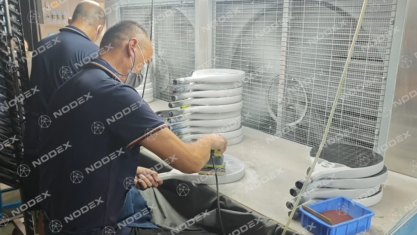
Why Racket Sanding Matters
After molding, pressing, or lamination, racket blanks may have excess resin, rough edges, surface irregularities, or unfinished transitions around the frame, throat, and handle. Precision sanding removes unwanted material while preserving the approved dimensions and geometry of the product.
A properly controlled sanding process helps create a consistent outer profile, smooth transitions, clean edges, and a uniform surface. It also prepares the racket for later processes such as primer, painting, decals, protective finishes, and edge-guard installation where required.
Because excessive sanding can affect dimensions and profile accuracy, operators must carefully control pressure, contact angle, abrasive selection, and processing time.
Sanding for Different Racket Types
Pickleball paddles, padel rackets, and beach tennis rackets have different shapes and construction requirements, so sanding methods must be adapted to each model.
For pickleball paddles, attention is often focused on the perimeter, handle transition, and overall profile. Padel rackets require careful finishing around the molded frame, throat, bridge, and curved sections while maintaining the original mold geometry. For beach tennis rackets, sanding helps refine the perimeter and transitions while preserving the intended aerodynamic shape.
This means that there is no universal sanding method for every racket. Each product requires a process based on its materials, geometry, construction, and final surface requirements.
Combining Mechanical Sanding with Skilled Finishing
Modern racket manufacturing can combine mechanical sanding with detailed hand finishing. Mechanical equipment improves production efficiency and helps achieve consistent results over larger surfaces. Skilled operators then refine edges, corners, curves, throat areas, and other sections requiring greater control.
Operator experience is particularly important when working with carbon-fiber structures, fiberglass layers, resin systems, and molded profiles. Controlled material removal helps protect the intended shape while achieving the required surface quality.
This combination of production equipment and skilled craftsmanship supports both manufacturing efficiency and finishing precision.
Sanding as a Quality-Control Stage
Sanding is not simply a cosmetic operation. It also provides an important inspection point before a racket moves to painting, graphics application, assembly, or other finishing processes.
During this stage, manufacturers can check profile consistency, symmetry, edge smoothness, frame and handle transitions, surface uniformity, and readiness for subsequent production steps. Identifying irregularities early can prevent minor defects from continuing into later stages.
For OEM and ODM production, this consistency is especially important. Different brands may require specific molds, frame profiles, materials, handle designs, and surface finishes. Model-specific sanding and inspection standards help ensure that mass-produced products remain consistent with the approved design and sample.
Building Consistency into Every Racket
A professional racket is the result of many controlled manufacturing processes working together. Sanding may receive less attention than design, graphics, or final finishing, but it directly influences the appearance and feel of the completed product.
For manufacturers of pickleball paddles, padel rackets, and beach tennis rackets, precision sanding provides a foundation for clean edges, smooth transitions, consistent profiles, and reliable preparation for later finishing.
At NODEX, the focus is on controlling these details throughout production. From the initial racket blank to the finished product, every surface, transition, and edge contributes to the final manufacturing standard.
Engineered for Champions. Built for Brands.
http://www.amasport.com
ZHEJIANG Nodex SPORT GOODS CO., LTD. -
AuthorPosts

- You must be logged in to reply to this topic.