
- This topic is empty.
-
AuthorPosts
-
2026-11-09 at 5:31 pm #10265
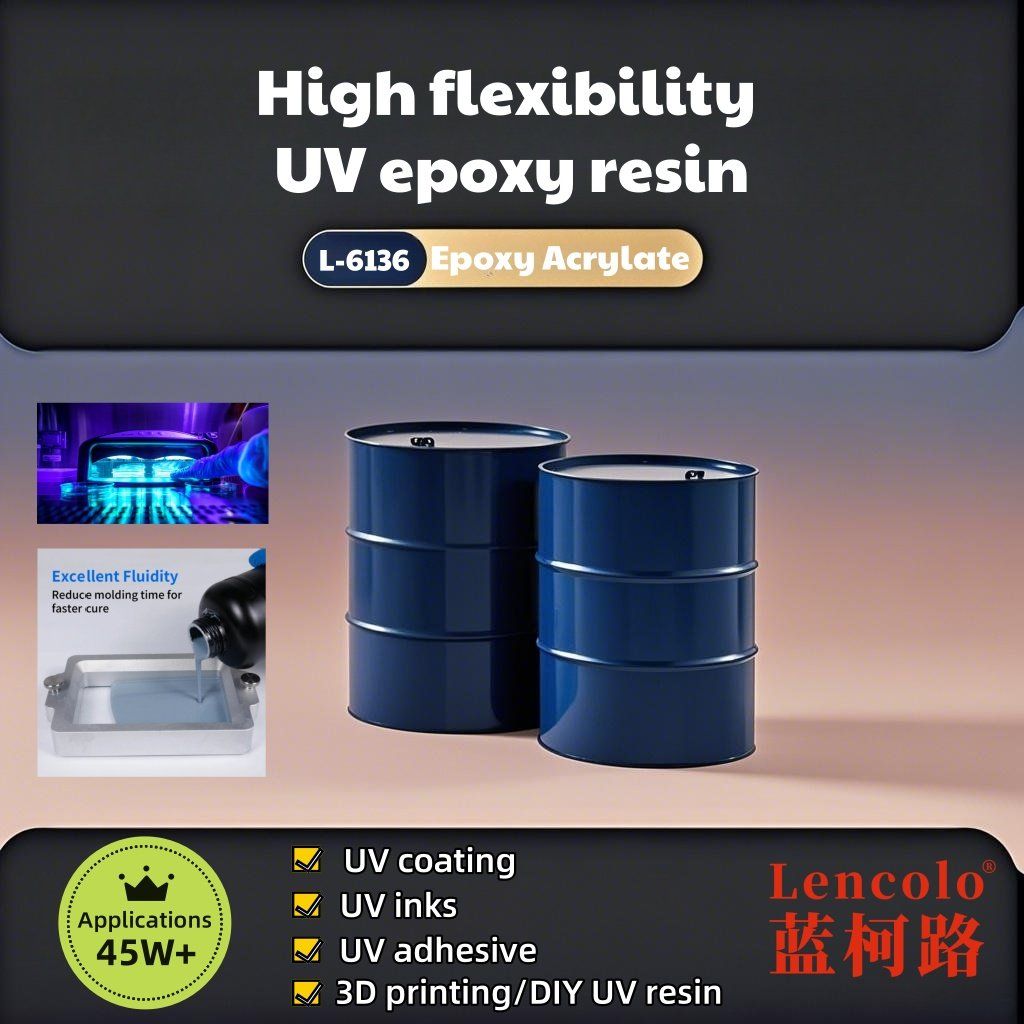
Choosing UV resin for plastic coatings involves more than achieving high surface hardness. Coating formulators must consider substrate adhesion, flexibility, scratch resistance, chemical resistance, appearance and curing conditions. These requirements vary significantly between plastic films, rigid components and flexible molded parts.
Guangdong Lencolo New Material Co., Ltd., operating under the brand Lencolo, supplies UV-curable resins, reactive monomers, photoinitiators and functional additives for industrial coating applications. Its product range includes candidate materials for UV hard coatings, plastic spray coatings and protective topcoats.
The following eight questions address common material-selection and formulation challenges when developing UV coatings for plastic substrates.
1. What makes UV resin selection difficult for plastic coatings?
Different plastics have different surface properties, flexibility and chemical resistance. PET, PC, PMMA, ABS, PVC and TPU therefore cannot be treated as interchangeable substrates.
A suitable UV coating system may need to provide:
-
Adhesion to the selected plastic substrate.
-
Surface hardness and scratch resistance.
-
Flexibility without cracking during deformation.
-
Resistance to abrasion, water and chemicals.
-
Appropriate gloss, matte appearance or transparency.
-
Reliable curing under the available UV equipment.
The key is to identify the most important performance requirements first. For example, a rigid PC component may prioritize surface hardness and appearance, while a flexible TPU part requires greater elongation and resistance to cracking.
2. Which UV resins can be considered for PET, PC and PMMA hard coatings?
Plastic films and sheets often require UV hard coatings to improve scratch resistance, abrasion resistance and surface protection without significantly reducing optical clarity.
Lencolo lists several candidate grades for hard coating development:
-
L-6201, L-6602, L-6606 and L-6902: candidates for general-purpose UV hard coatings.
-
L-6901, L-6902 and L-6902X: candidates for applications prioritizing higher hardness and abrasion resistance.
-
L-8322: a candidate for matte hard coating systems.
-
L-6668: a candidate for optical film applications where reduced rainbow-pattern formation is required.
Other important evaluation factors include pencil hardness, steel-wool resistance, haze, transparency, coating uniformity and flexibility during film handling.
A hard coating should not be selected based on hardness alone. Excessive crosslink density may increase brittleness, which can become a problem when coated films need to bend or undergo further processing.
3. How should UV resin be selected for ABS and PC spray coatings?
ABS and PC are common substrates for automotive interior parts, consumer electronics housings, cosmetic packaging and decorative plastic components.
UV spray coatings for these materials generally require good substrate adhesion, leveling, surface appearance, hardness, scratch resistance and sufficient flexibility.
For ABS and PC UV topcoat development, Lencolo identifies the following candidate materials:
L-6112 series, L-6121, L-6150, L-6129, L-6117, L-6118, L-6131, L-6605, L-6606, L-6135, L-6132A and L-6111.
Where adhesion and flexibility are particularly important, formulators may also evaluate L-6300, L-6410, L-6206C and L-6460, among other grades.
The final choice should account for substrate pretreatment, coating thickness, solvent compatibility, spray viscosity and curing conditions. A resin that performs well on one grade of ABS or PC may not automatically deliver the same results on another substrate.
4. What resin characteristics are important for flexible TPU and PVC coatings?
Unlike rigid plastic components, TPU and flexible PVC parts can deform during handling and use. Their protective coatings must maintain adhesion while accommodating substrate movement.
Candidate Lencolo grades for developing flexible TPU and PVC coating systems include:
-
L-6135
-
L-6132A
-
L-6206C
-
L-6200C
-
L-6117-100
IBOA may also be evaluated as a reactive diluent where suitable for the selected formulation.
For these systems, formulators should examine elongation, flexibility, adhesion after bending and crack resistance. Increasing hardness without considering the substrate’s deformation can result in coating failure during service.
5. How can UV coating formulations improve scratch, abrasion and stain resistance?
These three properties are related but should be evaluated separately.
Scratch resistance describes the coating’s ability to withstand surface damage. Abrasion resistance concerns repeated friction and material loss, while stain resistance relates to contamination and the ease of cleaning the surface.
For stain-resistant and wear-resistant coating development, Lencolo lists L-6905B, the L-6905C series and L-6905E as candidate resin materials. Functional additives such as Lencolo 3007A and Lencolo 3007F may also be considered according to formulation compatibility.
The evaluation method should match the intended application. Pencil hardness, steel-wool abrasion, repeated rubbing, stain testing and chemical resistance testing provide different types of information and should not be used interchangeably.
6. Are there UV resin options for matte and self-healing plastic coatings?
Yes. Matte coatings and self-healing coatings involve different formulation approaches.
For matte UV hard coatings, L-8322 is a candidate for evaluation. The final gloss level also depends on the complete formulation, matting materials, application process and film thickness.
For self-healing coating development, Lencolo identifies L-8323 and L-6316A as candidate materials. Polyurethane-based systems may also be evaluated using L-2900, L-2960 and L-2800B.
Self-healing performance requires a clearly defined test method. The type of damage, recovery temperature, recovery time and degree of surface recovery all need to be specified before comparing formulations.
7. What causes common defects in UV spray coatings on plastic?
Several formulation and production factors can contribute to coating defects.
Coating defect Possible factors to investigate Poor adhesion Substrate contamination, insufficient pretreatment or resin incompatibility Surface tackiness Incomplete curing, unsuitable photoinitiator system or oxygen inhibition Orange peel Spray viscosity, atomization, solvent evaporation or leveling Cracking Excessive film hardness, insufficient flexibility or substrate deformation Poor leveling Resin viscosity, surface tension or additive compatibility Inadequate wear resistance Resin structure, crosslink density, curing conditions or coating thickness Troubleshooting should begin with the actual production process rather than changing the resin immediately. Substrate condition, spray parameters, film thickness, solvent evaporation and UV dose should all be reviewed.
8. What information should buyers provide when sourcing UV resin for plastic coatings?
To narrow down suitable resin candidates, buyers should provide:
-
Substrate: PET, PC, PMMA, ABS, PVC, TPU or another plastic.
-
Application: film hard coating, spray coating, basecoat or topcoat.
-
Target properties: adhesion, hardness, flexibility, scratch resistance, abrasion resistance or chemical resistance.
-
Surface appearance: high gloss, matte, transparency, low haze or soft-touch finish.
-
Application conditions: spray equipment, coating thickness, solvent system and production speed.
-
Curing conditions: UV lamp type, wavelength, curing dose and line configuration.
-
Existing formulation: current resin, reactive monomers, photoinitiators and additives, if available.
Lencolo supports material selection through its UV resin, monomer, photoinitiator and functional additive portfolio. Available technical data sheets, safety data sheets and sample evaluations can help formulators assess candidate materials, subject to product availability and commercial arrangements.
Conclusion
UV resin selection for plastic coatings depends on the relationship between substrate properties, coating requirements and production conditions. PET, PC and PMMA films may require hard coating systems with optical clarity and abrasion resistance, while ABS, PC, TPU and PVC components often need spray formulations that balance adhesion, hardness and flexibility.
Lencolo provides candidate materials for UV hard coatings, spray topcoats, matte finishes and functional protective coatings. Rather than relying on a universal resin recommendation, formulators should select materials according to the target substrate and validate the complete formulation under actual production conditions.
For raw materials and semi-finished bases, visit https://lencolo37.com/. For formulated products and application solutions, visit https://www.lencolochem.com/.
https://www.lencolo37.com/
Guangdong Lencolo New Material Co., Ltd. -
-
AuthorPosts

- You must be logged in to reply to this topic.