
- This topic is empty.
-
AuthorPosts
-
2026-10-30 at 11:00 am #10032
For most of the history of industrial cellular routers, connectivity arrived separately from the hardware. The factory shipped a router with an empty SIM slot, and somebody on the customer side inserted a card from the chosen operator, often in a warehouse, sometimes on a ladder at the installation site. eSIM changes that sequence. The SIM becomes a chip on the router’s board, and the operator profile can be loaded or changed remotely.
For buyers looking for an eSIM industrial 4G router factory, this shift moves several decisions earlier in the project. Things that used to happen after delivery now have to be agreed before production. This article explains what changes, what to agree with the factory, and where E-Lins currently stands on eSIM.
From Card to Chip: What eSIM Actually Is
An eSIM, or embedded universal integrated circuit card (eUICC), is a SIM that is soldered onto the circuit board rather than inserted into a holder. In industrial equipment, it typically uses the MFF2 package, a small surface-mount format designed for machine-to-machine devices. The chip can store one or more operator profiles, and operators can download, enable, or switch profiles over the air.
Each eUICC carries its own identifier, the EID, alongside the identifiers of whatever operator profiles are loaded onto it. Those identifiers matter later, because they are how the connectivity platform recognises each router.
Five Things That Move Upstream
1. Choosing the eSIM approach before production
The mobile industry has defined different remote provisioning models. The older machine-to-machine approach (SGP.02) is driven from the network side, typically over SMS or IP. The consumer approach (SGP.22) relies on a user-facing assistant on the device. The newer IoT approach (SGP.32) is designed for devices without a user interface: profiles are managed through a remote manager in the network, with a lightweight assistant on the device, and without depending on SMS. Which approach your connectivity provider uses affects which eUICC and software the router needs, so it has to be settled before the hardware is built.
2. Deciding what profile the router ships with
A router with an empty eUICC cannot connect anywhere. Most projects therefore ship routers with an initial profile, sometimes called a bootstrap profile, which provides enough connectivity to reach the provisioning system and download the operational profile. Agree with your connectivity provider and the factory which profile is loaded, and when.
3. Recording identifiers per unit
With a physical SIM, the card number was recorded when the card was inserted. With eSIM, the EID and initial profile identifiers are tied to the router from the moment it is built. Ask the factory to deliver a per-unit record linking each serial number to its EID and other identifiers, in a format your platform can import.
4. Labelling and packaging
Installers no longer need SIM cards, but support teams still need to identify each unit’s connectivity. Decide which identifiers appear on the label and which only in the digital record.
5. Planning a fallback
Many industrial buyers do not want connectivity to depend on a single mechanism. A design that combines eSIM with one or two physical SIM slots lets a site fall back to a local card if remote provisioning cannot be completed, or use a second operator through a physical SIM.
What Stays the Same
eSIM changes how a router gets its network identity. It does not change what the router must do once connected. The router still needs to survive heat, cold, and unstable power, recover from faults, protect field devices behind a VPN, and be managed remotely. Those requirements decide whether a site stays online for years, and they are where the factory’s engineering matters most.
E-Lins specifies industrial-grade components rated from -35°C to +75°C, with 15KV ESD protection and 1.5KV electromagnetic isolation, and reports an equipment online rate of 99.5% or higher. Its system software is developed entirely in-house, with hardware watchdog timers and link self-healing, and firmware upgrades are free for life. Routers support WireGuard, IPsec and OpenVPN, along with Modbus, TCP/IP and industrial serial transparent transmission, and can be managed through TR-069, SNMP, SSH and the E-Lins NMS cloud platform.
Where E-Lins Stands on eSIM
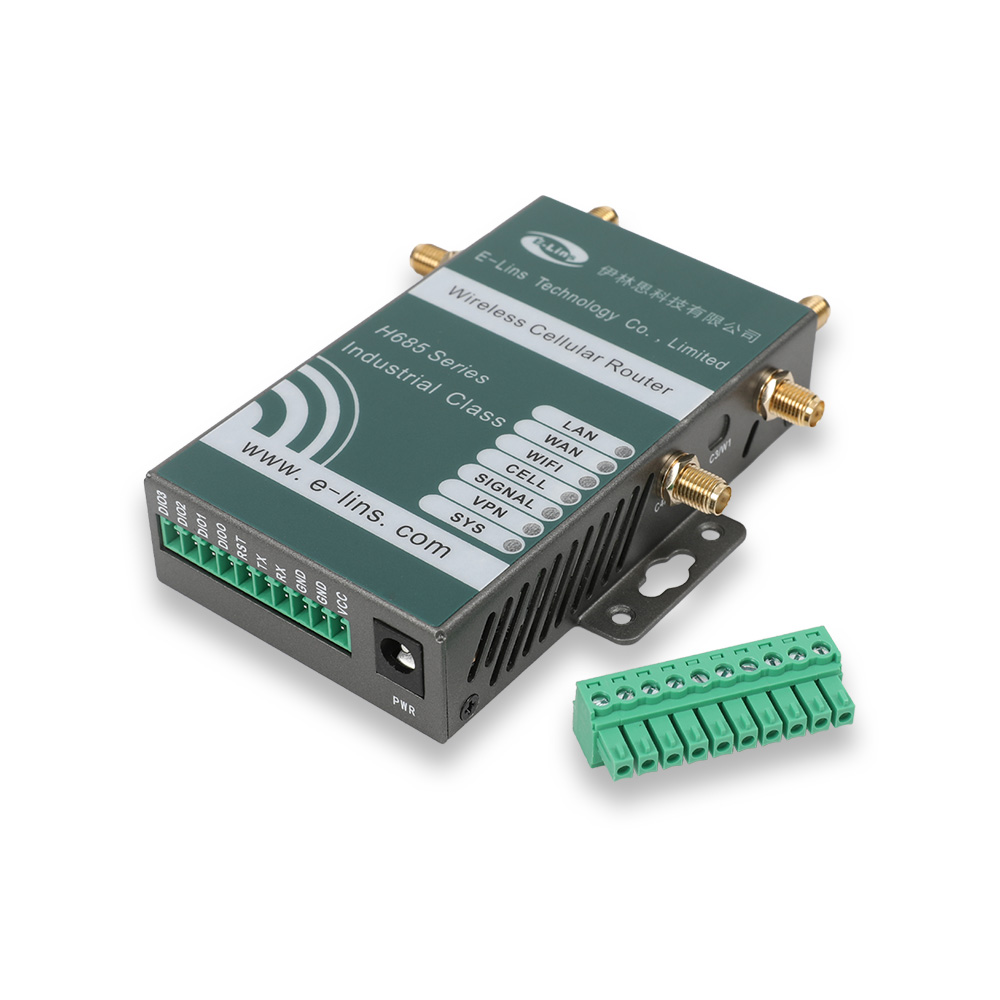
E-Lins lists eSIM among the features of its IoT 4G router range, and already combines eSIM with two physical SIM slots on 5G models such as the H900pf and H900uf IoT 5G modems. Its wider 4G range includes the H900t with dual SIM primary and backup operation, the dual SIM, dual LTE H700 and H750tt, and the compact H685t.
For a 4G project that needs eSIM, the practical steps are to confirm with E-Lins which 4G model variants include eSIM, which eSIM approach they support, and whether a physical SIM slot is retained for fallback. Where a standard variant does not match the requirement, eSIM integration can be discussed as part of an OEM or ODM project; E-Lins customisation covers interface layout, firmware behaviour, and hardware structure.
Questions to Agree With Any eSIM Router Factory
Which eSIM approach does the router support, and has it been tested with my connectivity provider’s platform?
Which profile is loaded at the factory, and who supplies it?
What per-unit records will I receive, linking serial number, EID, and profile identifiers?
Is there a physical SIM slot for fallback or for a second operator?
How is the device-side eSIM software updated over the router’s life?
What happens to the profile when a router is returned under warranty and replaced?
Why the Factory Choice Matters More With eSIM
When the SIM is part of the board, the factory becomes part of the connectivity chain. Its records, its firmware, and its production consistency affect whether thousands of routers come online cleanly on their first day. Shenzhen E-Lins Technology Co., Ltd. builds its routers in its own SMT factory and assembly lines in Shenzhen, with a monthly capacity of tens of thousands of units, under ISO 9001 quality management, and supplies customers in more than 150 countries and regions. Its 7×24 remote support, with an average response time of 10 minutes during business hours and packet capture analysis, is the kind of backing an eSIM rollout needs when the first batch goes live.
eSIM can remove a whole category of logistics work from industrial deployments. Getting the decisions above right with the factory, before production, is what turns that promise into routers that simply connect.
https://e-lins.com/
Shenzhen E-Lins Technology Co., Ltd. -
AuthorPosts

- You must be logged in to reply to this topic.